Department of Environmental Science, Baylor University, One Bear Place #97266, Waco, TX 76798-7266, USA.
Int J Environ Res Public Health. 2024 Oct 18;21(10):1376. doi: 10.3390/ijerph21101376.
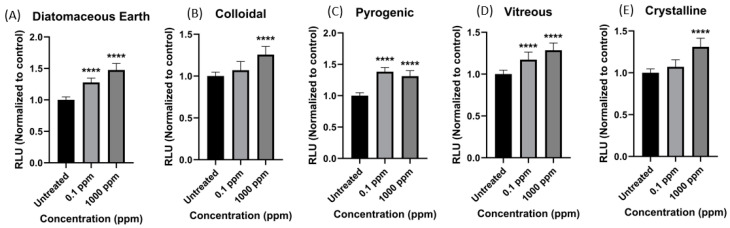
Silicon dioxide (SiO), commonly known as silica, is a naturally occurring mineral extracted from the Earth's crust. It is widely used in commercial products such as food, medicine, and dental ceramics. There are few studies on the health effects of pyrogenic and colloidal silica after ingestion. No research has compared the impact of microscale morphologies on mitochondrial activity in colon cells after acute exposure. The results show that crystalline and amorphous silica had a concentration-independent effect on cells, with an initial increase in mitochondrial activity followed by a decrease. Vitreous silica did not affect cells. Diatomaceous earth and pyrogenic silica had a concentration-dependent response, causing a reduction in mitochondrial activity as concentration increased. Diatomaceous earth triggered the highest cellular response, with mitochondrial activity ranging from 78.84% ± 12.34 at the highest concentration (1000 ppm) to 62.54% ± 17.43 at the lowest concentration (0.01 ppm) and an average HO concentration of 1.48 ± 0.15 RLUs. This research advances our understanding of silica's impact on human gastrointestinal cells, highlighting the need for ongoing exploration. These findings can improve risk mitigation strategies in silica-exposed environments.
二氧化硅(SiO),俗称硅石,是一种从地壳中提取的天然存在的矿物质。它广泛用于食品、药品和牙科陶瓷等商业产品中。关于摄入后热解和胶体硅的健康影响,研究较少。没有研究比较过急性暴露后,不同微观形态对结肠细胞线粒体活性的影响。结果表明,结晶态和无定形态的二氧化硅对细胞具有浓度无关的影响,初始时线粒体活性增加,随后减少。玻璃态二氧化硅对细胞没有影响。硅藻土和热解二氧化硅具有浓度依赖性反应,随着浓度的增加,线粒体活性降低。硅藻土引发的细胞反应最高,线粒体活性最高浓度(1000ppm)为 78.84%±12.34%,最低浓度(0.01ppm)为 62.54%±17.43%,平均 HO 浓度为 1.48±0.15RLUs。这项研究增进了我们对二氧化硅对人类胃肠道细胞影响的理解,强调了需要持续探索。这些发现可以改善暴露于二氧化硅环境中的风险缓解策略。