
N-肽锌改善老年自发性高血压大鼠(SHRs)慢性社会隔离所影响的认知功能和急性应激反应。
N-Pep-Zn Improves Cognitive Functions and Acute Stress Response Affected by Chronic Social Isolation in Aged Spontaneously Hypertensive Rats (SHRs).
作者信息
Stepanichev Mikhail Y, Onufriev Mikhail V, Moiseeva Yulia V, Nedogreeva Olga A, Novikova Margarita R, Kostryukov Pavel A, Lazareva Natalia A, Manolova Anna O, Mamedova Diana I, Ovchinnikova Victoria O, Kastberger Birgit, Winter Stefan, Gulyaeva Natalia V
机构信息
Laboratory of Functional Biochemistry of the Nervous System, Institute of Higher Nervous Activity and Neurophysiology, Russian Academy of Sciences, 117485 Moscow, Russia.
Research and Clinical Center for Neuropsychiatry of Moscow Healthcare Department, 115419 Moscow, Russia.
出版信息
Biomedicines. 2024 Oct 4;12(10):2261. doi: 10.3390/biomedicines12102261.
BACKGROUND/OBJECTIVES: Aging and chronic stress are regarded as the most important risk factors of cognitive decline. Aged spontaneously hypertensive rats (SHRs) represent a suitable model of age-related vascular brain diseases. The aim of this study was to explore the effects of chronic isolation stress in aging SHRs on their cognitive functions and response to acute stress, as well as the influence of the chronic oral intake of N-Pep-Zn, the Zn derivative of N-PEP-12.
METHODS
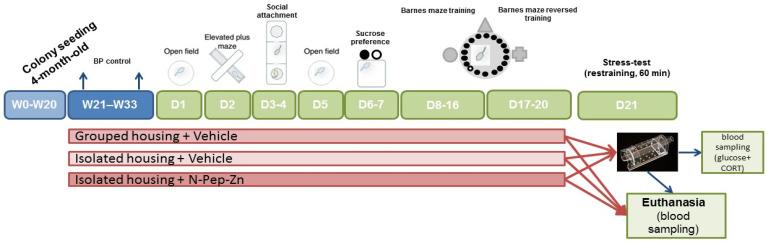
Nine-month-old SHRs were subjected to social isolation for 3 months (SHRiso group), and one group received N-pep-Zn orally (SHRisoP, 1.5 mg/100 g BW). SHRs housed in groups served as the control (SHRsoc). The behavioral study included the following tests: sucrose preference, open field, elevated plus maze, three-chamber sociability and social novelty and spatial learning and memory in a Barnes maze. Levels of corticosterone, glucose and proinflammatory cytokines in blood plasma as well as salivary amylase activity were measured. Restraint (60 min) was used to test acute stress response.
RESULTS
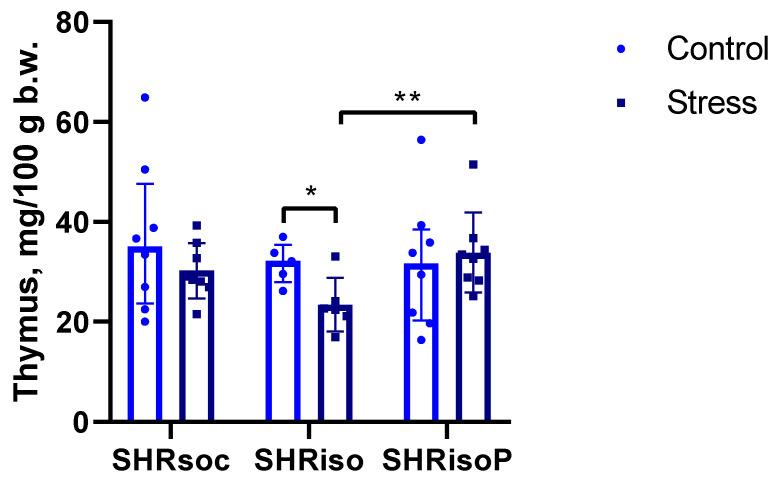
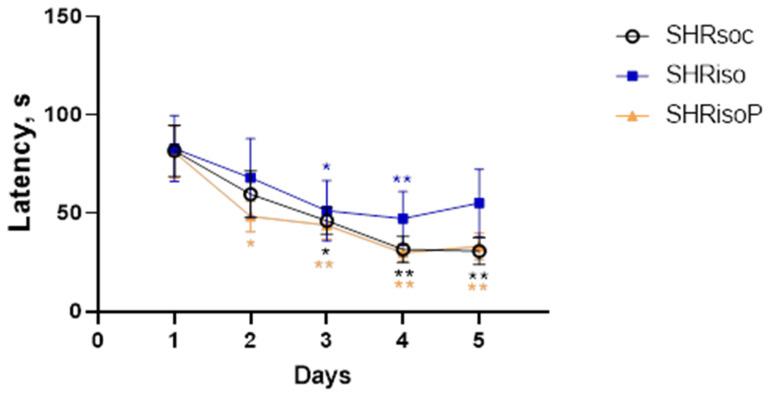
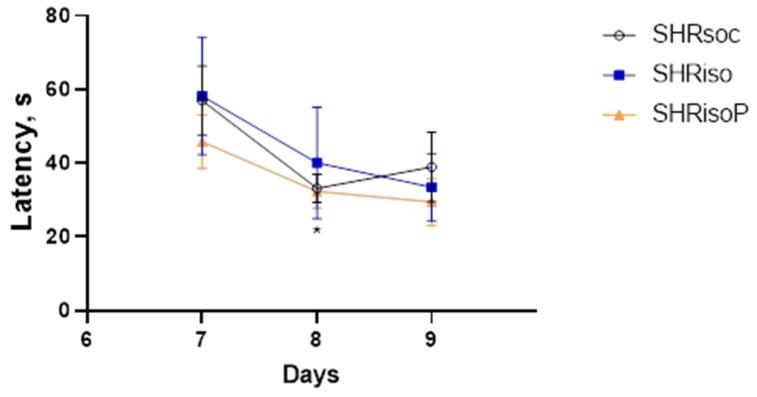
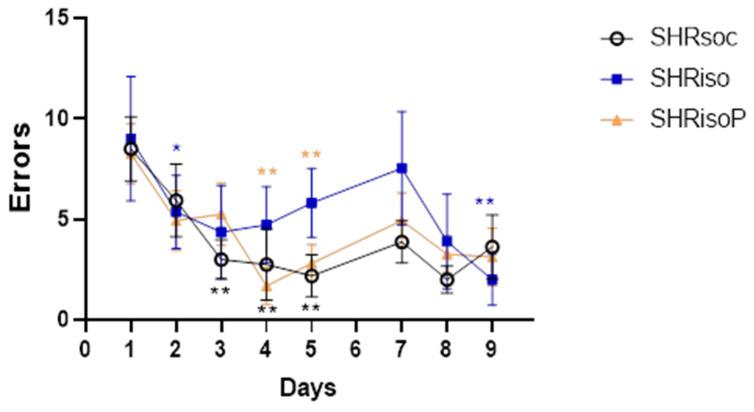
Isolation negatively affected the SHRs learning and memory in the Barnes maze, while the treatment of isolated rats with N-Pep-Zn improved their long-term memory and working memory impairments, making the SHRisoP comparable to the SHRsoc group. Acute stress induced a decrease in the relative thymus weight in the SHRiso group (but not SHRsoc), whereas treatment with N-Pep-Zn prevented thymus involution. N-pep-Zn mitigated the increment in blood cortisol and glucose levels induced by acute stress.
CONCLUSIONS
N-pep-Zn enhanced the adaptive capabilities towards chronic (isolation) and acute (immobilization) stress in aged SHRs and prevented cognitive disturbances induced by chronic isolation, probably affecting the hypothalamo-pituitary-adrenal, sympathetic, and immune systems.
背景/目的:衰老和慢性应激被视为认知能力下降的最重要风险因素。老年自发性高血压大鼠(SHR)是与年龄相关的血管性脑部疾病的合适模型。本研究的目的是探讨衰老SHR的慢性隔离应激对其认知功能和急性应激反应的影响,以及N-PEP-12的锌衍生物N-Pep-Zn长期口服摄入的影响。
方法
将9月龄的SHR进行3个月的社会隔离(SHRiso组),一组口服N-pep-Zn(SHRisoP,1.5mg/100g体重)。群居的SHR作为对照(SHRsoc)。行为学研究包括以下测试:蔗糖偏好、旷场试验、高架十字迷宫、三室社交和社交新奇性以及Barnes迷宫中的空间学习和记忆。测量血浆中皮质酮、葡萄糖和促炎细胞因子的水平以及唾液淀粉酶活性。采用束缚(60分钟)来测试急性应激反应。
结果
隔离对SHR在Barnes迷宫中的学习和记忆产生负面影响,而用N-Pep-Zn治疗隔离大鼠可改善其长期记忆和工作记忆障碍,使SHRisoP组与SHRsoc组相当。急性应激导致SHRiso组(而非SHRsoc组)的相对胸腺重量降低,而用N-Pep-Zn治疗可防止胸腺退化。N-pep-Zn减轻了急性应激诱导的血液皮质醇和葡萄糖水平的升高。
结论
N-pep-Zn增强了老年SHR对慢性(隔离)和急性(束缚)应激的适应能力,并预防了慢性隔离引起的认知障碍,可能影响下丘脑-垂体-肾上腺、交感神经和免疫系统。




 Zotero 插件