Almayouf Mina A, Charguia Raihane, Awad Manal A, Ben Bacha Abir, Ben Abdelmalek Imen
Department of Biology, College of Science, Qassim University, Buraydah 51452, Saudi Arabia.
Department of Physics, College of Science, Qassim University, Buraydah 51452, Saudi Arabia.
Pharmaceuticals (Basel). 2024 Oct 15;17(10):1371. doi: 10.3390/ph17101371.
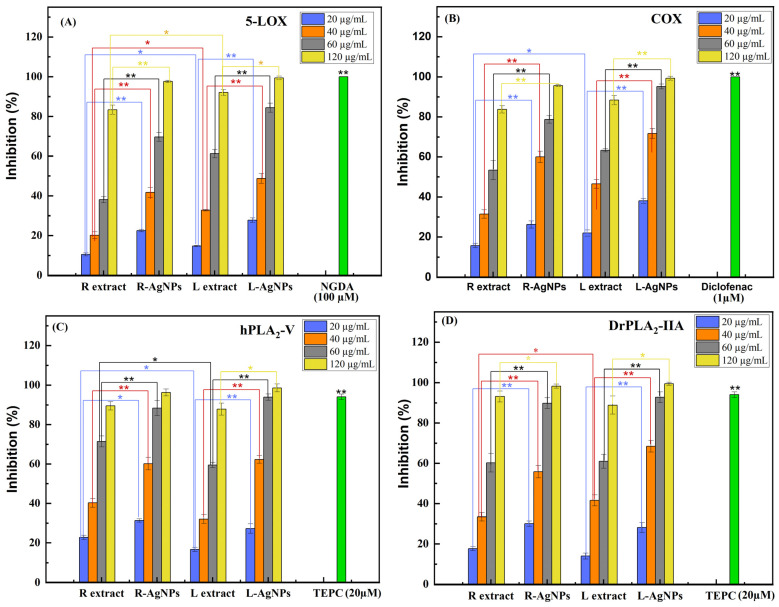
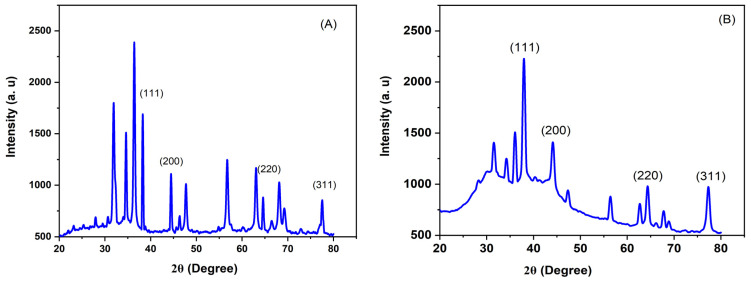
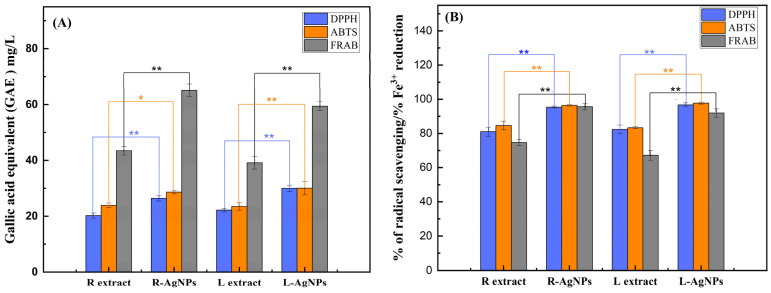
: Nanoparticles derived from medicinal plants are gaining attention for their diverse biological activities and potential therapeutic applications. : This study explored the antioxidant, anti-inflammatory, anti-tumoral, and antimicrobial properties of green synthesized silver nanoparticles (AgNPs) using the aqueous leaf and root extracts of (). The physicochemical characterizations of both biosynthesized AgNPs using the aqueous leaf extract (L-AgNPs) and root extract (R-AgNPs) were examined using UV spectroscopy, fluorescence spectroscopy, transmission electron microscopy, energy-dispersive X-ray spectroscopy, X-ray diffraction, dynamic light scattering, and Fourier-transform infrared spectroscopy. The antioxidant activity measured using ABTS, DPPH, and FRAP assays showed that AgNPs, particularly from roots, had higher activity than aqueous extracts, attributed to phenolic compounds acting as capping and antioxidant agents. : Enzyme inhibition studies indicated that AgNPs exhibited remarkable anti-inflammatory effects, inhibiting COX-1, 5-LOX, and secreted PLA enzymes by over 99% at 120 µg/mL, comparable to standard drugs. The anti-tumoral effects were evaluated on the human cancer cell lines HCT-116, LoVo, and MDA-MB-231, with AgNPs inhibiting cell proliferation dose-dependently and IC values between 42 and 60 µg/mL, demonstrating greater potency than extracts. The AgNPs also showed enhanced antimicrobial activities against various microbial strains, with IC values as low as 14 µg/mL, which could be linked to nanoparticle interactions with microbial cell membranes, causing structural damage and cell death. : These findings suggest that -derived AgNPs are promising natural, biodegradable agents for various biological applications and potential new therapeutic agents, necessitating further research to explore their mechanisms and applications.
源自药用植物的纳米颗粒因其多样的生物活性和潜在的治疗应用而受到关注。本研究利用()的叶和根水提取物,探索了绿色合成银纳米颗粒(AgNPs)的抗氧化、抗炎、抗肿瘤和抗菌特性。使用紫外光谱、荧光光谱、透射电子显微镜、能量色散X射线光谱、X射线衍射、动态光散射和傅里叶变换红外光谱对叶水提取物(L-AgNPs)和根水提取物(R-AgNPs)生物合成的AgNPs进行了物理化学表征。使用ABTS、DPPH和FRAP测定法测得的抗氧化活性表明,AgNPs,尤其是来自根部的AgNPs,比水提取物具有更高的活性,这归因于酚类化合物作为封端剂和抗氧化剂。酶抑制研究表明,AgNPs表现出显著的抗炎作用,在120μg/mL时对COX-1、5-LOX和分泌型PLA酶的抑制率超过99%,与标准药物相当。在人癌细胞系HCT-116、LoVo和MDA-MB-231上评估了抗肿瘤作用,AgNPs剂量依赖性地抑制细胞增殖,IC值在42至60μg/mL之间,显示出比提取物更强的效力。AgNPs还对各种微生物菌株表现出增强的抗菌活性,IC值低至14μg/mL,这可能与纳米颗粒与微生物细胞膜的相互作用有关,导致结构损伤和细胞死亡。这些发现表明,源自()的AgNPs是用于各种生物应用的有前景的天然、可生物降解的试剂和潜在的新型治疗剂,需要进一步研究以探索其作用机制和应用。