Department of Integrative Structural and Computational Biology, The Scripps Research Institute, La Jolla, CA, USA.
Chakra Techworks Inc., San Diego, CA, USA.
Nat Commun. 2024 Oct 26;15(1):9258. doi: 10.1038/s41467-024-53469-x.
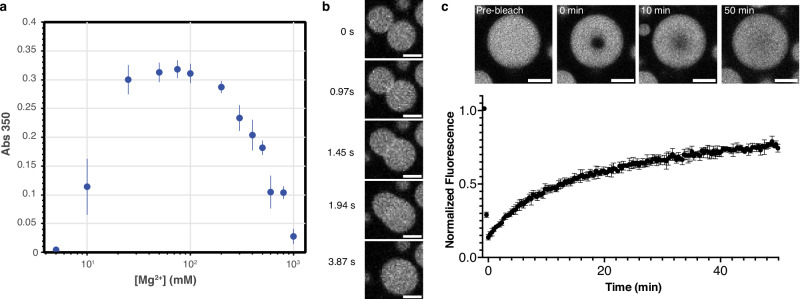
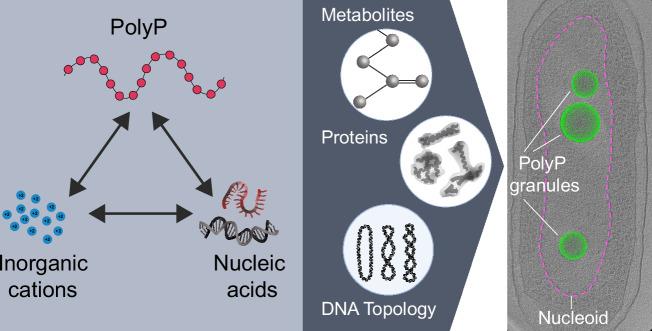
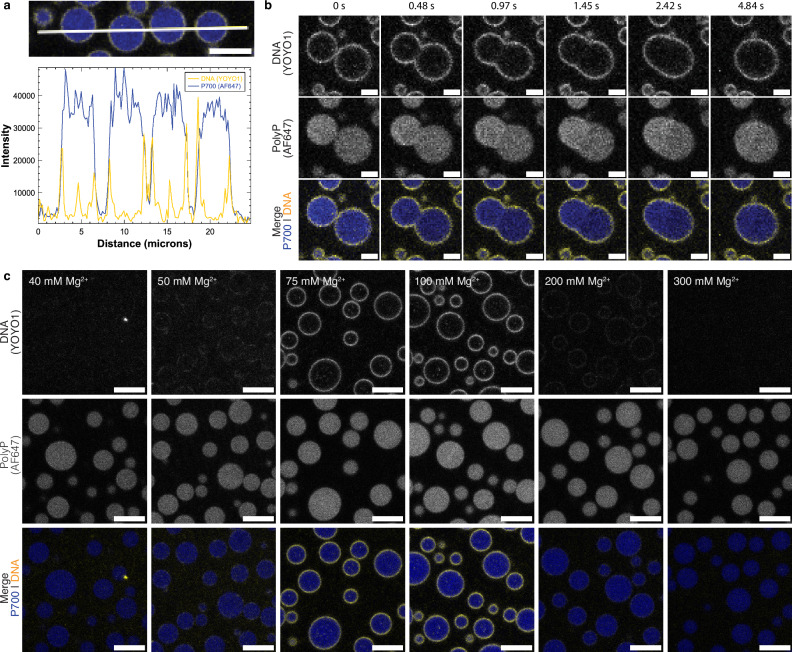
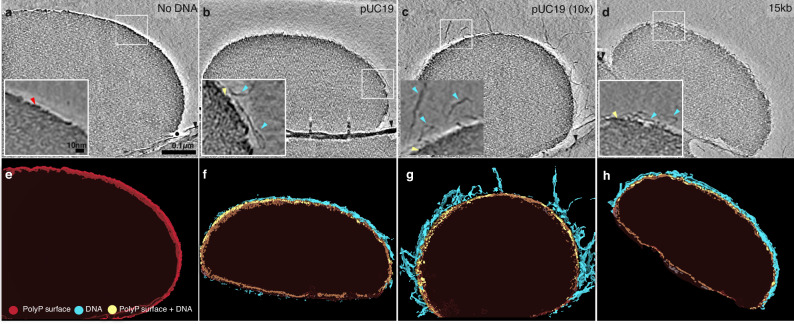
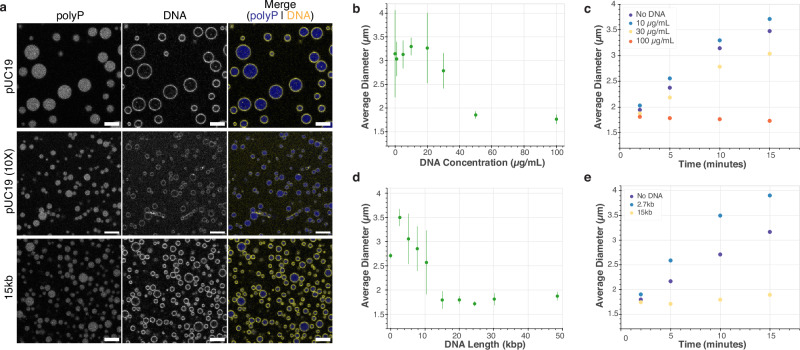
The inorganic biopolymer polyphosphate (polyP) occurs in all domains of life and affects myriad cellular processes. A longstanding observation is polyP's frequent proximity to chromatin, and, in many bacteria, its occurrence as magnesium (Mg)-enriched condensates embedded in the nucleoid region, particularly in response to stress. The physical basis of the interaction between polyP, DNA and Mg, and the resulting effects on the organization of the nucleoid and polyP condensates, remain poorly understood. Here, using a minimal system of polyP, Mg, and DNA, we find that DNA can form shells around polyP-Mg condensates. These shells show reentrant behavior, that is, they form within a window of Mg concentrations, representing a tunable architecture with potential relevance in other multicomponent condensates. This surface association tunes condensate size and DNA morphology in a manner dependent on DNA length and concentration, even at DNA concentrations orders of magnitude lower than found in the cell. Our work also highlights the remarkable capacity of two primordial inorganic species to organize DNA.
无机生物聚合物多聚磷酸盐(polyP)存在于所有生命领域,影响着无数的细胞过程。一个长期存在的观察结果是,多聚磷酸盐经常靠近染色质,并且在许多细菌中,它作为富含镁(Mg)的凝聚物存在于核区,特别是在应激反应中。多聚磷酸盐、DNA 和 Mg 之间相互作用的物理基础,以及对核区和多聚磷酸盐凝聚物组织的影响,仍然知之甚少。在这里,我们使用多聚磷酸盐、Mg 和 DNA 的最小系统,发现 DNA 可以在多聚磷酸盐-Mg 凝聚物周围形成壳。这些壳表现出再进入行为,即在 Mg 浓度窗口内形成,代表一种具有可调结构的潜在相关多组分凝聚物。这种表面缔合以依赖于 DNA 长度和浓度的方式调控制物大小和 DNA 形态,即使在 DNA 浓度低至细胞内浓度的数量级时也是如此。我们的工作还突出了两种原始无机物质组织 DNA 的惊人能力。