Zhang Yang, Liu Yong, Gan Zhimeng, Du Wei, Ai Xiaoyan, Zhu Wei, Wang Huiliang, Wang Furong, Gong Linzhong, He Huaping
Hubei Key Laboratory of Germplasm Innovation and Utilization of Fruit Trees, Institute of Fruit and Tea, Hubei Academy of Agricultural Science, Wuhan, China.
Front Plant Sci. 2024 Oct 11;15:1478055. doi: 10.3389/fpls.2024.1478055. eCollection 2024.
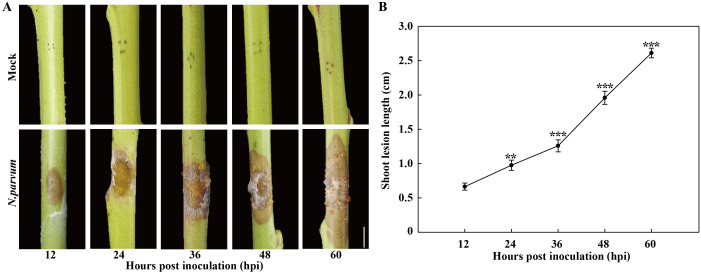
Peach gummosis, a devastating disease caused by , significantly shortens peach tree lifespan and reduces the yield of peach trees. Despite its impact, the molecular mechanism underlying this disease remains largely unexplored. In this study, we used RNA-seq, sugar metabolism measurements, and an integrated transcriptional and metabolomic analysis to uncover the molecular events driving peach gummosis. Our results revealed that infection drastically altered the transcripts of cell wall degradation-related genes, the logFold change in the transcript level of encoding xyloglucan endotransglycosylase decreased 2.6-fold, while encoding expansin increased by 2.58-fold at 12 hpi under stress. Additionally, sugar content analysis revealed an increase in maltose, sucrose, L-rhamnose, and inositol levels in the early stages of infection, while D-galactose, D-glucose, D-fructose consistently declined as gummosis progressed. Key genes related to cell wall degradation and starch degradation, as well as UDP-sugar biosynthesis, were significantly upregulated in response to . These findings suggest that manipulates cell wall degradation and UDP-sugar-related genes to invade peach shoot cells, ultimately triggering gum secretion. Furthermore, weighted gene co-expression network analysis (WGCNA) identified two transcription factors, and , as central regulators in the downregulated and upregulated modules, respectively. Overall, this study enhances our understanding of the physiological and molecular responses of peach trees to infection and provide valuable insights into the mechanisms of peach defense against biotic stresses.
桃流胶病是一种由[病原体名称未给出]引起的毁灭性病害,显著缩短桃树寿命并降低桃树产量。尽管其影响重大,但该病害的分子机制在很大程度上仍未得到探索。在本研究中,我们使用RNA测序、糖代谢测量以及转录组和代谢组综合分析来揭示驱动桃流胶病的分子事件。我们的结果表明,[病原体名称未给出]感染极大地改变了细胞壁降解相关基因的转录本,在[胁迫条件未给出]下,接种后12小时,编码木葡聚糖内转糖基酶的转录水平的对数倍变化下降了2.6倍,而编码扩张蛋白的转录本增加了2.58倍。此外,糖含量分析显示,在感染早期,麦芽糖、蔗糖、L-鼠李糖和肌醇水平增加,而随着流胶病的进展,D-半乳糖、D-葡萄糖、D-果糖持续下降。与细胞壁降解和淀粉降解以及UDP-糖生物合成相关的关键基因在响应[病原体名称未给出]时显著上调。这些发现表明,[病原体名称未给出]操纵细胞壁降解和UDP-糖相关基因以侵入桃树嫩梢细胞,最终触发胶分泌。此外,加权基因共表达网络分析(WGCNA)确定了两个转录因子,分别为[转录因子名称未给出]和[转录因子名称未给出],它们分别是下调模块和上调模块中的核心调节因子。总体而言,本研究增强了我们对桃树对[病原体名称未给出]感染的生理和分子反应的理解,并为桃树抵御生物胁迫的机制提供了有价值的见解。