Wei Zongjie, Bai Xuesong, Xv Yingjie, Chen Shao-Hao, Yin Siwen, Li Yang, Lv Fajin, Xiao Mingzhao, Xie Yongpeng
Department of Urology, The First Affiliated Hospital of Chongqing Medical University, Chongqing, China.
Department of Urology, Urology Research Institute, The First Affiliated Hospital of Fujian Medical University, Fuzhou, China.
Insights Imaging. 2024 Oct 28;15(1):262. doi: 10.1186/s13244-024-01840-3.
To develop a computed tomography (CT) radiomics-based interpretable machine learning (ML) model to preoperatively predict human epidermal growth factor receptor 2 (HER2) status in bladder cancer (BCa) with multicenter validation.
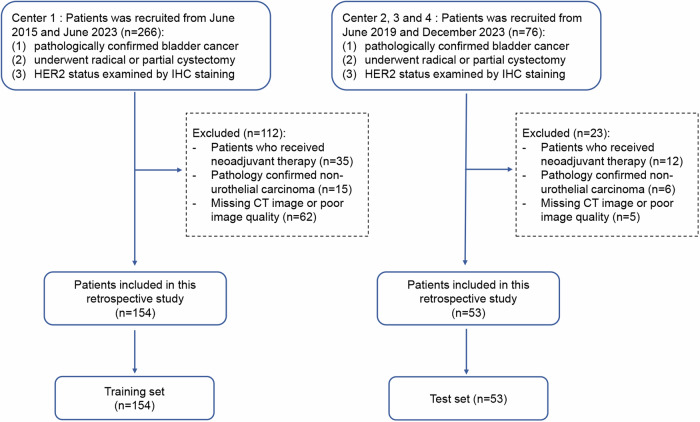
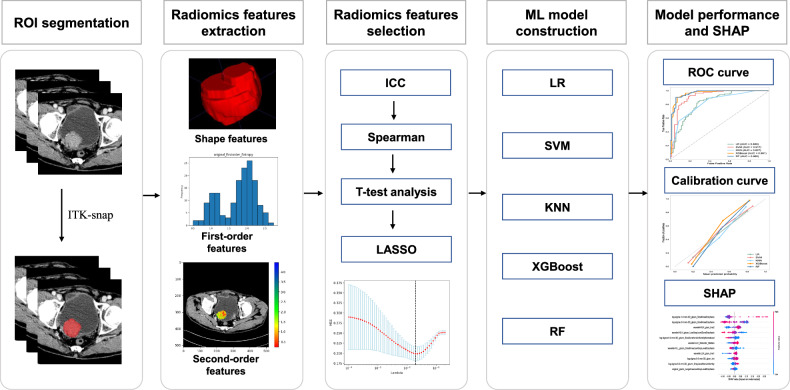
In this retrospective study, 207 patients with pathologically confirmed BCa were enrolled and divided into the training set (n = 154) and test set (n = 53). Least absolute shrinkage and selection operator (LASSO) regression was used to identify the most discriminative features in the training set. Five radiomics-based ML models, namely logistic regression (LR), support vector machine (SVM), k-nearest neighbors (KNN), eXtreme Gradient Boosting (XGBoost) and random forest (RF), were developed. The predictive performance of established ML models was evaluated by the area under the receiver operating characteristic curve (AUC). The Shapley additive explanation (SHAP) was used to analyze the interpretability of ML models.
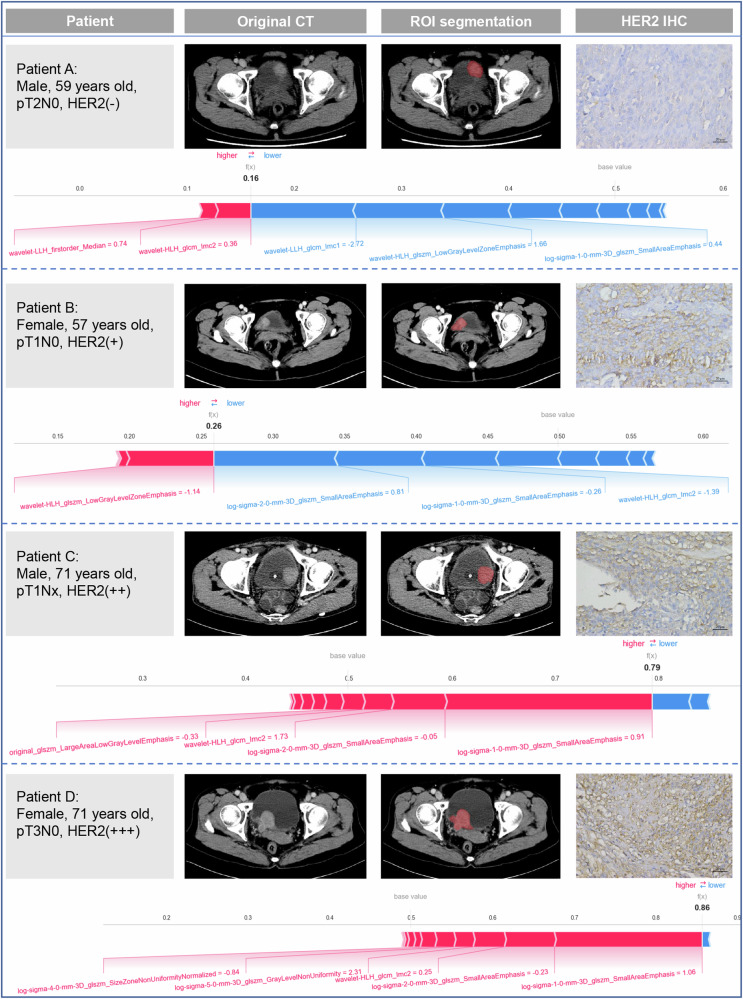
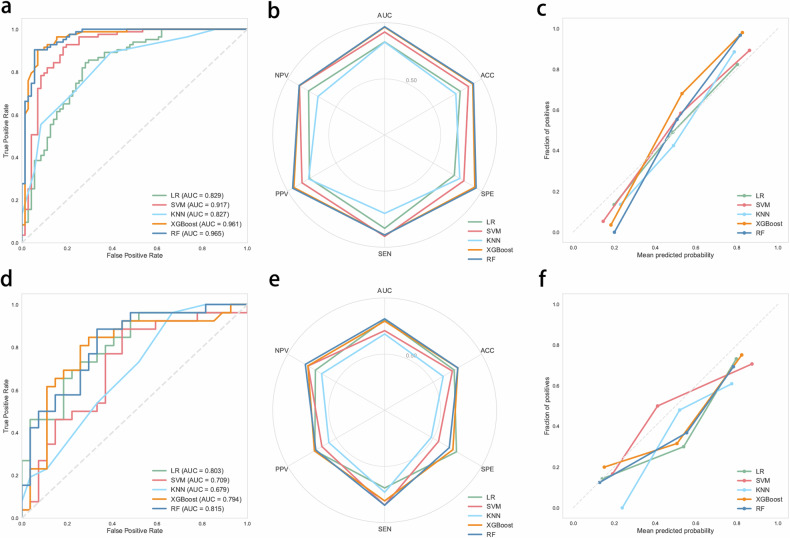
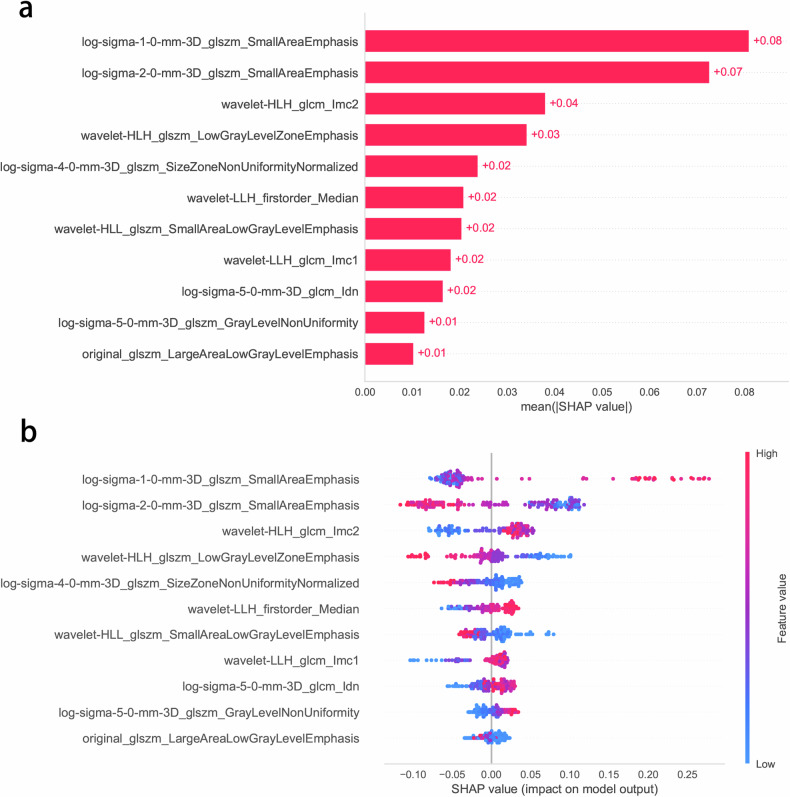
A total of 1218 radiomics features were extracted from the nephrographic phase CT images, and 11 features were filtered for constructing ML models. In the test set, the AUCs of LR, SVM, KNN, XGBoost, and RF were 0.803, 0.709, 0.679, 0.794, and 0.815, with corresponding accuracies of 71.7%, 69.8%, 60.4%, 75.5%, and 75.5%, respectively. RF was identified as the optimal classifier. SHAP analysis showed that texture features (gray level size zone matrix and gray level co-occurrence matrix) were significant predictors of HER2 status.
The radiomics-based interpretable ML model provides a noninvasive tool to predict the HER2 status of BCa with satisfactory discriminatory performance.
An interpretable radiomics-based machine learning model can preoperatively predict HER2 status in bladder cancer, potentially aiding in the clinical decision-making process.
The CT radiomics model could identify HER2 status in bladder cancer. The random forest model showed a more robust and accurate performance. The model demonstrated favorable interpretability through SHAP method.
开发一种基于计算机断层扫描(CT)影像组学的可解释机器学习(ML)模型,用于术前预测膀胱癌(BCa)患者的人表皮生长因子受体2(HER2)状态,并进行多中心验证。
在这项回顾性研究中,纳入207例经病理证实的BCa患者,分为训练集(n = 154)和测试集(n = 53)。采用最小绝对收缩和选择算子(LASSO)回归在训练集中识别最具鉴别力的特征。开发了5种基于影像组学的ML模型,即逻辑回归(LR)、支持向量机(SVM)、k近邻(KNN)、极端梯度提升(XGBoost)和随机森林(RF)。通过受试者操作特征曲线下面积(AUC)评估所建立ML模型的预测性能。使用Shapley加性解释(SHAP)分析ML模型的可解释性。
从肾实质期CT图像中提取了总共1218个影像组学特征,筛选出11个特征用于构建ML模型。在测试集中,LR、SVM、KNN、XGBoost和RF的AUC分别为0.803、0.709、0.679、0.794和0.815,相应的准确率分别为71.7%、69.8%、60.4%、75.5%和75.5%。RF被确定为最佳分类器。SHAP分析表明,纹理特征(灰度级大小区域矩阵和灰度共生矩阵)是HER2状态的重要预测指标。
基于影像组学的可解释ML模型提供了一种非侵入性工具,可用于预测BCa的HER2状态,具有令人满意的鉴别性能。
基于影像组学的可解释机器学习模型可以术前预测膀胱癌的HER2状态,可能有助于临床决策过程。
CT影像组学模型可以识别膀胱癌中的HER2状态。随机森林模型表现出更强健和准确的性能。该模型通过SHAP方法表现出良好的可解释性。