Department of Chemistry, University of Pittsburgh, Pittsburgh, Pennsylvania, USA.
Department of Pharmacy and Biotechnology, Alma Mater Studiorum-Università di Bologna, Bologna, Italy.
Protein Sci. 2024 Nov;33(11):e5198. doi: 10.1002/pro.5198.
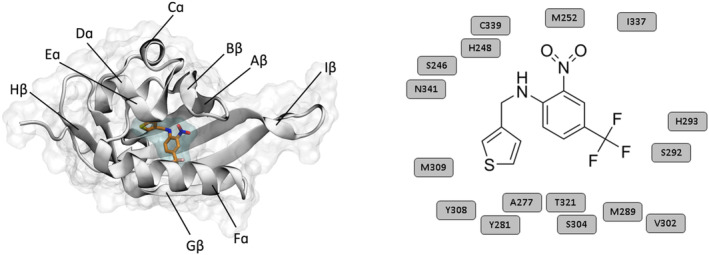
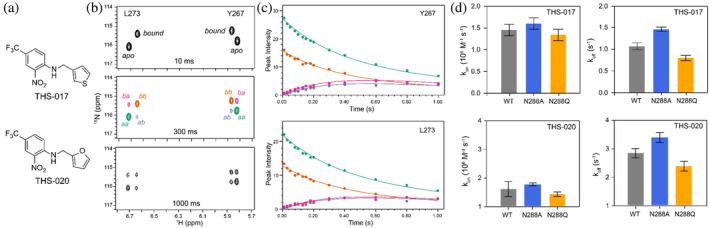
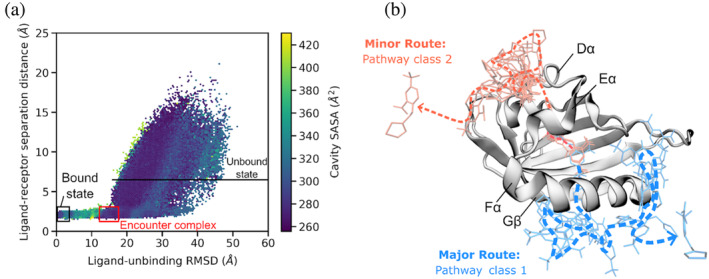
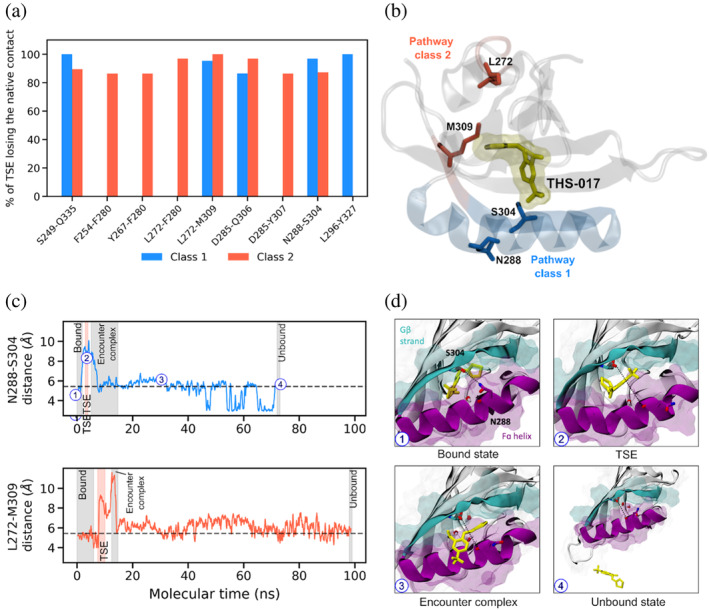
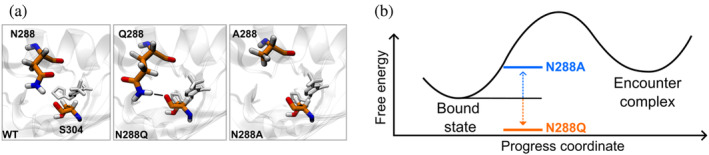
While transcription factors have been generally perceived as "undruggable," an exception is the HIF-2 hypoxia-inducible transcription factor, which contains an internal cavity that is sufficiently large to accommodate a range of small-molecules, including the therapeutically used inhibitor belzutifan. Given the relatively long ligand residence times of these small molecules and the lack of any experimentally observed pathway connecting the cavity to solvent, there has been great interest in understanding how these drug ligands exit the buried receptor cavity. Here, we focus on the relevant PAS-B domain of hypoxia-inducible factor 2α (HIF-2α) and examine how one such small molecule (THS-017) exits from the buried cavity within this domain on the seconds-timescale using atomistic simulations and ZZ-exchange NMR. To enable the simulations, we applied the weighted ensemble path sampling strategy, which generates continuous pathways for a rare-event process [e.g., ligand (un)binding] with rigorous kinetics in orders of magnitude less computing time compared to conventional simulations. Results reveal the formation of an encounter complex intermediate and two distinct classes of pathways for ligand exit. Based on these pathways, we identified two pairs of conformational gating residues in the receptor: one for the major class (N288 and S304) and another for the minor class (L272 and M309). ZZ-exchange NMR validated the kinetic importance of N288 for ligand unbinding. Our results provide an ideal simulation dataset for rational manipulation of ligand unbinding kinetics.
虽然转录因子通常被认为是“不可成药的”,但 HIF-2 缺氧诱导转录因子是一个例外,它包含一个足够大的内部空腔,可以容纳一系列小分子,包括临床上使用的抑制剂贝伐单抗。鉴于这些小分子的配体停留时间相对较长,而且没有观察到任何实验途径将空腔与溶剂连接起来,因此人们非常感兴趣地了解这些药物配体如何从埋藏的受体空腔中排出。在这里,我们专注于缺氧诱导因子 2α(HIF-2α)的相关 PAS-B 结构域,并使用原子模拟和 ZZ 交换 NMR 研究了一种这样的小分子(THS-017)如何在几秒钟的时间内从该结构域中的埋藏空腔中排出。为了进行模拟,我们应用了加权集合路径采样策略,该策略以与传统模拟相比数量级少的计算时间生成了稀有事件过程(例如配体(非)结合)的连续路径,具有严格的动力学。结果揭示了形成一个遭遇复合物中间体和两种不同类型的配体出口途径。基于这些途径,我们在受体中确定了两对构象门控残基:一对用于主要类(N288 和 S304),另一对用于次要类(L272 和 M309)。ZZ 交换 NMR 验证了 N288 对配体非结合的动力学重要性。我们的结果为合理操纵配体非结合动力学提供了一个理想的模拟数据集。