Gu Yu, Seong Dong-Hun, Liu Wenduo, Wang Zilin, Jeong Yong Whi, Kim Jae-Cheol, Kang Dae Ryong, Lee Rose Ji Eun, Koh Jin-Ho, Kim Sang Hyun
Department of Sports Science, College of Natural Science, Jeonbuk National University, Jeonju 54896, Korea.
Department of Medical Informatics and Biostatistics, Graduate School, Yonsei University, Wonju 26426, Korea.
Korean J Physiol Pharmacol. 2024 Nov 1;28(6):515-526. doi: 10.4196/kjpp.2024.28.6.515.
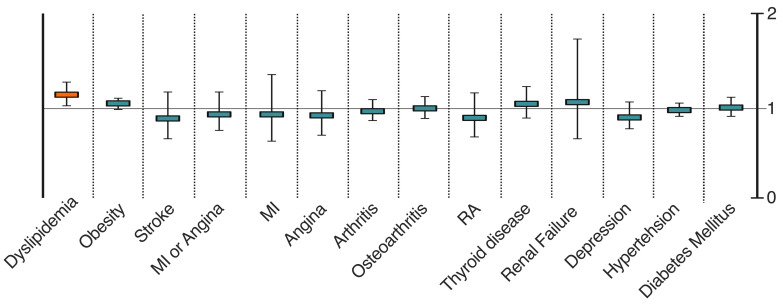
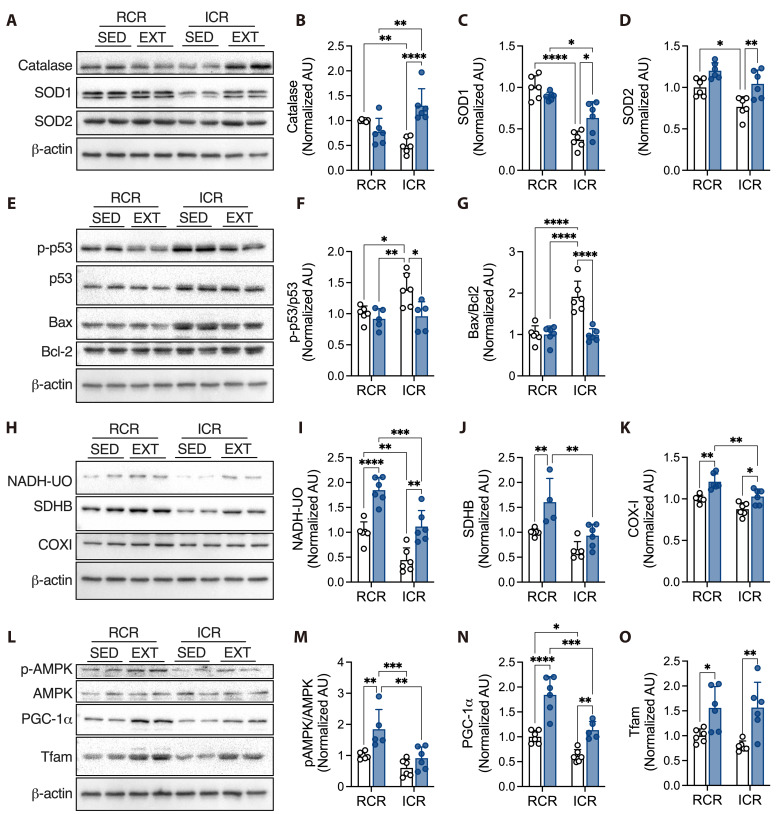
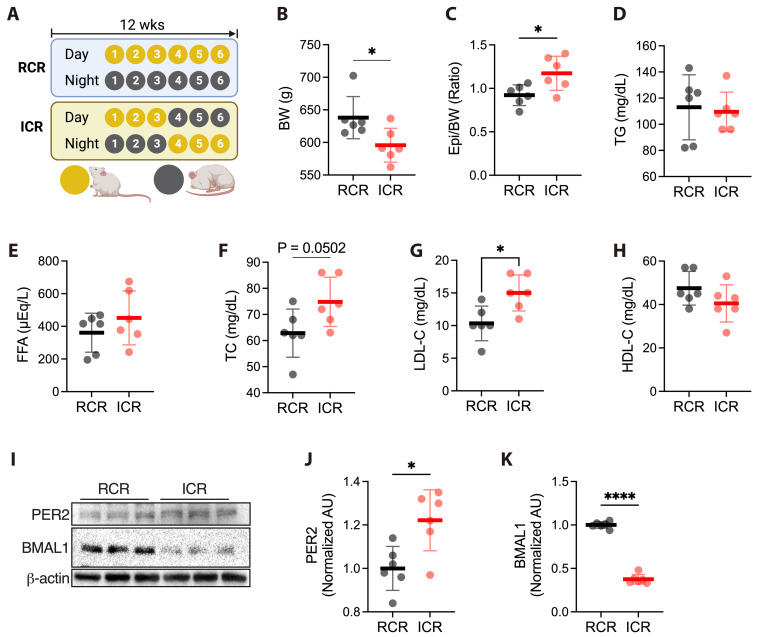
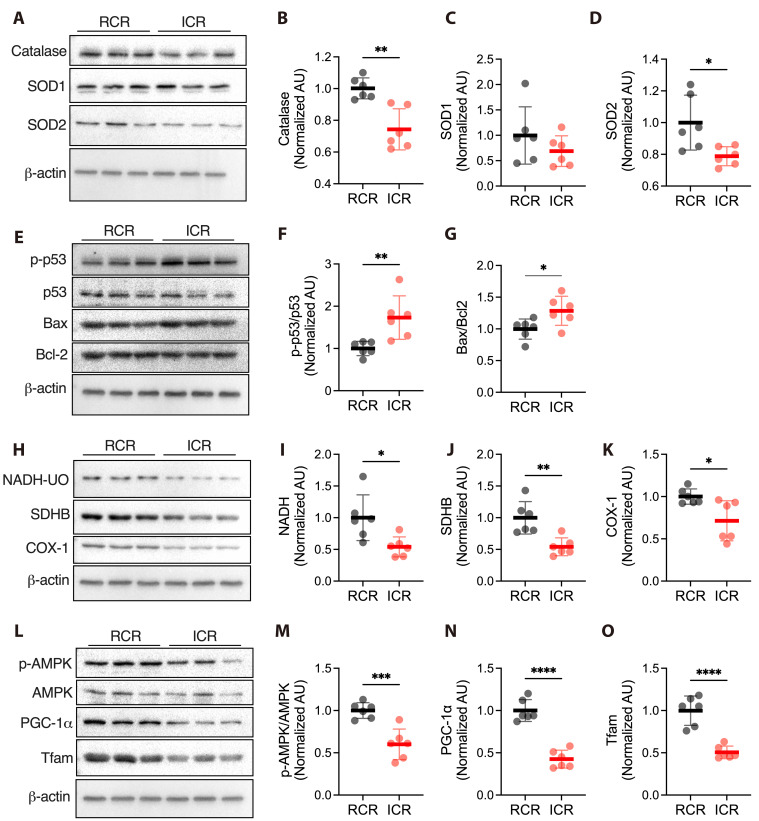
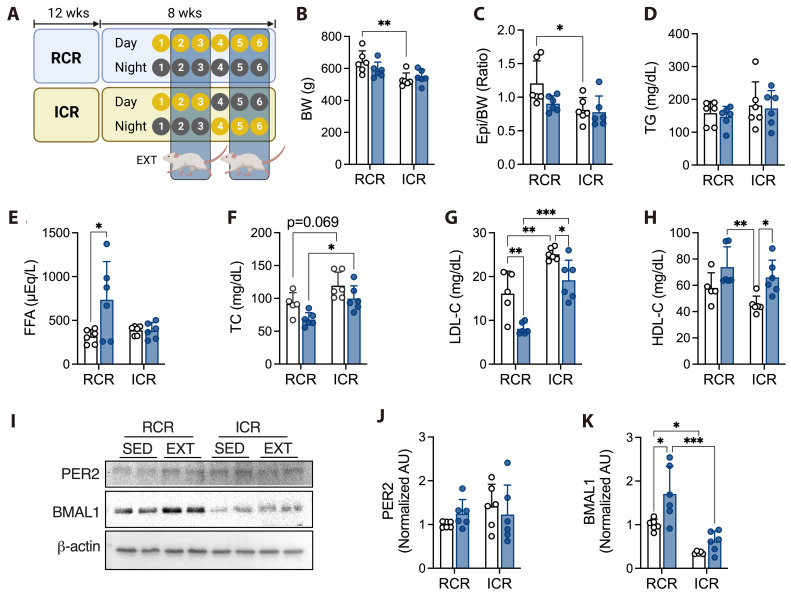
We investigated whether endurance exercise training (EXT) ameliorates circadian rhythm (CR)-induced risk factors by improving skeletal muscle (SKM) mitochondrial biogenesis, reducing oxidative stress, and modulating apoptotic protein expression. We distinguished between regular and shift workers using the National Health and Nutrition Examination Survey (NHANES) and investigated the health problems caused by shift work (CR disturbance) and the potential therapeutic effects of exercise. In our animal study, 36 rats underwent 12 weeks of CR disturbance, divided into regular and irregular CR groups. These groups were further split into EXT (n = 12) and sedentary (n = 12) for an additional 8 weeks. We analyzed SKM tissue to understand the molecular changes induced by CR and EXT. NHANES data were analyzed using SAS 9.4 and Prism 8 software, while experimental animal data were analyzed using Prism 8 software. The statistical procedures used in each experiment are indicated in the figure legends. Our studies showed that CR disturbance increases dyslipidemia, alters circadian clock proteins (BMAL1, PER2), raises apoptotic protein levels, and reduces mitochondrial biogenesis in SKM. EXT improved LDL-C and HDLC levels without affecting muscle BMAL1 expression. It also enhanced mitochondrial biogenesis (AMPK, PGC-1α, Tfam, NADH-UO, COX-I), antioxidant levels (Catalase, SOD1, SOD2), and apoptotic protein (p53, Bax/Bcl2) expression or activity in SKM. We demonstrated that shift work-induced CR disturbance leads to dyslipidemia, diminished mitochondrial biogenesis, and reduced antioxidant capacity in SKM. However, EXT can counteract dyslipidemia under CR disturbance, potentially lowering the risk of cardiovascular disorders.
我们研究了耐力运动训练(EXT)是否通过改善骨骼肌(SKM)线粒体生物合成、降低氧化应激和调节凋亡蛋白表达来减轻昼夜节律(CR)诱导的风险因素。我们使用美国国家健康和营养检查调查(NHANES)区分了正常工作者和轮班工作者,并研究了轮班工作(CR紊乱)引起的健康问题以及运动的潜在治疗效果。在我们的动物研究中,36只大鼠经历了12周的CR紊乱,分为正常CR组和不规则CR组。这些组进一步分为EXT组(n = 12)和久坐组(n = 12),并持续8周。我们分析了SKM组织,以了解CR和EXT诱导的分子变化。NHANES数据使用SAS 9.4和Prism 8软件进行分析,而实验动物数据使用Prism 8软件进行分析。每个实验中使用的统计程序在图注中注明。我们的研究表明,CR紊乱会增加血脂异常,改变昼夜节律时钟蛋白(BMAL1、PER2),提高凋亡蛋白水平,并降低SKM中的线粒体生物合成。EXT改善了低密度脂蛋白胆固醇(LDL-C)和高密度脂蛋白胆固醇(HDLC)水平,而不影响肌肉BMAL1表达。它还增强了SKM中的线粒体生物合成(AMPK、PGC-1α、Tfam、NADH-UO、COX-I)、抗氧化水平(过氧化氢酶、超氧化物歧化酶1、超氧化物歧化酶2)以及凋亡蛋白(p53、Bax/Bcl2)的表达或活性。我们证明,轮班工作引起的CR紊乱会导致血脂异常、线粒体生物合成减少和SKM抗氧化能力降低。然而,EXT可以在CR紊乱的情况下对抗血脂异常, potentially降低心血管疾病的风险。