Department of Translational Medicine and Physiology, Sleep and Performance Research Center, Elson S. Floyd College of Medicine, Washington State University, Spokane, WA, USA.
Department of Integrative Physiology and Neuroscience, Washington State University, Pullman, WA, USA.
Biol Sex Differ. 2024 Oct 28;15(1):85. doi: 10.1186/s13293-024-00664-6.
Insomnia is more prevalent in individuals with Autism Spectrum Disorder (ASD), can worsen core-symptoms and reduces quality of life of both individuals and caregivers. Although ASD is four times more prevalent in males than females, less is known about sex specific sleep differences in autistic individuals. Recent ASD studies suggest that sleep problems may be more severe in females, which aligns with the sex bias seen in insomnia for the general population. We have previously shown that male mice with a mutation in the high confidence ASD gene Shank3, Shank3, recapitulate most aspects of the ASD insomnia phenotype. The objective of the present study was to leverage the Shank3 model to investigate sex-specific effects in sleep using polysomnography.
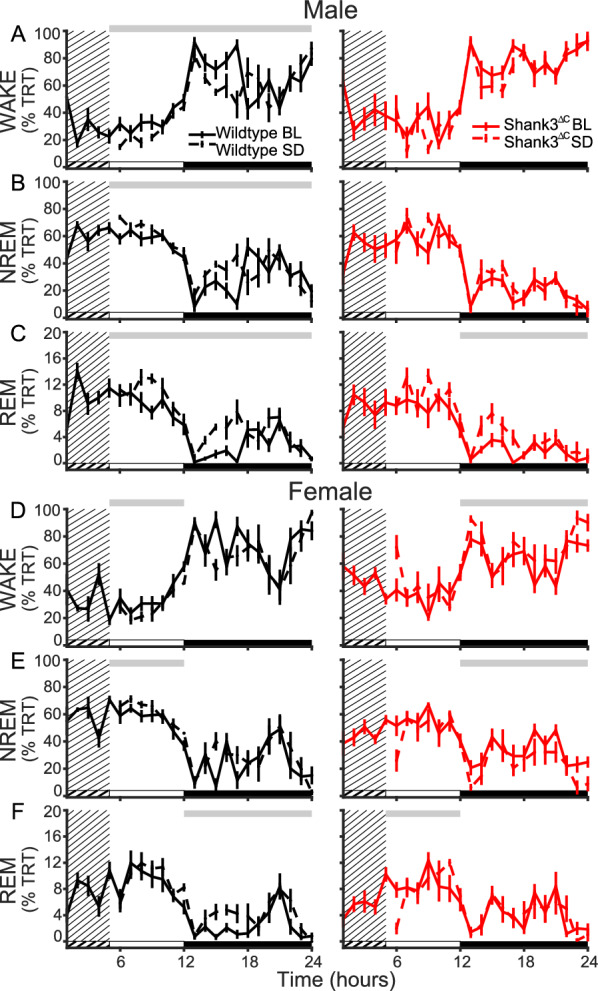
Adult male and female Shank3 and wildtype (WT) littermates were first recorded for 24 h of baseline recordings. Subsequently, they were sleep deprived (SD) for five hours via gentle handling and allowed 19 h of recovery sleep to characterize the homeostatic response to SD. Vigilance states (rapid eye movement (REM) sleep, non-rapid eye movement (NREM) sleep and wake) were assigned by manual inspection using SleepSign. Data processing, statistical analysis and visualization were conducted using MATLAB.
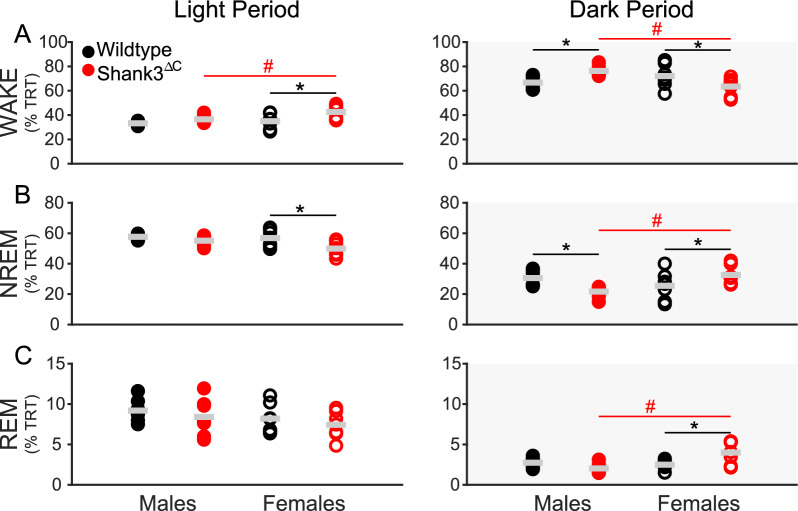
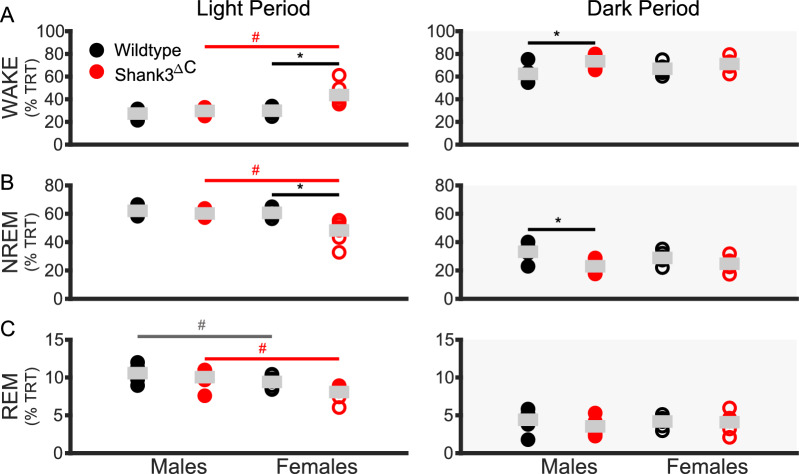
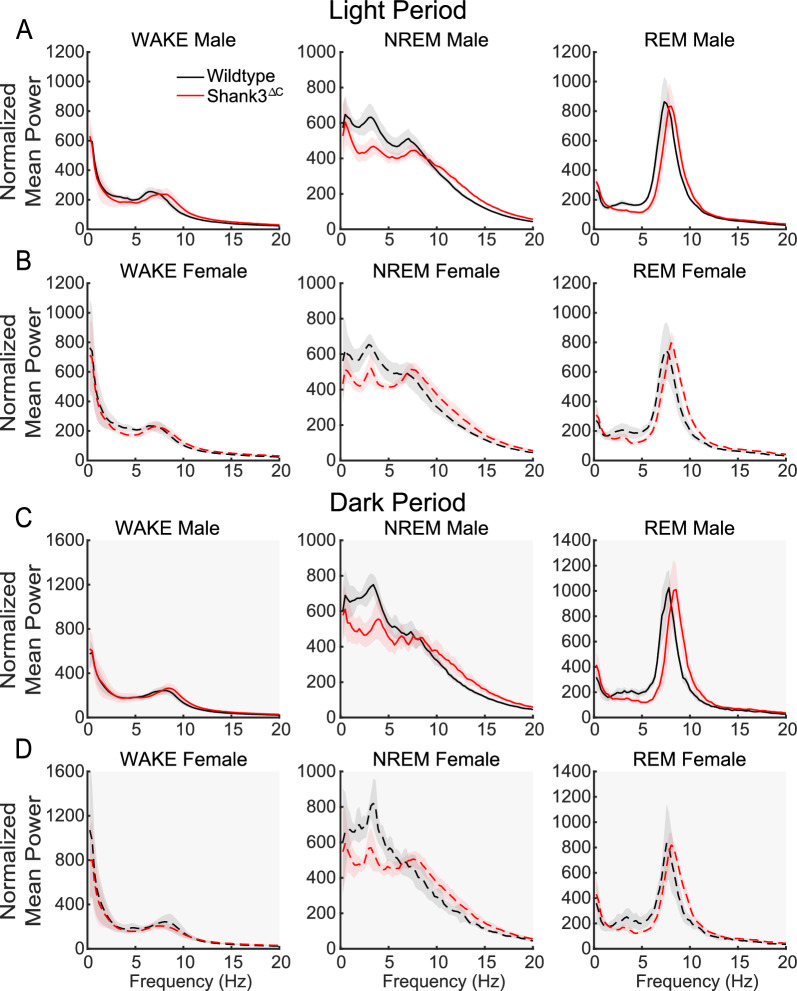
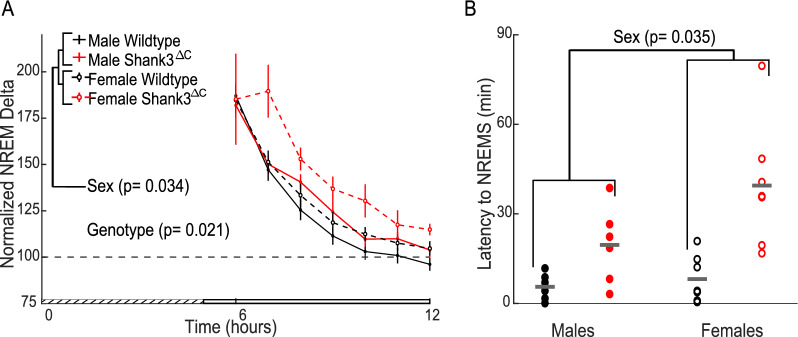
Sex and genotype effects were found during baseline sleep and after SD. At baseline, male Shank3 mice sleep less during the dark period (active phase) while female Shank3 mice sleep less during the light period (rest phase) and sleep more during the dark period. Both male and female Shank3 mice show reduced spectral power in NREM sleep. We detect a significant effect of sex and genotype in sleep onset latency and homeostatic sleep pressure (sleepiness). In addition, while male Shank3 mice fail to increase sleep time following SD as seen in WT, female Shank3 mice decrease sleep time.
Overall, our study demonstrates sex differences in sleep architecture and homeostatic response to SD in adult Shank3 mice. Thus, our study demonstrates an interaction between sex and genotype in Shank3 mice and supports the use of the Shank3 model to better understand mechanisms contributing to the sex differences in insomnia in ASD in clinical populations.
自闭症谱系障碍(ASD)患者中失眠更为常见,会加重核心症状并降低患者及其照护者的生活质量。尽管 ASD 患者中男性的发病率是女性的四倍,但关于自闭症个体中性别特异性睡眠差异的了解较少。最近的 ASD 研究表明,睡眠问题在女性中可能更为严重,这与一般人群中失眠的性别偏见一致。我们之前已经表明,具有 Shank3 高可信度 ASD 基因突变的雄性小鼠重现了 ASD 失眠表型的大多数方面。本研究的目的是利用 Shank3 模型通过多导睡眠图来研究睡眠中的性别特异性影响。
成年雄性和雌性 Shank3 及野生型(WT)同窝仔鼠首先进行 24 小时基线记录。随后,通过轻柔处理使其睡眠剥夺(SD)五小时,并允许 19 小时恢复睡眠,以表征对 SD 的生理性睡眠反弹反应。使用 SleepSign 通过手动检查分配警觉状态(快速眼动(REM)睡眠、非快速眼动(NREM)睡眠和觉醒)。数据处理、统计分析和可视化均使用 MATLAB 进行。
在基线睡眠和 SD 后发现了性别和基因型的影响。在基线时,雄性 Shank3 小鼠在黑暗期(活动期)睡眠时间较少,而雌性 Shank3 小鼠在光照期(休息期)睡眠时间较少,在黑暗期睡眠时间较多。雄性和雌性 Shank3 小鼠的 NREM 睡眠谱功率均降低。我们检测到性别和基因型对睡眠潜伏期和生理性睡眠压力(困倦)有显著影响。此外,尽管雄性 Shank3 小鼠未能像 WT 一样在 SD 后增加睡眠时间,但雌性 Shank3 小鼠减少了睡眠时间。
总的来说,我们的研究表明成年 Shank3 小鼠的睡眠结构和对 SD 的生理性睡眠反弹反应存在性别差异。因此,我们的研究表明 Shank3 小鼠中性别和基因型之间存在相互作用,并支持使用 Shank3 模型来更好地理解导致 ASD 临床人群中失眠性别差异的机制。