Department of Speech and Hearing Science, Box 357920, UW Autism Center, University of Washington, Seattle, Washington, USA.
Department of Psychiatry and Behavioral Sciences, University of Washington, Seattle, Washington, USA.
Autism Res. 2023 Jan;16(1):164-173. doi: 10.1002/aur.2848. Epub 2022 Nov 7.
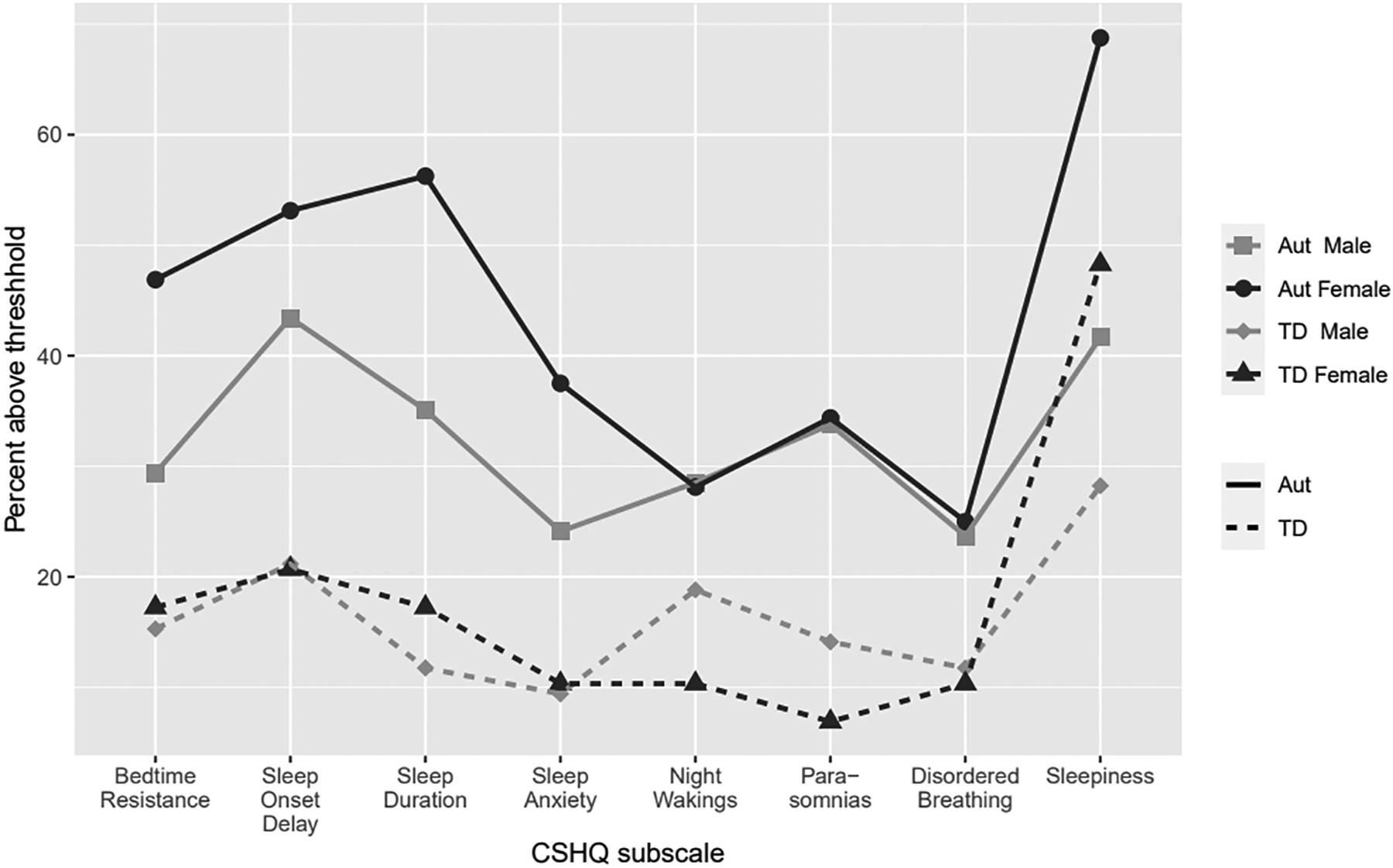
Clinically significant sleep problems affect up to 86% of the autistic population in school-age. Sleep problems can have negative impacts on child cognition, behavior, and health. However, sex differences in the prevalence and types of sleep problems are not well understood in autism. To evaluate sex differences in sleep problems in the school-age autistic population, we obtained parent-report of sleep problems on the Children's Sleep Habits Questionnaire and conducted direct assessments to establish diagnosis and intellectual ability in 6-12-year-old children (autism n = 250; typical development [TD] n = 114). Almost 85% of autistic females demonstrated sleep problems compared to 65.8% of autistic males, 44.8% of TD females, and 42.4% of TD males; a statistically significant increase for autistic females. Autistic females demonstrated increased bedtime resistance, sleep anxiety, and sleepiness, and decreased sleep duration, but did not differ in sleep onset delay, night wakings, parasomnias, or disordered breathing compared with autistic males. Intellectual ability was not related to increased sleep problems. Higher anxiety scores were associated with more sleep problems for males but not females. In one of the first studies to evaluate sex differences in sleep in the school-age, autistic population, autistic females demonstrated increased sleep problems compared to autistic males, TD females, and TD males. Current autism assessment and intervention practices may benefit from increased attention to sleep problems in autistic school-age females and to anxiety in autistic males to enhance well-being and behavioral and health outcomes.
临床上明显的睡眠问题影响了多达 86%的学龄期自闭症患者。睡眠问题会对儿童的认知、行为和健康产生负面影响。然而,自闭症患者中睡眠问题的性别差异及其类型尚未得到充分了解。为了评估学龄期自闭症患者中睡眠问题的性别差异,我们使用儿童睡眠习惯问卷获得了家长对睡眠问题的报告,并对 6-12 岁儿童进行了直接评估以确定诊断和智力能力(自闭症 n=250;典型发育[TD]n=114)。几乎 85%的自闭症女性表现出睡眠问题,而自闭症男性为 65.8%,TD 女性为 44.8%,TD 男性为 42.4%;自闭症女性的睡眠问题显著增加。自闭症女性表现出增加的就寝时间抵抗、睡眠焦虑和嗜睡,以及减少的睡眠时间,但与自闭症男性相比,入睡延迟、夜间醒来、睡眠障碍或呼吸障碍没有差异。智力能力与睡眠问题的增加无关。较高的焦虑评分与男性的睡眠问题更多相关,而与女性无关。这是评估学龄期自闭症患者睡眠问题性别差异的首批研究之一,研究表明自闭症女性的睡眠问题比自闭症男性、TD 女性和 TD 男性更多。目前的自闭症评估和干预实践可能需要更加关注自闭症学龄期女性的睡眠问题以及自闭症男性的焦虑问题,以提高他们的幸福感以及行为和健康结果。