Division of Life Sciences, Institute of Advanced Study in Science and Technology (IASST), Guwahati, 781035, Assam, India.
Department of Biotechnology, Gauhati University, Guwahati, 781014, Assam, India.
Cell Commun Signal. 2024 Oct 28;22(1):520. doi: 10.1186/s12964-024-01900-7.
Lactiplantibacillus species are extensively studied for their ability to regulate host immune responses and functional therapeutic potentials. Nevertheless, there is a lack of understanding on the mechanisms of interactions with the hosts during immunoregulatory activities.
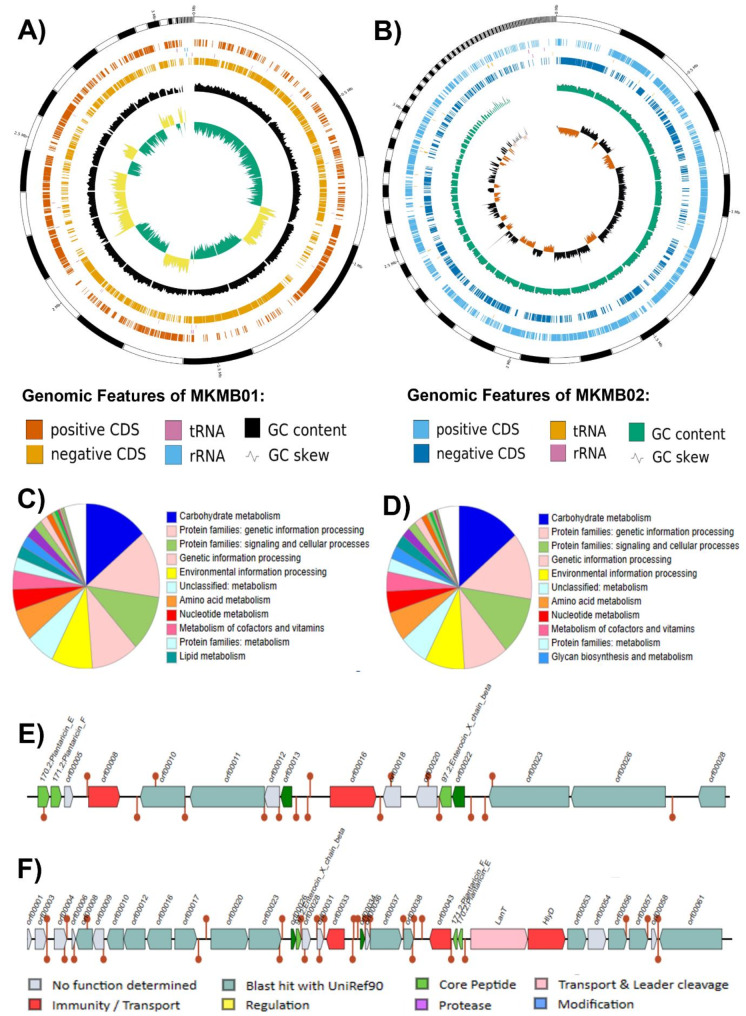
Two Lactiplantibacillus plantarum strains MKMB01 and MKMB02 were tested for probiotic potential following Indian Council of Medical Research (ICMR) guidelines. Human colorectal adenocarcinoma cells such as HT-29, caco-2, and human monocytic cell THP-1 were also used to study the potential of MKMB01 and MKMB02 in regulating the host immune response when challenged with enteric pathogen Salmonella enterica typhimurium. Cells were pre-treated with MKMB01 and MKMB02 for 4 h and then stimulated with Salmonella. qRT-PCR and ELISA were used to analyze the genes and protein expression. Confocal microscopy and field emission scanning electron microscopy (FESEM) were used to visualize the effects. An Agilent Seahorse XF analyzer was used to determine real-time mitochondrial functioning.
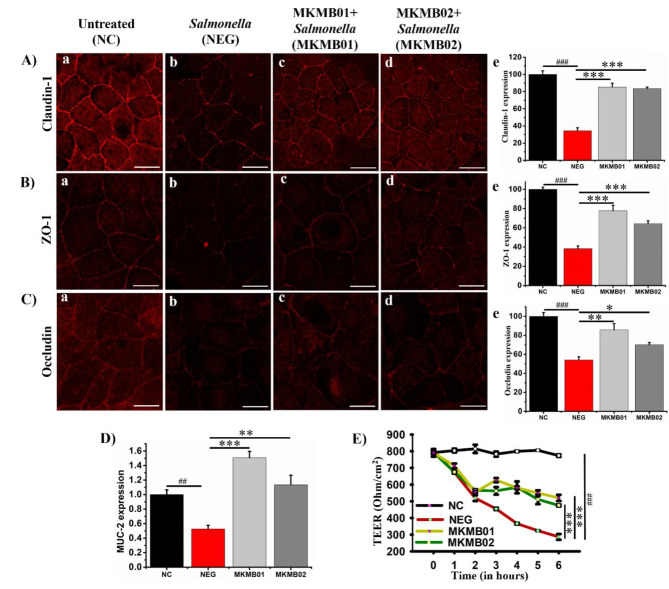
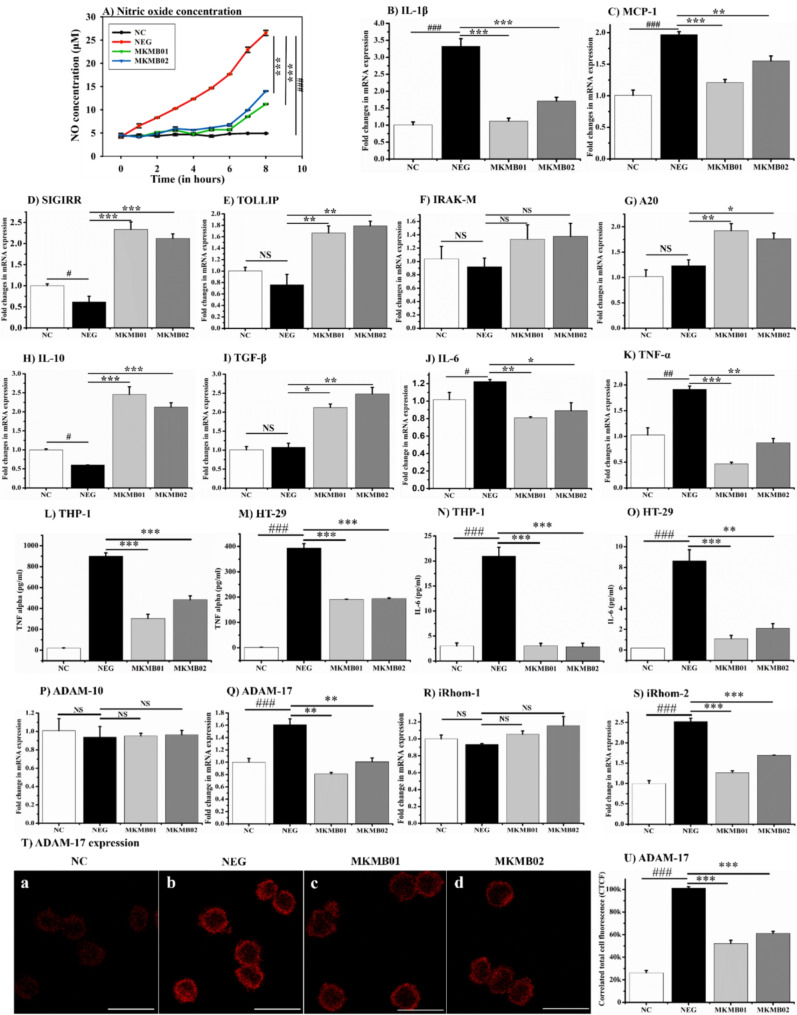
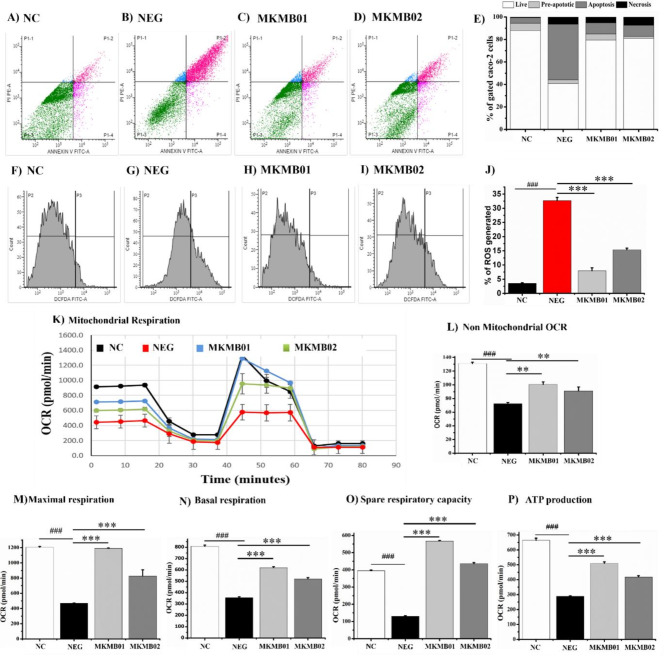
Both probiotic strains could defend against Salmonella by maintaining gut integrity via expressing tight junction proteins (TJPs), MUC-2, and toll-like receptors (TLRs) negative regulators such as single Ig IL-1-related receptor (SIGIRR), toll-interacting protein (Tollip), interleukin-1 receptor-associated kinase (IRAK)-M, A20, and anti-inflammatory transforming growth factor-β and interleukin-10. Both strains also downregulated the expression of pro-inflammatory cytokines/chemokines interleukin-1β, monocyte chemoattractant protein (MCP)-1, tumor necrosis factor-alpha (TNF-α), interleukin 6, and nitric oxide (NO). Moreover, TNF-α sheddase protein, a disintegrin and metalloproteinase domain 17 (ADAM17), and its regulator iRhom2 were downregulated by both strains. Moreover, the bacteria also ameliorated Salmonella-induced mitochondrial dysfunction by restoring bioenergetic profiles, such as non-mitochondrial respiration, spare respiratory capacity (SRC), basal respiration, adenosine triphosphate (ATP) production, and maximal respiration.
MKMB01 and MKMB02 can reduce pathogen-induced gut-associated disorders and therefore should be further explored for their probiotic potential.
植物乳杆菌属因其调节宿主免疫反应和功能治疗潜力而被广泛研究。然而,对于其在免疫调节活动中与宿主相互作用的机制,人们的了解还很缺乏。
根据印度医学研究理事会(ICMR)的指导方针,对两株植物乳杆菌(Lactiplantibacillus plantarum)MKMB01 和 MKMB02 进行了益生菌潜力测试。还使用人结直肠腺癌细胞(如 HT-29、Caco-2 和人单核细胞 THP-1)研究了 MKMB01 和 MKMB02 在受到肠道病原体鼠伤寒沙门氏菌(Salmonella enterica typhimurium)挑战时调节宿主免疫反应的潜力。将细胞用 MKMB01 和 MKMB02 预处理 4 小时,然后用沙门氏菌刺激。采用 qRT-PCR 和 ELISA 分析基因和蛋白表达。共聚焦显微镜和场发射扫描电子显微镜(FESEM)用于观察效果。使用安捷伦 Seahorse XF 分析仪实时测定线粒体功能。
两种益生菌株均可通过表达紧密连接蛋白(TJPs)、MUC-2 和 Toll 样受体(TLRs)负调节剂(如单免疫球蛋白 IL-1 相关受体(SIGIRR)、Toll 相互作用蛋白(Tollip)、白细胞介素-1 受体相关激酶(IRAK)-M、A20 和抗炎性转化生长因子-β和白细胞介素-10)来抵抗沙门氏菌,维持肠道完整性。两种菌株还下调了促炎细胞因子/趋化因子白细胞介素-1β、单核细胞趋化蛋白-1(MCP-1)、肿瘤坏死因子-α(TNF-α)、白细胞介素 6 和一氧化氮(NO)的表达。此外,两种菌株还下调了 TNF-α 脱落酶蛋白、解整合素和金属蛋白酶域 17(ADAM17)及其调节剂 iRhom2 的表达。此外,细菌还通过恢复非线粒体呼吸、备用呼吸能力(SRC)、基础呼吸、三磷酸腺苷(ATP)产生和最大呼吸等生物能谱来改善沙门氏菌诱导的线粒体功能障碍。
MKMB01 和 MKMB02 可减轻病原体引起的肠道相关疾病,因此应进一步探索其益生菌潜力。