Granoski Maia B, Fischer Katharina S, Hahn William W, Sivaraj Dharshan, Kussie Hudson C, Quintero Filiberto, Alsharif Abdelrahman M, McKenna Eamonn, Yasmeh Jonathan P, Hostler Andrew C, Mora Pinos Maria Gracia, Erickson Robert P, Witte Marlys H, Chen Kellen, Gurtner Geoffrey C
Department of Surgery, University of Arizona, Tucson, AZ, United States.
Front Physiol. 2024 Oct 15;15:1427113. doi: 10.3389/fphys.2024.1427113. eCollection 2024.
The FOXC2 transcription factor has been tied to a wide range of disease states, serving as a promising prognostic biomarker associated with aggressive basal-like human breast cancers (increased cancer invasion and metastasis). Dysregulation of FOXC2 expression has also been found to promote defects in lymphatic remodeling and hyperplastic lymphedema-distichiasis (LD). Since chronic lymphedema is a forerunner of several malignancies and cancers have been known to arise from poorly healing chronic wounds (e.g., Marjolin ulcers), we examined the effect of Foxc2 dysfunction on skin wound healing.
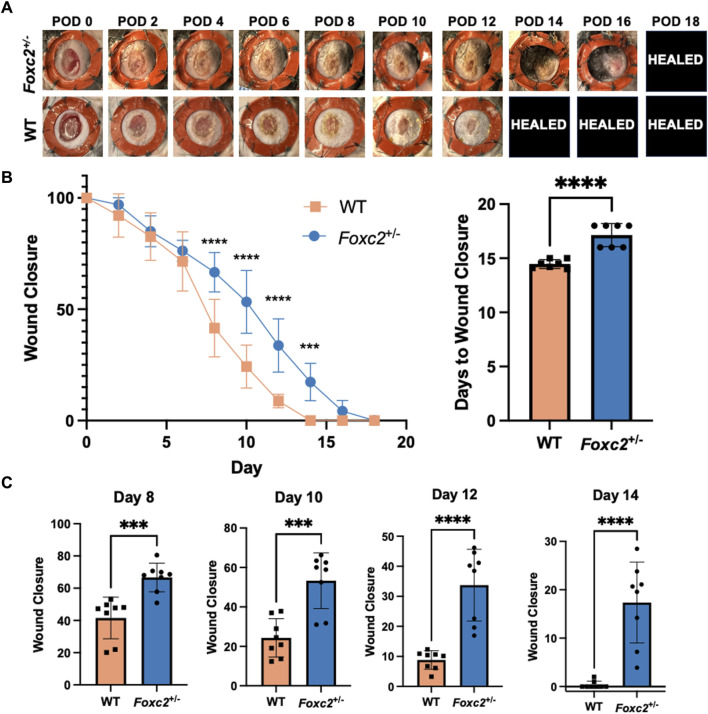
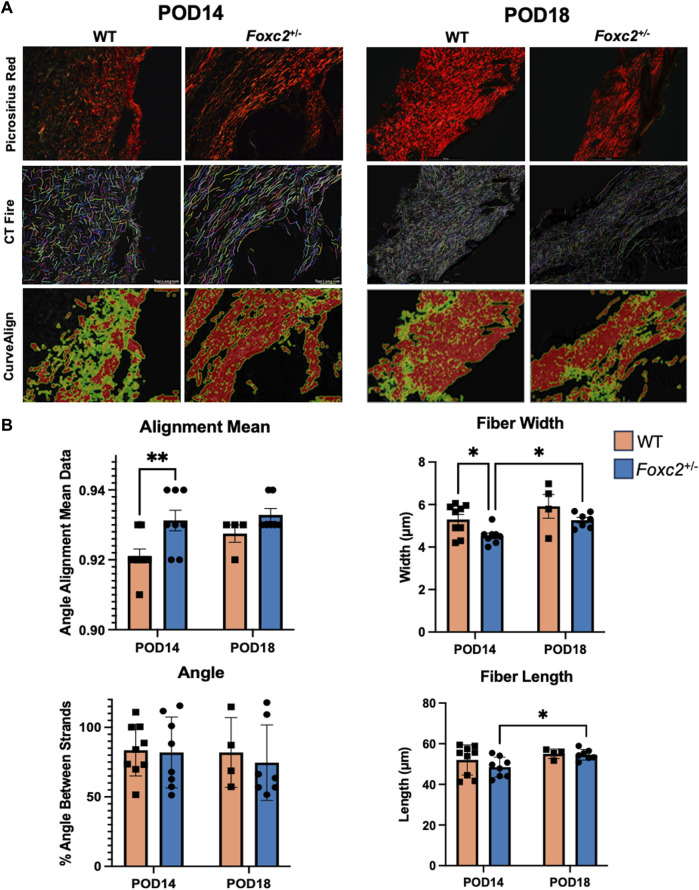
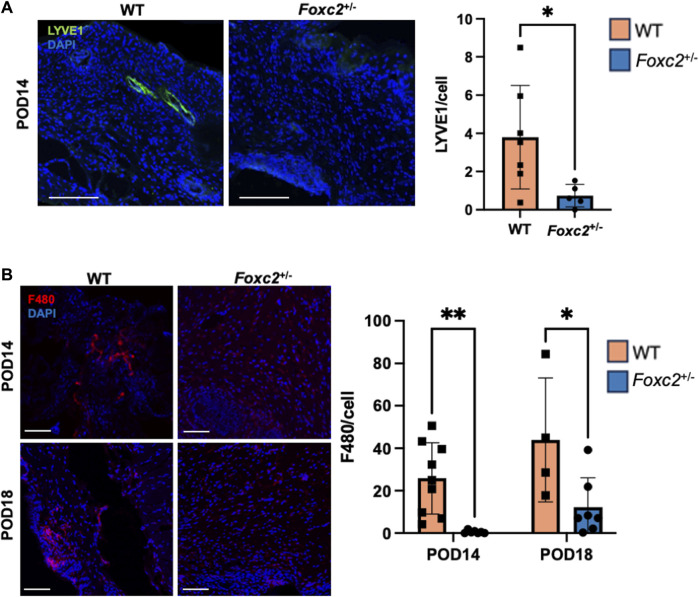
We used our splinted excisional wounding model that mimics human-like wound healing on wildtype and Foxc2 mice (n = 4), which demonstrate incomplete lymphatic vasculature and lymphatic dysfunction. Wound size was measured over the course of 18 days. Tissue was explanted from both groups at post-operative day (POD) 14 and 18 and stained with Masson's Trichrome to assess scar formation, Picrosirius Red for dermal integrity, or immunofluorescence to assess lymphatic (LYVE1) cell populations.
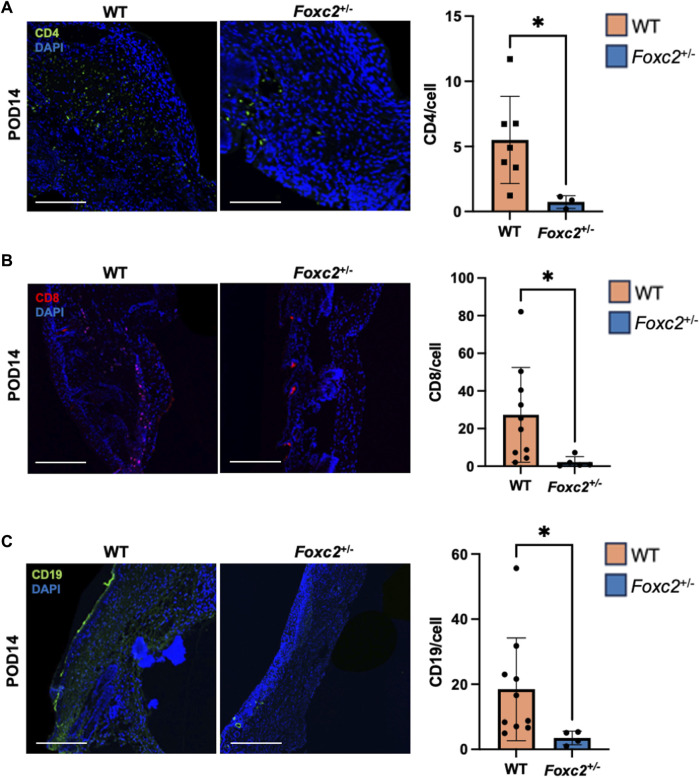
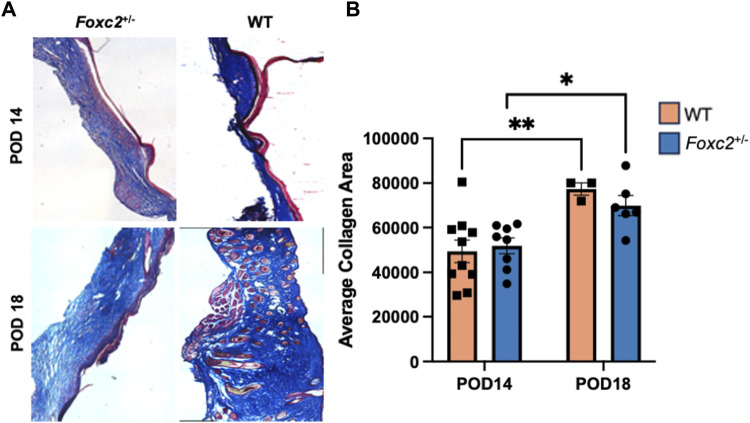
Wildtype mice completely healed by POD 14, while Foxc2mice did not completely heal until POD18. Scar area of healed Foxc2mice (POD 18) was larger than that of healed wild-type mice (POD 14; = 0.0294). At POD 14, collagen "bers in the scars of Foxc2mice to be narrower ( = 0.0117) and more highly aligned ( = 0.0110), indicating signi"cantly more "brosis in these mice. Collagen "bers in both groups became longer ( = 0.0116) and wider ( = 0.0020) from POD 14 to 18, indicating a temporal evolution of "brosis. Foxc2mice also had lower numbers of LYVE1+, F4/80+ and CD4+ cells compared to wildtype mice.
Individuals over 65 years old are more likely to develop cancer and are highly susceptible to developing chronic wounds. Here, we found that FOXC2, which is tied to cancer metastasis and lymphatic dysregulation, also impairs wound healing and promotes "brotic tissue architecture. With FOXC2 proposed as a potential therapeutic target for cancer metastasis, its downstream systemic effects should be considered against the increased chance of developing nonhealing wounds. Further delineation of the microenvironment, cellular events, and molecular signals during normal and Foxc2-associated abnormal wound healing will improve clinical therapies targeting this important marker.
FOXC2转录因子与多种疾病状态相关,是一种有前景的预后生物标志物,与侵袭性基底样人类乳腺癌(癌症侵袭和转移增加)有关。还发现FOXC2表达失调会促进淋巴重塑缺陷和增生性淋巴水肿-双行睫(LD)。由于慢性淋巴水肿是几种恶性肿瘤的先兆,并且已知癌症起源于愈合不良的慢性伤口(例如,马乔林溃疡),我们研究了Foxc2功能障碍对皮肤伤口愈合的影响。
我们使用了夹板切除伤口模型,该模型在野生型和Foxc2小鼠(n = 4)上模拟人类样伤口愈合,这些小鼠表现出不完全的淋巴管系统和淋巴功能障碍。在18天的过程中测量伤口大小。在术后第14天和第18天从两组中取出组织,用Masson三色染色法评估瘢痕形成,用苦味酸天狼星红染色法评估真皮完整性,或用免疫荧光法评估淋巴管(LYVE1)细胞群。
野生型小鼠在术后第14天完全愈合,而Foxc2小鼠直到术后第18天才完全愈合。愈合的Foxc2小鼠(术后第18天)的瘢痕面积大于愈合的野生型小鼠(术后第14天;P = 0.0294)。在术后第14天,Foxc2小鼠瘢痕中的胶原纤维更窄(P = 0.0117)且排列更紧密(P = 0.0110),表明这些小鼠的纤维化程度明显更高。从术后第14天到第18天,两组中的胶原纤维都变得更长(P = 0.0116)且更宽(P = 0.0020),表明纤维化的时间演变。与野生型小鼠相比,Foxc2小鼠的LYVE1+、F4/80+和CD4+细胞数量也更低。
65岁以上的个体更有可能患癌症,并且极易发生慢性伤口。在这里,我们发现与癌症转移和淋巴调节异常相关的FOXC2也会损害伤口愈合并促进纤维化组织结构。由于FOXC2被提议作为癌症转移的潜在治疗靶点,应考虑其下游的全身效应,以应对发生不愈合伤口的可能性增加。进一步描绘正常和与Foxc2相关的异常伤口愈合过程中的微环境、细胞事件和分子信号,将改善针对这一重要标志物的临床治疗。