Douglas Aaron, Stevens Brenneth, Rendas Miguel, Kane Harry, Lynch Evan, Kunkemoeller Britta, Wessendorf-Rodriguez Karl, Day Emily A, Sutton Caroline, Brennan Martin, O'Brien Katie, Kohlgruber Ayano C, Prendeville Hannah, Garza Amanda E, O'Neill Luke A J, Mills Kingston H G, Metallo Christian M, Veiga-Fernandes Henrique, Lynch Lydia
School of Biochemistry and Immunology, Trinity Biomedical Science Institute, Trinity College Dublin, Dublin, Ireland.
Champalimaud Research, Champalimaud Centre for the Unknown, Lisbon, Portugal.
Nature. 2024 Dec;636(8041):206-214. doi: 10.1038/s41586-024-08131-3. Epub 2024 Oct 30.
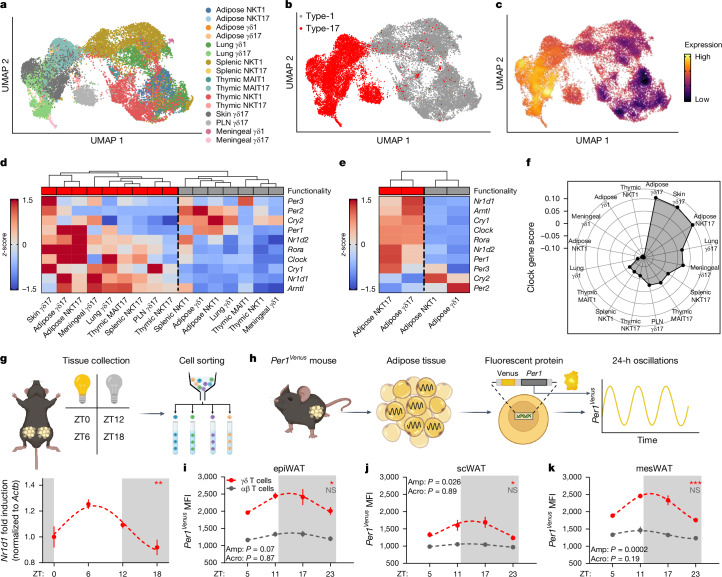
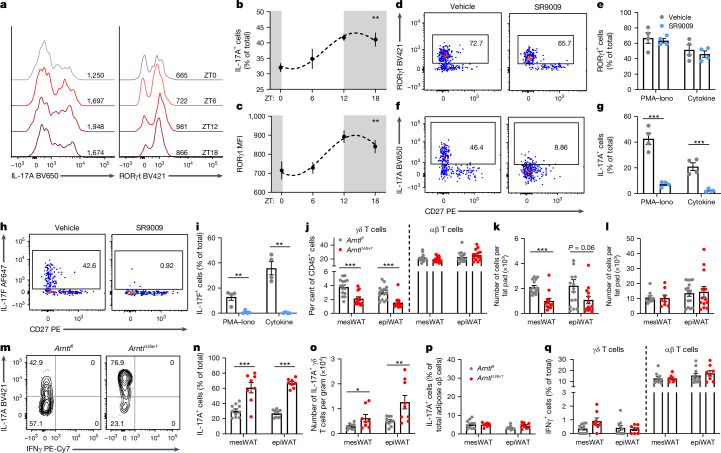
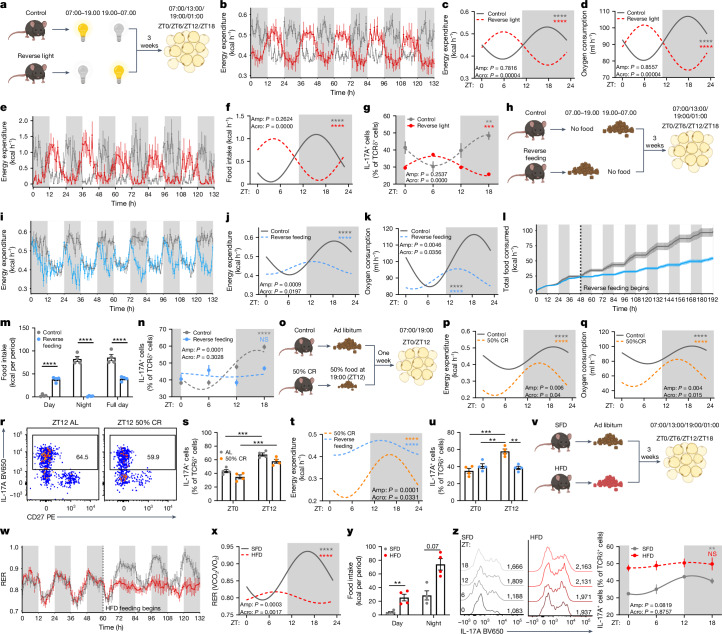
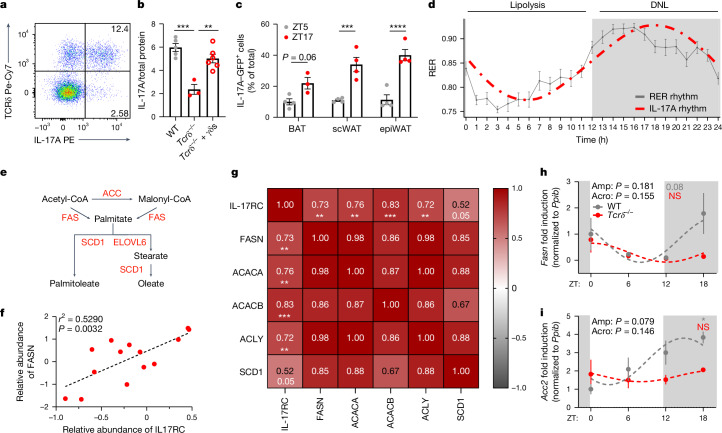
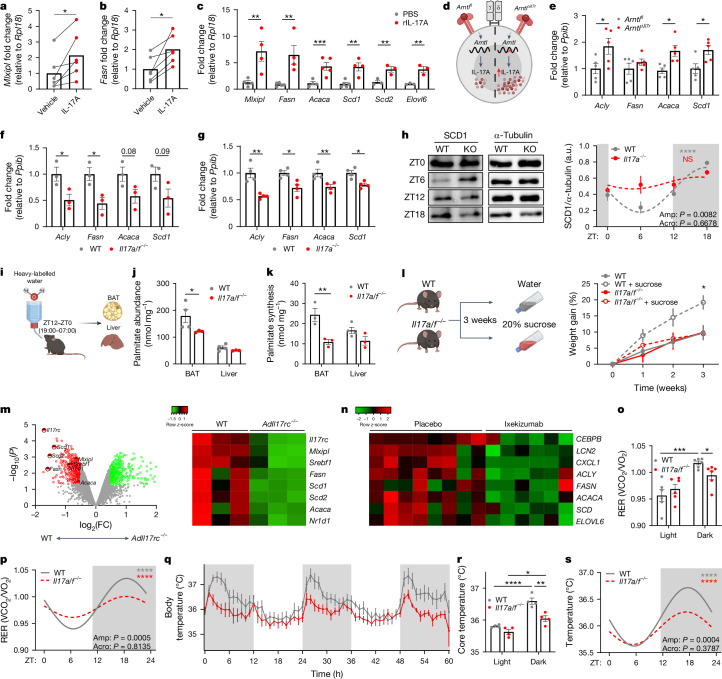
The circadian rhythm of the immune system helps to protect against pathogens; however, the role of circadian rhythms in immune homeostasis is less well understood. Innate T cells are tissue-resident lymphocytes with key roles in tissue homeostasis. Here we use single-cell RNA sequencing, a molecular-clock reporter and genetic manipulations to show that innate IL-17-producing T cells-including γδ T cells, invariant natural killer T cells and mucosal-associated invariant T cells-are enriched for molecular-clock genes compared with their IFNγ-producing counterparts. We reveal that IL-17-producing γδ (γδ17) T cells, in particular, rely on the molecular clock to maintain adipose tissue homeostasis, and exhibit a robust circadian rhythm for RORγt and IL-17A across adipose depots, which peaks at night. In mice, loss of the molecular clock in the CD45 compartment (Bmal1) affects the production of IL-17 by adipose γδ17 T cells, but not cytokine production by αβ or IFNγ-producing γδ (γδ) T cells. Circadian IL-17 is essential for de novo lipogenesis in adipose tissue, and mice with an adipocyte-specific deficiency in IL-17 receptor C (IL-17RC) have defects in de novo lipogenesis. Whole-body metabolic analysis in vivo shows that Il17aIl17f mice (which lack expression of IL-17A and IL-17F) have defects in their circadian rhythm for de novo lipogenesis, which results in disruptions to their whole-body metabolic rhythm and core-body-temperature rhythm. This study identifies a crucial role for IL-17 in whole-body metabolic homeostasis and shows that de novo lipogenesis is a major target of IL-17.
免疫系统的昼夜节律有助于抵御病原体;然而,昼夜节律在免疫稳态中的作用尚不太清楚。固有T细胞是组织驻留淋巴细胞,在组织稳态中起关键作用。在这里,我们使用单细胞RNA测序、分子钟报告基因和基因操作来表明,与产生IFNγ的同类细胞相比,产生白细胞介素17的固有T细胞(包括γδT细胞、不变自然杀伤T细胞和黏膜相关不变T细胞)富含分子钟基因。我们发现,特别是产生白细胞介素17的γδ(γδ17)T细胞依赖分子钟来维持脂肪组织稳态,并且在各个脂肪库中,RORγt和白细胞介素17A呈现出强烈的昼夜节律,在夜间达到峰值。在小鼠中,CD45区室(Bmal1)中分子钟的缺失会影响脂肪γδ17 T细胞产生白细胞介素17,但不影响αβ或产生IFNγ的γδ(γδ)T细胞产生细胞因子。昼夜节律性白细胞介素17对脂肪组织中的从头脂肪生成至关重要,并且白细胞介素17受体C(IL-17RC)脂肪细胞特异性缺陷的小鼠在从头脂肪生成方面存在缺陷。体内全身代谢分析表明,Il17aIl17f小鼠(缺乏白细胞介素17A和白细胞介素17F的表达)在从头脂肪生成的昼夜节律方面存在缺陷,这导致其全身代谢节律和核心体温节律受到破坏。这项研究确定了白细胞介素17在全身代谢稳态中的关键作用,并表明从头脂肪生成是白细胞介素17的主要靶点。