Aquib Md, Yang Wenting, Yu Luofeng, Kannaujiya Vinod Kumar, Zhang Yuhao, Li Peng, Whittaker Andrew, Fu Changkui, Boyer Cyrille
Cluster for Advanced Macromolecular Design (CAMD) and Australian Centre for NanoMedicine (ACN), School of Chemical Engineering UNSW Australia Sydney NSW 2052 Australia.
Australian Institute for Bioengineering and Nanotechnology, The University of Queensland St Lucia Queensland 4072 Australia.
Chem Sci. 2024 Oct 24;15(45):19057-69. doi: 10.1039/d4sc05797j.
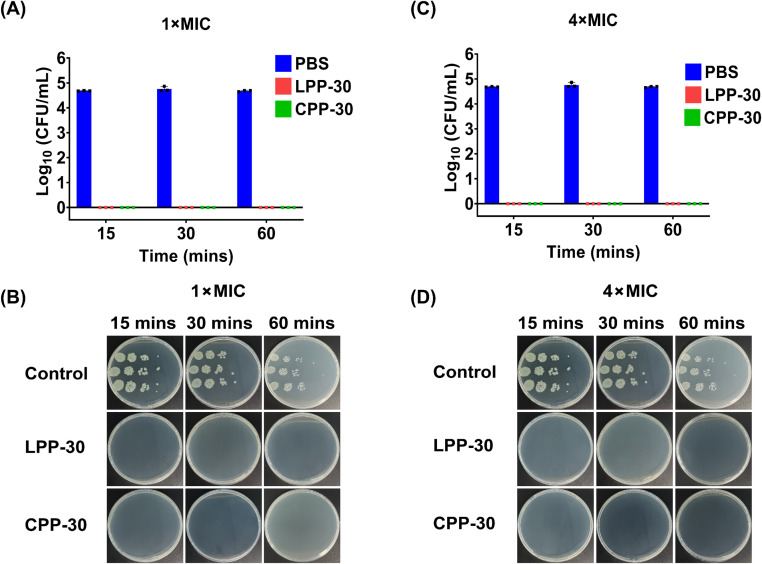
Host-defense peptides (HDPs) and their analogs hold significant potential for combating multidrug-resistant (MDR) bacterial infections. However, their clinical use has been hindered by susceptibility to proteases, high production costs, and cytotoxicity towards mammalian cells. Synthetic polymers with diverse topologies and compositions, designed to mimic HDPs, show promise for treating bacterial infections. In this study, we explored the antibacterial activity and biocompatibility of synthetic amphiphilic linear (LPs) and cyclic terpolymers (CPs) containing hydrophobic groups 2-ethylhexyl (E) and 2-phenylethyl (P) at 20% and 30% content. LPs were synthesized RAFT polymerization and then cyclized into CPs through a hetero-Diels-Alder click reaction. The bioactivity of these terpolymers was correlated with their topology (LPs CPs) and hydrophobic composition. LPs demonstrated superior antibacterial efficacy compared to CPs against four Gram-negative bacterial strains, with terpolymers containing (P) outperforming those with (E). Increasing the hydrophobicity from 20% to 30% in the terpolymers increased toxicity to both bacterial and mammalian cells. Notably, our terpolymers inhibited the MDR Gram-negative bacterial strain PA37 more effectively than gentamicin and ciprofloxacin. Furthermore, our terpolymers were able to disrupt cell membranes and rapidly eliminate Gram-negative bacteria (99.99% within 15 minutes). Interestingly, CPs exhibited higher hemocompatibility and biocompatibility with mammalian macrophage cells compared to LPs, showcasing a better safety profile (CPs > LPs). These findings underscore the importance of tailoring polymer architectures and optimizing the hydrophilic/hydrophobic balance to address challenges related to toxicity and selectivity in developing antimicrobial polymers.
宿主防御肽(HDPs)及其类似物在对抗多重耐药(MDR)细菌感染方面具有巨大潜力。然而,它们的临床应用受到蛋白酶敏感性、高生产成本以及对哺乳动物细胞的细胞毒性的阻碍。设计用于模拟HDPs的具有不同拓扑结构和组成的合成聚合物,在治疗细菌感染方面显示出前景。在本研究中,我们探索了含有20%和30%含量的疏水基团2-乙基己基(E)和2-苯乙基(P)的合成两亲性线性聚合物(LPs)和环状三元共聚物(CPs)的抗菌活性和生物相容性。LPs通过可逆加成-断裂链转移(RAFT)聚合合成,然后通过杂环狄尔斯-阿尔德点击反应环化形成CPs。这些三元共聚物的生物活性与其拓扑结构(LPs与CPs)和疏水组成相关。与CPs相比,LPs对四种革兰氏阴性菌菌株表现出优异的抗菌效果,含(P)的三元共聚物优于含(E)的。三元共聚物中疏水性从20%增加到30%会增加对细菌和哺乳动物细胞的毒性。值得注意的是,我们的三元共聚物比庆大霉素和环丙沙星更有效地抑制多重耐药革兰氏阴性菌菌株PA37。此外,我们的三元共聚物能够破坏细胞膜并迅速清除革兰氏阴性菌(15分钟内清除99.99%)。有趣的是,与LPs相比,CPs与哺乳动物巨噬细胞表现出更高的血液相容性和生物相容性,展示出更好的安全性(CPs > LPs)。这些发现强调了定制聚合物结构和优化亲水/疏水平衡以应对开发抗菌聚合物中与毒性和选择性相关挑战的重要性。