Department of Cardiology, Institute of Cardiovascular Research, The Second Affiliated Hospital of Army Medical University, Chongqing, China.
FEops NV, Ghent, Belgium.
BMC Cardiovasc Disord. 2024 Oct 31;24(1):607. doi: 10.1186/s12872-024-04302-2.
Despite the frequency of persistent new-onset conduction disturbances after transcatheter aortic valve replacement (TAVR), few preoperative methods of prediction exist.
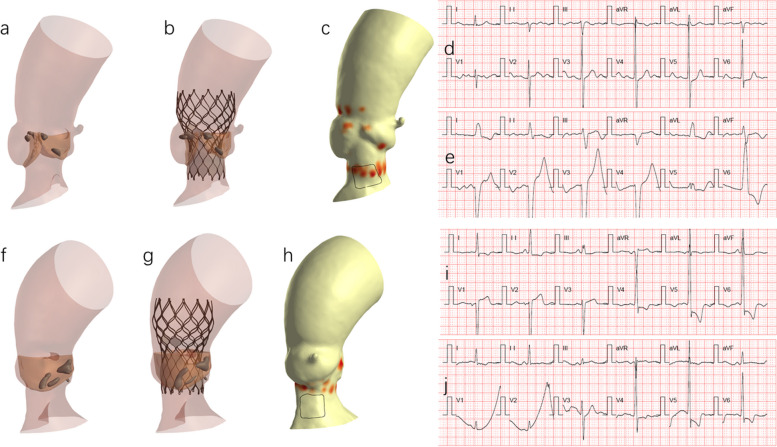
Patients who underwent TAVR in the Department of Cardiology of the Second Affiliated Hospital of the Army Medical University from December 2020 to September 2021 and postoperative aortic root modeling via the FEOPS finite element analysis were included in this single-center case-control study, divided into persistent conduction disturbances (PCD) and non-PCD groups according to their pre- and postoperative electrocardiograms in the first month. Risk factors affecting PCD were identified by comparing the baseline data of these two groups, including echocardiograms, computed tomography angiography of the aortic root, surgical decision-making, and FEOPS data. Independent risk factors were screened using logistic regression modeling, and the receiver operating characteristic (ROC) curve was used to test the predictive ability.
A total of 56 patients were included in this study, 37 with bicuspid aortic valve (BAV) and 19 with trileaflet aortic valve (TAV), with 17 cases of PCD. The contact pressure index (CPI) of FEOPS, valve oversize ratio, differences between membranous interventricular septum length and implantation depth (ΔMSID) and valve implantation depth were statistically different (P < 0.05). CPI could be used as an independent risk factor for PCD (P < 0.05), and the ROC curve comparison showed that the CPI was more predictive (AUC = 0.806, 95% CI: 0.684-0.928, P = 0.001).
The CPI of FEOPS has better predictive value for new-onset conduction disturbance after TAVR compared to other known predictors.
尽管经导管主动脉瓣置换术(TAVR)后持续性新发传导障碍的频率较高,但术前预测方法很少。
本单中心病例对照研究纳入 2020 年 12 月至 2021 年 9 月在陆军军医大学第二附属医院心内科接受 TAVR 并通过 FEOPS 有限元分析进行术后主动脉根部建模的患者,根据术后第一个月的术前和术后心电图将其分为持续性传导障碍(PCD)和非 PCD 组。通过比较两组的基线数据,包括超声心动图、主动脉根部计算机断层血管造影、手术决策和 FEOPS 数据,确定影响 PCD 的危险因素。使用逻辑回归建模筛选独立危险因素,并使用受试者工作特征(ROC)曲线测试预测能力。
本研究共纳入 56 例患者,其中 37 例为二叶式主动脉瓣(BAV),19 例为三叶式主动脉瓣(TAV),17 例为 PCD。FEOPS 的接触压力指数(CPI)、瓣环超扩张比、室间隔膜长度与植入深度差(ΔMSID)和植入深度的差异均有统计学意义(P<0.05)。CPI 可作为 PCD 的独立危险因素(P<0.05),ROC 曲线比较表明 CPI 更具预测性(AUC=0.806,95%CI:0.684-0.928,P=0.001)。
与其他已知预测因素相比,FEOPS 的 CPI 对 TAVR 后新发传导障碍具有更好的预测价值。