Department of Clinical Laboratories, NHO Osaka Toneyama Medical Center, 5-1-1 Toneyama, Toyonaka, Osaka, 560-8552, Japan.
Department of Respiratory Medicine, NHO Osaka Toneyama Medical Center, 5-1-1 Toneyama, Toyonaka, Osaka, 560-8552, Japan.
BMC Pulm Med. 2024 Oct 31;24(1):550. doi: 10.1186/s12890-024-03312-2.
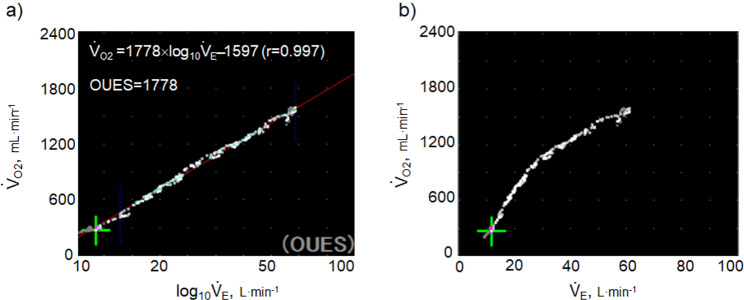
In patients with chronic obstructive pulmonary disease (COPD), the clinical use of the minute ventilation-carbon dioxide production ([Formula: see text]-[Formula: see text]) slope has been reported as a measure of exercise efficiency, but the oxygen uptake efficiency slope (OUES), i.e., the slope of oxygen uptake ([Formula: see text]) versus the logarithmically transformed [Formula: see text], has rarely been reported.
We hypothesized that the [Formula: see text]-[Formula: see text] slope is more useful than OUES in clinical use for the pathophysiological evaluation of COPD. Then, we investigated the cardiopulmonary exercise testing parameters affecting each of these slopes in 122 patients with all Global Initiative for Chronic Obstructive Lung Disease (GOLD) COPD grades selected from our database.
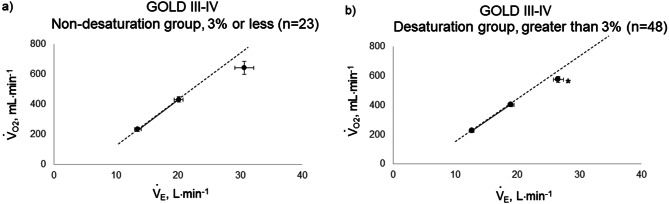
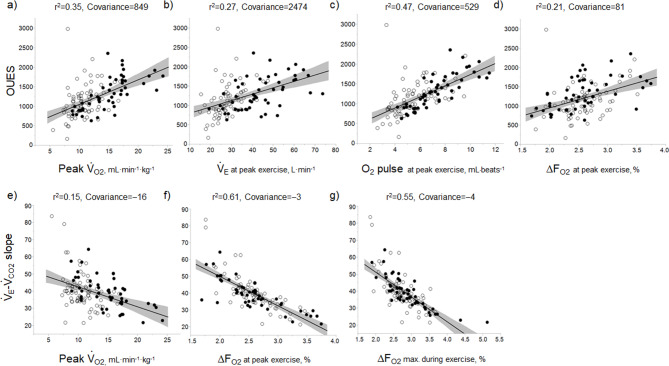
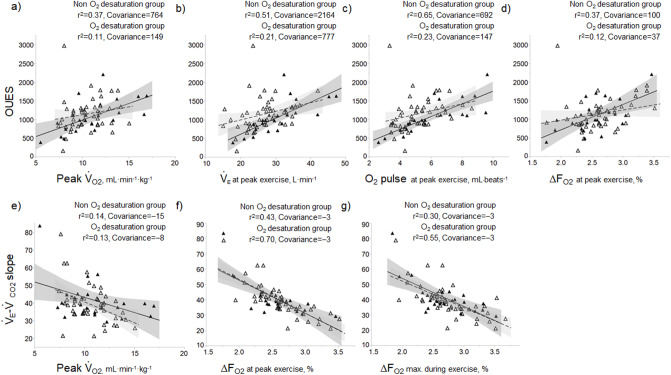
Compared with the GOLD I-II group (n = 51), peak [Formula: see text] (p < 0.0001), OUES (p = 0.0161), [Formula: see text] at peak exercise (p < 0.0001), and percutaneous oxygen saturation (SpO) at peak exercise (p = 0.0004) were significantly lower in the GOLD III-IV group (n = 71). The GOLD III-IV group was divided into two groups by the exertional decrease in SpO from rest to peak exercise: 3% or less (the non-desaturation group: n = 23), or greater than 3% (the desaturation group: n = 48). OUES correlated only weakly with peak [Formula: see text], [Formula: see text] at peak exercise, and the difference between inspired and expired mean O concentrations (ΔF) at peak exercise, i.e., an indicator of oxygen consumption ability throughout the body, in the GOLD III-IV group with exertional hypoxemia. In contrast, the [Formula: see text]-[Formula: see text] slope was significantly correlated with ΔF at peak exercise, regardless of the COPD grade and exertional desaturation. Across all COPD stages, there was no correlation between the [Formula: see text]-[Formula: see text] slope and [Formula: see text] at peak exercise, and stepwise analysis identified peak [Formula: see text] (p = 0.0345) and ΔF (p < 0.0001) as variables with a greater effect on the [Formula: see text]-[Formula: see text] slope.
The OUES may be less useful in advanced COPD with exertional hypoxemia. The [Formula: see text]-[Formula: see text] slope, which is independent of [Formula: see text], focuses on oxygen consumption ability and exercise tolerance in COPD, regardless of the exertional hypoxemia level and COPD grade. Therefore, the [Formula: see text]-[Formula: see text] slope might be useful in establishing or evaluating tailor-made therapies for individual patient's pathologies in COPD as an indicator focusing on oxygen consumption ability.
在慢性阻塞性肺疾病(COPD)患者中,分钟通气量-二氧化碳产量([Formula: see text]-[Formula: see text])斜率已被报道为运动效率的衡量标准,但很少有研究报道摄氧量效率斜率(OUES),即摄氧量([Formula: see text])与对数变换后的[Formula: see text]的斜率。
我们假设[Formula: see text]-[Formula: see text]斜率在 COPD 的病理生理学评估方面比 OUES 在临床应用中更有用。然后,我们在从数据库中选择的所有 GOLD COPD 分级的 122 例患者中研究了影响这些斜率的心肺运动测试参数。
与 GOLD I-II 组(n = 51)相比,GOLD III-IV 组(n = 71)的峰值[Formula: see text](p < 0.0001)、OUES(p = 0.0161)、峰值运动时的[Formula: see text](p < 0.0001)和峰值运动时的经皮血氧饱和度(SpO)(p = 0.0004)显著降低。GOLD III-IV 组根据运动时 SpO 从休息到峰值的下降程度分为两组:下降 3%或以下(非低氧血症组:n = 23)或下降大于 3%(低氧血症组:n = 48)。OUES 仅与 GOLD III-IV 组运动性低氧血症患者的峰值[Formula: see text]、峰值运动时的[Formula: see text]和峰值运动时的吸气和呼气平均 O 浓度差(ΔF)相关,即全身摄氧量的指标。相比之下,[Formula: see text]-[Formula: see text]斜率与峰值运动时的ΔF显著相关,无论 COPD 分级和运动性低氧血症如何。在所有 COPD 阶段,[Formula: see text]-[Formula: see text]斜率与峰值运动时的[Formula: see text]均无相关性,逐步分析确定峰值[Formula: see text](p = 0.0345)和ΔF(p < 0.0001)为影响[Formula: see text]-[Formula: see text]斜率的更大变量。
在有运动性低氧血症的晚期 COPD 中,OUES 的作用可能较小。[Formula: see text]-[Formula: see text]斜率不依赖于[Formula: see text],专注于 COPD 患者的摄氧量能力和运动耐量,无论运动性低氧血症水平和 COPD 分级如何。因此,[Formula: see text]-[Formula: see text]斜率可能是 COPD 患者针对个体病理情况制定或评估个体化治疗的有用指标,因为它专注于摄氧量能力。