Department of Pathology and Laboratory Medicine, University of Kansas Medical Center, Kansas City, Kansas 66160, United States.
Department of Cancer Biology, University of Kansas Medical Center, Kansas City, Kansas 66160, United States.
ACS Appl Bio Mater. 2024 Nov 18;7(11):7770-7783. doi: 10.1021/acsabm.4c01500. Epub 2024 Oct 31.
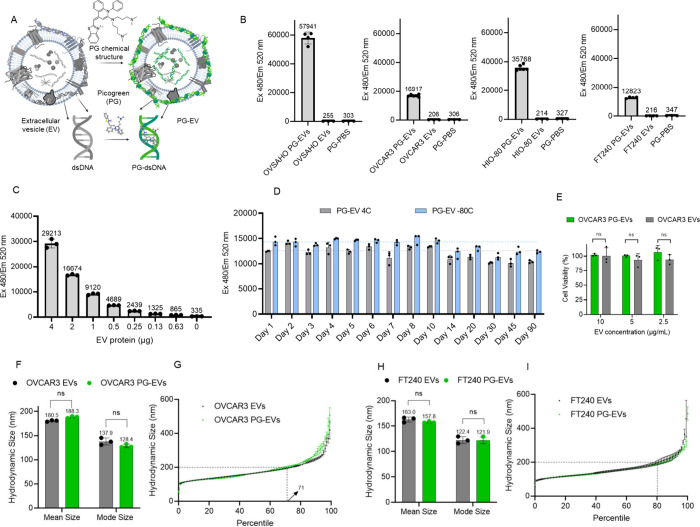
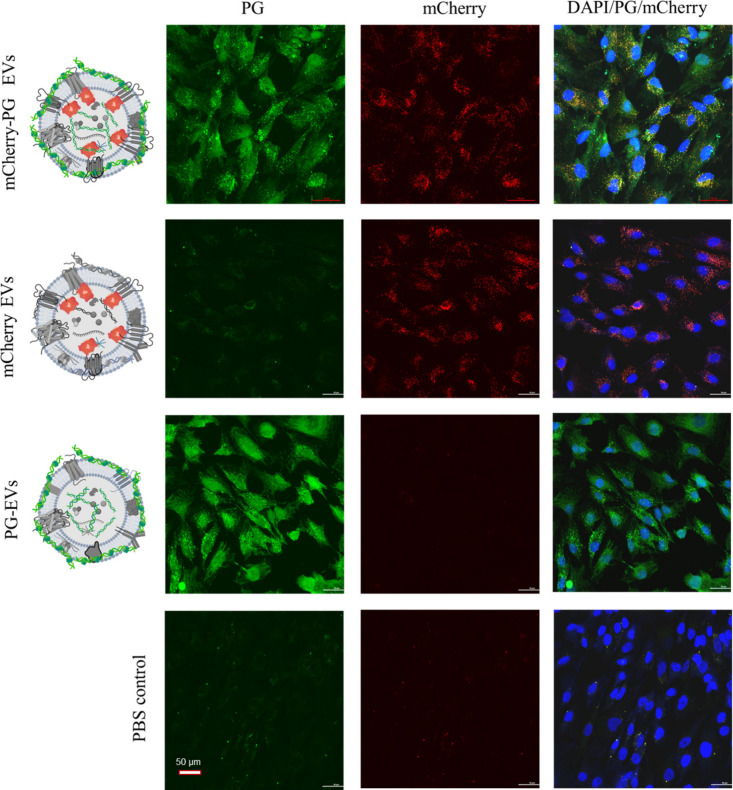
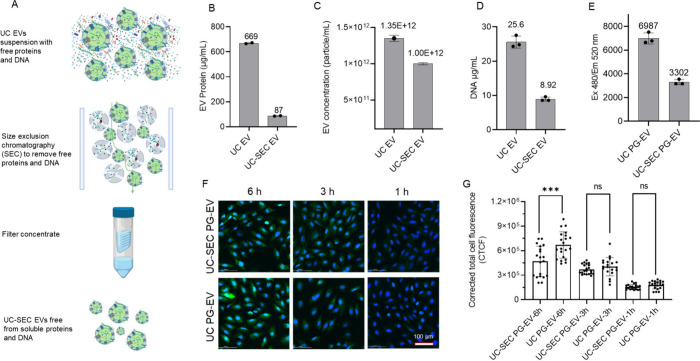
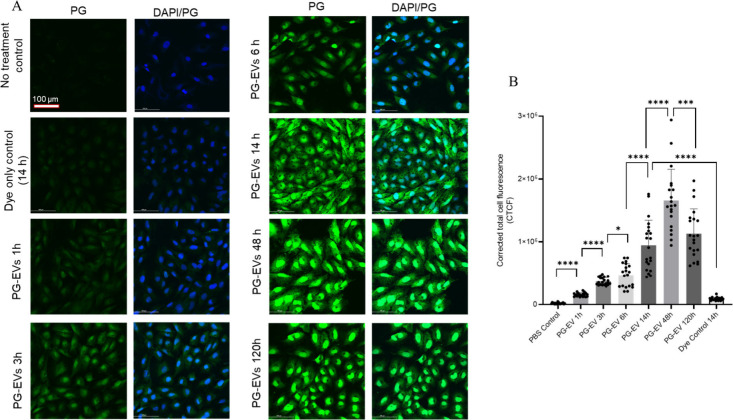
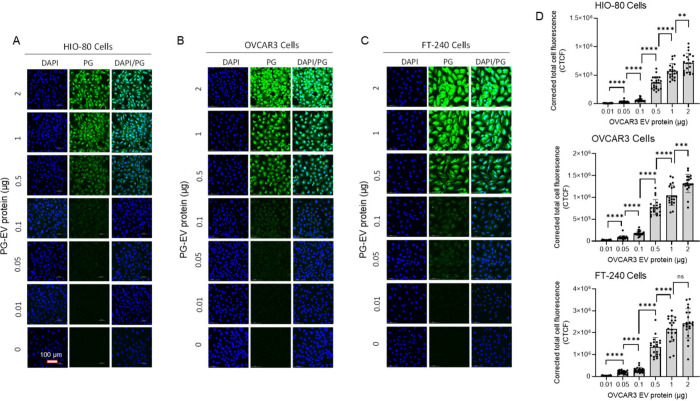
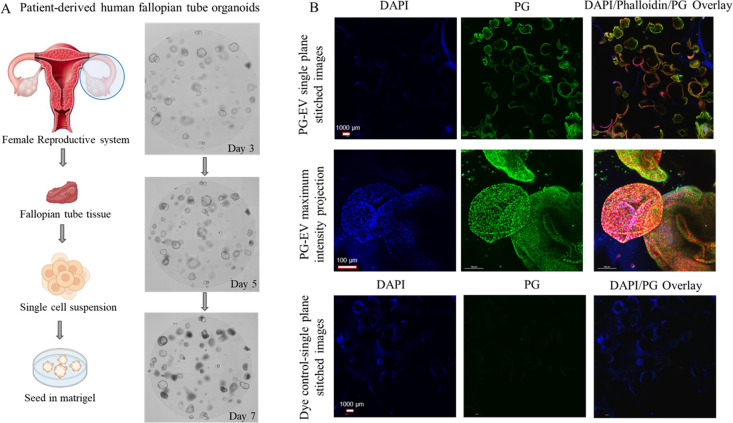
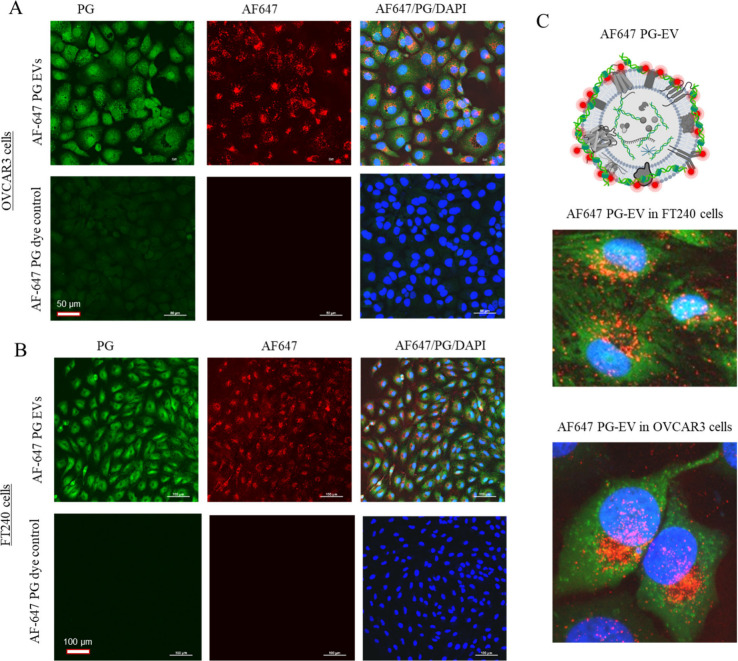
Extracellular vesicles (EVs) are cell-secreted lipid bilayer delimited particles that mediate cellular communication. These tiny sacs of cellular information play an important role in cell communication and alter the physiological process under both normal and pathological conditions. As such, tracking EVs can provide valuable information regarding the basic understanding of cell communication, the onset of early malignancy, and biomarker discovery. Most of the current EV-tracking strategies are invasive, altering the natural characteristics of EVs by modifying the lipid bilayer with lipophilic dyes or surface proteins with fluorescent reporters. The invasive labeling strategies could alter the natural processes of EVs and thereby have major limitations for functional studies. Here, we report an alternative minimally invasive EV labeling strategy using PicoGreen (PG), a small molecule that fluoresces at 520 nm when bound to dsDNA. We show that PG binds to dsDNA associated with small EVs (50-200 nm), forming a stable and highly fluorescent PG-DNA complex in EVs (PG-EVs). In both 2D cell culture and 3D organoid models, PG-EV showed efficient tracking properties, including a high signal-to-noise ratio, time- and concentration-dependent uptake, and the ability to traverse a 3D environment. We further validated PG-EV tracking using dual-labeled EVs following two orthogonal labeling strategies: (1) Bioconjugation via surface amine labeling and (2) donor cell engineering via endogenously expressing mCherry-tetraspanin (CD9/CD63/CD81) reporter proteins. Our study has shown the feasibility of using PG-EV as an effective EV tracking strategy that can be applied for studying the functional role of EVs across multiple model systems.
细胞外囊泡 (EVs) 是由细胞分泌的双层脂质膜限定的颗粒,介导细胞间通讯。这些微小的细胞信息囊泡在正常和病理条件下的细胞通讯和改变生理过程中发挥着重要作用。因此,跟踪 EVs 可以提供有关细胞通讯基本理解、早期恶性肿瘤发生和生物标志物发现的有价值信息。目前大多数 EV 追踪策略都是侵入性的,通过用亲脂性染料或荧光报告蛋白修饰脂质双层来改变 EV 的天然特征,从而对 EV 进行标记。这种侵入性的标记策略可能会改变 EV 的自然过程,因此对功能研究有很大的局限性。在这里,我们报告了一种使用 PicoGreen(PG)的替代微创 EV 标记策略,PG 是一种小分子,当与双链 DNA(dsDNA)结合时会在 520nm 处发出荧光。我们表明,PG 与与小 EV(50-200nm)相关的 dsDNA 结合,在 EV 中形成稳定且高度荧光的 PG-DNA 复合物(PG-EVs)。在 2D 细胞培养和 3D 类器官模型中,PG-EV 均表现出高效的追踪特性,包括高信噪比、时间和浓度依赖性摄取以及穿越 3D 环境的能力。我们进一步通过两种正交标记策略(1)通过表面胺标记进行生物共轭和(2)通过内源性表达 mCherry-四跨膜蛋白(CD9/CD63/CD81)报告蛋白进行供体细胞工程来验证 PG-EV 追踪。我们的研究表明,使用 PG-EV 作为一种有效的 EV 追踪策略是可行的,可以应用于在多个模型系统中研究 EV 的功能作用。