Haouchine Nazim, Hackney David B, Pieper Steve D, Wells William M, Sanhinova Malika, Balboni Tracy A, Spektor Alexander, Huynh Mai A, Kozono David E, Doyle Patrick, Alkalay Ron N
Brigham & Women's Hospital, Boston, MA.
Harvard Medical School, Boston, MA.
medRxiv. 2024 Nov 12:2024.10.14.24314447. doi: 10.1101/2024.10.14.24314447.
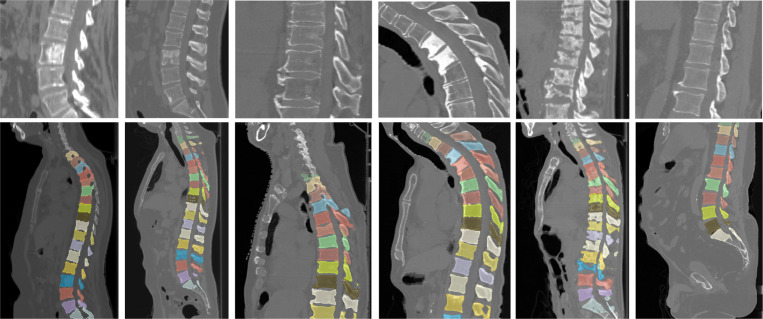
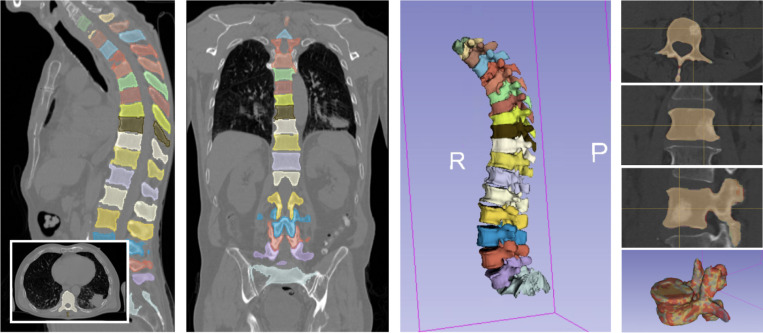
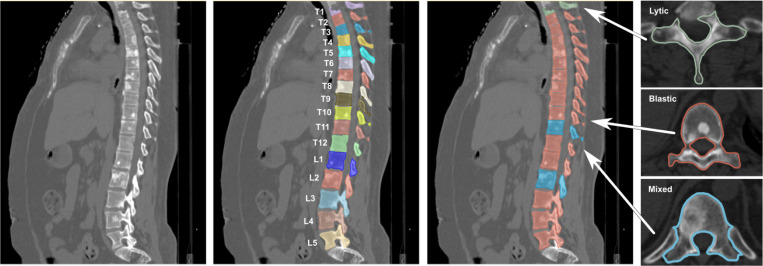
Automatic analysis of pathologic vertebrae from computed tomography (CT) scans could significantly improve the diagnostic management of patients with metastatic spine disease. We provide the first publicly available annotated imaging dataset of cancerous CT spines to help develop artificial intelligence frameworks for automatic vertebrae segmentation and classification. This collection contains a dataset of 55 CT scans collected on patients with various types of primary cancers at two different institutions. In addition to raw images, data include manual segmentations and contours, vertebral level labeling, vertebral lesion-type classifications, and patient demographic details. Our automated segmentation model uses nnU-Net, a freely available open-source framework for deep learning in healthcare imaging, and is made publicly available. This data will facilitate the development and validation of models for predicting the mechanical response to loading and the resulting risk of fractures and spinal deformity.
通过计算机断层扫描(CT)对病理性椎体进行自动分析,可显著改善转移性脊柱疾病患者的诊断管理。我们提供了首个公开可用的带注释的癌性CT脊柱影像数据集,以助力开发用于椎体自动分割和分类的人工智能框架。该数据集包含在两家不同机构收集的55例患有各种原发性癌症患者的CT扫描数据。除原始图像外,数据还包括手动分割和轮廓、椎体水平标记、椎体病变类型分类以及患者人口统计学细节。我们的自动分割模型使用nnU-Net(一种用于医疗影像深度学习的免费开源框架),并已公开提供。这些数据将有助于开发和验证用于预测负荷机械反应以及由此产生的骨折和脊柱畸形风险的模型。