Department of Blood and Marrow Transplant and Cellular Immunotherapy, H. Lee Moffitt Cancer Center & Research Institute, Tampa, Florida, USA.
Janssen Scientific Affairs, LLC, Horsham, Pennsylvania, USA.
Cancer Med. 2024 Nov;13(21):e70308. doi: 10.1002/cam4.70308.
Daratumumab, lenalidomide, and dexamethasone (DRd) and bortezomib, lenalidomide, and dexamethasone (VRd) are the only preferred treatment regimens for patients with transplant-ineligible (TIE) newly diagnosed multiple myeloma (NDMM). As there are no randomized head-to-head studies of DRd versus VRd, this analysis aimed to compare real-world time-to-next-treatment (TTNT) or death in this population.
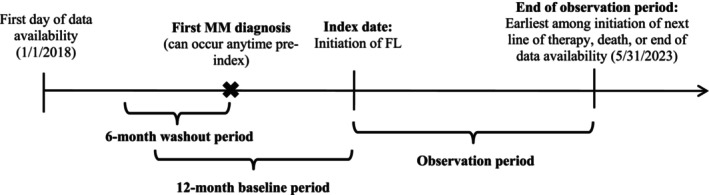
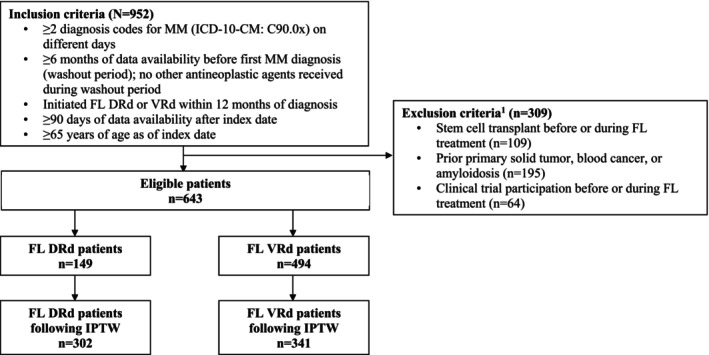
Patients with NDMM who received front-line (FL) DRd or VRd were identified from the Acentrus database (January 1, 2018 to May 31, 2023). Those with a record of a stem cell transplant or aged < 65 years were excluded to limit analysis to the TIE population. Inverse probability of treatment weighting was used to balance baseline patient characteristics. A doubly robust Cox proportional hazards model was used to compare TTNT or death between cohorts.
A total of 149 and 494 patients who initiated DRd and VRd, respectively, were identified. After weighting (weighted N = 302, weighted N = 341), cohorts had similar baseline characteristics. Of these, 98 (32.4%) DRd and 175 (51.2%) VRd patients either received a subsequent line of therapy or died, with a median TTNT or death of 37.8 months in the DRd cohort and 18.7 months in the VRd cohort (hazard ratio: 0.58, 95% confidence interval: 0.35, 0.81; p < 0.001).
Treatment of TIE NDMM patients with DRd led to a significantly longer TTNT or death compared to VRd, evidenced by a 42% risk reduction, supporting the effectiveness of DRd over VRd as FL treatment in this patient population.
达雷妥尤单抗、来那度胺和地塞米松(DRd)以及硼替佐米、来那度胺和地塞米松(VRd)是唯一适用于不适合移植(TIE)的新发多发性骨髓瘤(NDMM)患者的首选治疗方案。由于没有 DRd 与 VRd 的头对头随机对照研究,因此本分析旨在比较该人群中的真实世界下至下一次治疗(TTNT)或死亡时间。
从 Acentrus 数据库(2018 年 1 月 1 日至 2023 年 5 月 31 日)中确定接受一线(FL)DRd 或 VRd 治疗的 NDMM 患者。排除有干细胞移植记录或年龄<65 岁的患者,以将分析限定在 TIE 人群中。采用逆概率治疗加权法来平衡基线患者特征。采用双稳健 Cox 比例风险模型比较两组的 TTNT 或死亡情况。
分别确定了 149 例和 494 例开始接受 DRd 和 VRd 治疗的患者。经加权处理(加权 N=302,加权 N=341)后,两组的基线特征相似。其中,98 例(32.4%)DRd 组和 175 例(51.2%)VRd 组患者接受了后续治疗或死亡,DRd 组的中位 TTNT 或死亡时间为 37.8 个月,VRd 组为 18.7 个月(风险比:0.58,95%置信区间:0.35,0.81;p<0.001)。
与 VRd 相比,TIE NDMM 患者接受 DRd 治疗可显著延长 TTNT 或死亡时间,风险降低 42%,这支持 DRd 作为 FL 治疗在该患者人群中的有效性优于 VRd。