Kiliushik Daniil, Goenner Coleman, Law Matthew, Schroeder Griffin M, Srivastava Yoshita, Jenkins Jermaine L, Wedekind Joseph E
Department of Biochemistry and Biophysics, University of Rochester School of Medicine and Dentistry, Rochester, New York, USA; Center for RNA Biology, University of Rochester School of Medicine and Dentistry, Rochester, New York, USA.
Department of Biochemistry and Biophysics, University of Rochester School of Medicine and Dentistry, Rochester, New York, USA; Center for RNA Biology, University of Rochester School of Medicine and Dentistry, Rochester, New York, USA.
J Biol Chem. 2024 Dec;300(12):107951. doi: 10.1016/j.jbc.2024.107951. Epub 2024 Oct 30.
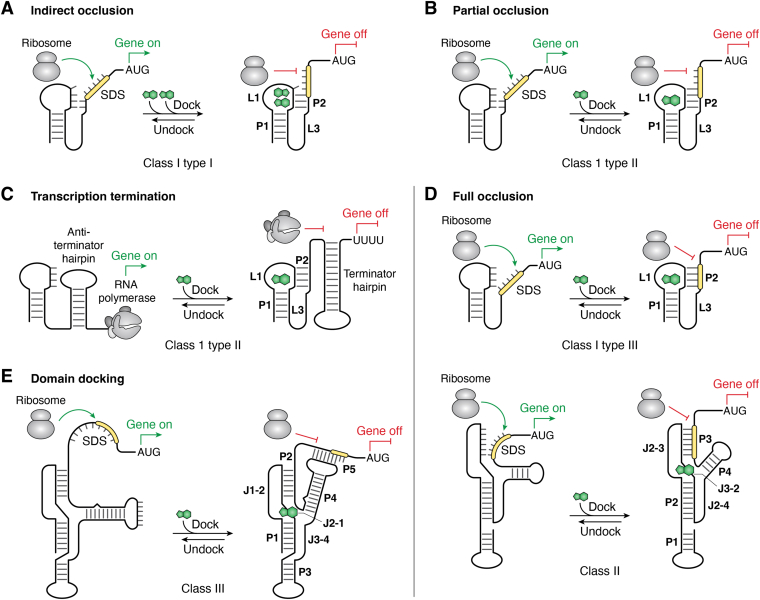
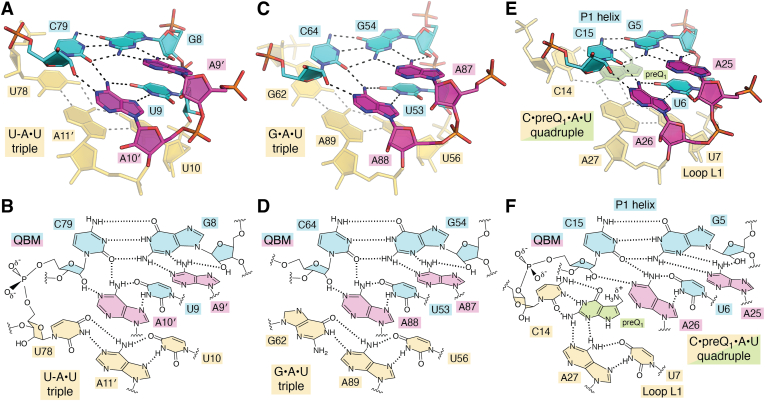
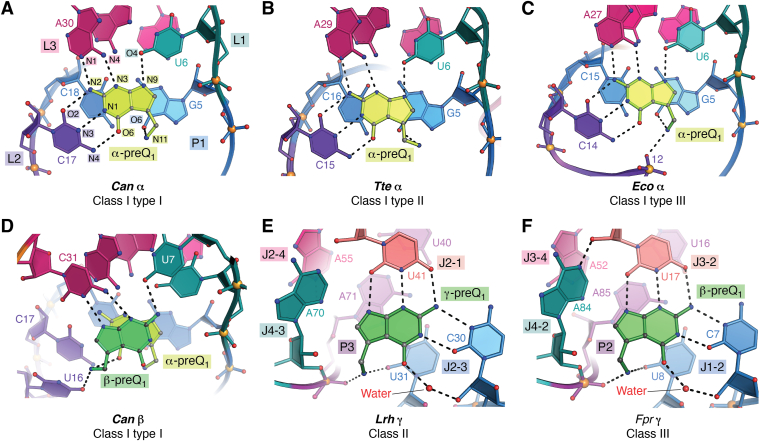
Riboswitches sense specific cellular metabolites, leading to messenger RNA conformational changes that regulate downstream genes. Here, we review the three known prequeosine (preQ) riboswitch classes, which encompass five gene-regulatory motifs derived from distinct consensus models of folded RNA pseudoknots. Structural and functional analyses reveal multiple gene-regulation strategies ranging from partial occlusion of the ribosome-binding Shine-Dalgarno sequence (SDS), SDS sequestration driven by kinetic or thermodynamic folding pathways, direct preQ recognition by the SDS, and complete SDS burial with in the riboswitch architecture. Family members can also induce elemental transcriptional pausing, which depends on ligand-mediated pseudoknot formation. Accordingly, preQ family members provide insight into a wide range of gene-regulatory tactics as well as a diverse repertoire of chemical approaches used to recognize the preQ metabolite. From a broader perspective, future challenges for the field will include the identification of new riboswitches in mRNAs that do not possess an SDS or those that induce ligand-dependent transcriptional pausing. When choosing an antibacterial target, the field must also consider how well a riboswitch accommodates mutations. Investigation of riboswitches in their natural context will also be critical to elucidate how RNA-mediated gene regulation influences organism fitness, thus providing a firm foundation for antibiotic development.
核糖开关可感知特定的细胞代谢物,导致信使核糖核酸(mRNA)构象发生变化,从而调节下游基因。在此,我们综述了三种已知的前鸟嘌呤(preQ)核糖开关类别,它们包含五个基因调控基序,这些基序源自折叠RNA假结的不同共有模型。结构和功能分析揭示了多种基因调控策略,范围从核糖体结合的Shine-Dalgarno序列(SDS)的部分封闭、由动力学或热力学折叠途径驱动的SDS隔离、SDS对preQ的直接识别,到核糖开关结构中SDS的完全掩埋。家族成员还可诱导基本转录暂停,这取决于配体介导的假结形成。因此,preQ家族成员为广泛的基因调控策略以及用于识别preQ代谢物的多种化学方法提供了见解。从更广泛的角度来看,该领域未来的挑战将包括在不具有SDS的mRNA中或那些诱导配体依赖性转录暂停的mRNA中鉴定新的核糖开关。在选择抗菌靶点时,该领域还必须考虑核糖开关对突变的耐受程度。在其自然环境中研究核糖开关对于阐明RNA介导的基因调控如何影响生物体适应性也至关重要,从而为抗生素开发提供坚实基础。