Conrad Alice Marguerite, Zimmermann Julia, Mohr David, Froelich Matthias F, Hertel Alexander, Rathmann Nils, Boesing Christoph, Thiel Manfred, Schoenberg Stefan O, Krebs Joerg, Luecke Thomas, Rocco Patricia R M, Otto Matthias
Department of Anesthesiology and Critical Care Medicine, Faculty of Medicine, University Hospital Mannheim, University of Heidelberg, Theodor-Kutzer Ufer 1-3, 68165, Mannheim, Germany.
Department of Clinical Radiology and Nuclear Medicine, Faculty of Medicine, University Hospital Mannheim, University of Heidelberg, Theodor-Kutzer Ufer 1-3, 68165, Mannheim, Germany.
Intensive Care Med Exp. 2024 Nov 2;12(1):95. doi: 10.1186/s40635-024-00685-w.
Quantification of pulmonary edema in patients with acute respiratory distress syndrome (ARDS) by chest computed tomography (CT) scan has not been validated in routine diagnostics due to its complexity and time-consuming nature. Therefore, the single-indicator transpulmonary thermodilution (TPTD) technique to measure extravascular lung water (EVLW) has been used in the clinical setting. Advances in artificial intelligence (AI) have now enabled CT images of inhomogeneous lungs to be segmented automatically by an intensive care physician with no prior radiology training within a relatively short time. Nevertheless, there is a paucity of data validating the quantification of pulmonary edema using automated lung segmentation on CT compared with TPTD.
A retrospective study (January 2016 to December 2021) analyzed patients with ARDS, admitted to the intensive care unit of the Department of Anesthesiology and Critical Care Medicine, University Hospital Mannheim, who underwent a chest CT scan and hemodynamic monitoring using TPTD at the same time. Pulmonary edema was estimated using manually and automated lung segmentation on CT and then compared to the pulmonary edema calculated from EVLW determined using TPTD.
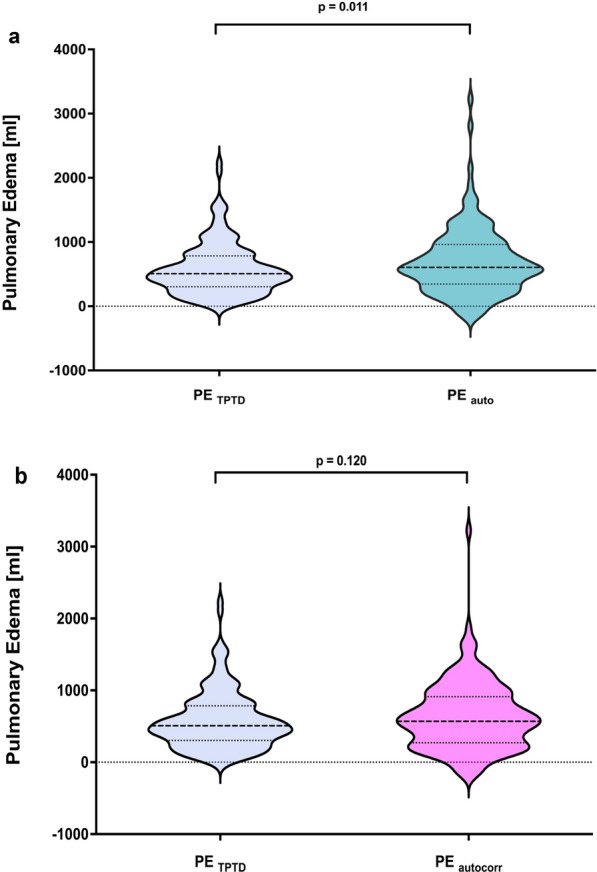
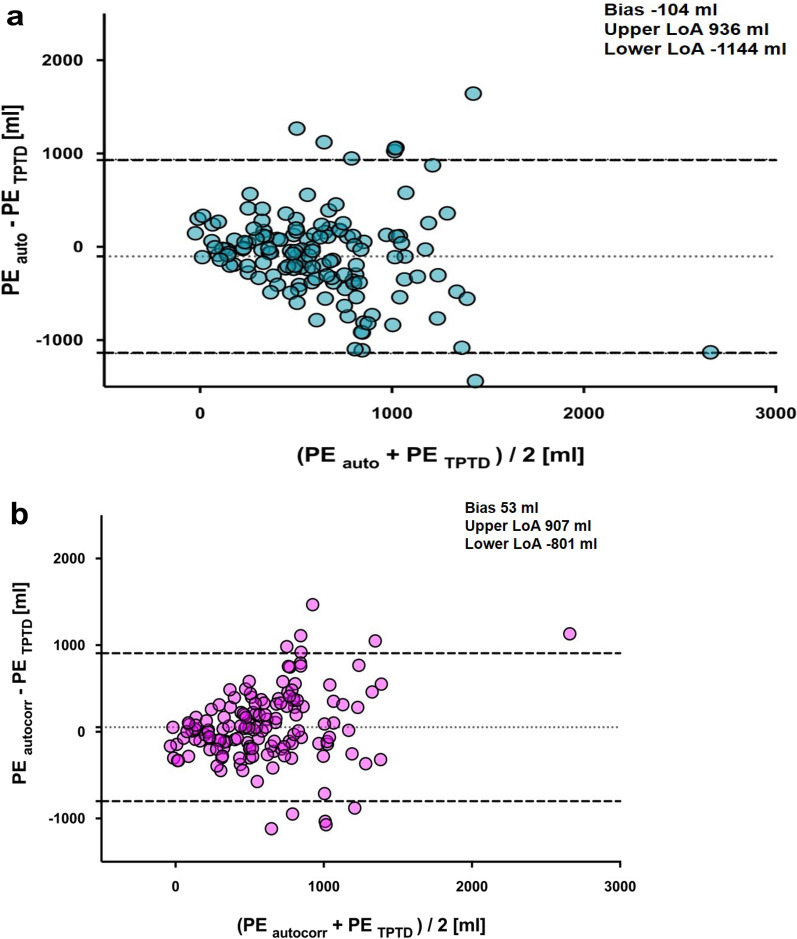
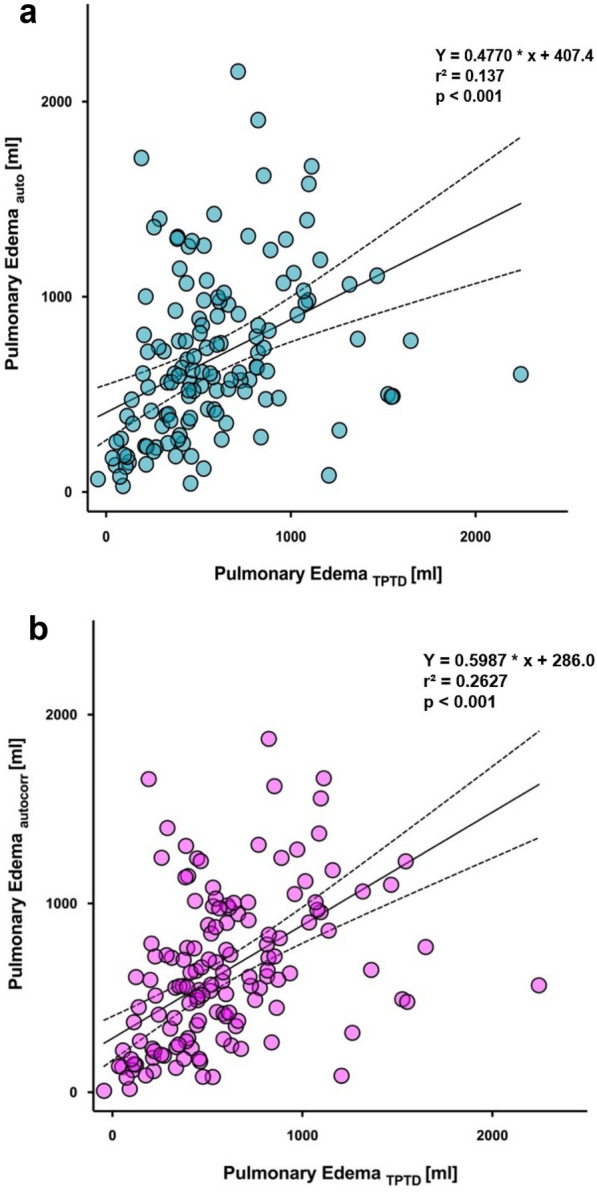
145 comparative measurements of pulmonary edema with TPTD and CT were included in the study. Estimating pulmonary edema using either automated lung segmentation on CT or TPTD showed a low bias overall (- 104 ml) but wide levels of agreement (upper: 936 ml, lower: - 1144 ml). In 13% of the analyzed CT scans, the agreement between the segmentation of the AI algorithm and a dedicated investigator was poor. Manual segmentation and automated segmentation adjusted for contrast agent did not improve the agreement levels.
Automated lung segmentation on CT can be considered an unbiased but imprecise measurement of pulmonary edema in mechanically ventilated patients with ARDS.
急性呼吸窘迫综合征(ARDS)患者的肺水肿通过胸部计算机断层扫描(CT)进行定量分析,因其操作复杂且耗时,尚未在常规诊断中得到验证。因此,用于测量血管外肺水(EVLW)的单指标经肺热稀释(TPTD)技术已应用于临床。人工智能(AI)的发展使得在相对较短的时间内,无需事先接受放射学培训的重症监护医生就能自动分割不均匀肺部的CT图像。然而,与TPTD相比,使用CT自动肺分割来验证肺水肿定量分析的数据较少。
一项回顾性研究(2016年1月至2021年12月)分析了入住曼海姆大学医院麻醉与重症医学科重症监护病房的ARDS患者,这些患者同时接受了胸部CT扫描和使用TPTD的血流动力学监测。通过CT上的手动和自动肺分割来估计肺水肿,然后与通过TPTD测定的EVLW计算出的肺水肿进行比较。
该研究纳入了145次TPTD与CT对肺水肿的对比测量。使用CT自动肺分割或TPTD估计肺水肿总体偏差较低(-104 ml),但一致性水平差异较大(上限:936 ml,下限:-1144 ml)。在13%的分析CT扫描中,AI算法分割与专业研究人员之间的一致性较差。针对造影剂进行调整的手动分割和自动分割并未提高一致性水平。
对于机械通气的ARDS患者,CT自动肺分割可被视为对肺水肿的一种无偏差但不精确的测量方法。