Klosterhalfen Stephanie, Viechtbauer Wolfgang, Kotz Daniel
Institute of General Practice, Centre for Health and Society, Addiction Research and Clinical Epidemiology Unit, Medical Faculty and University Hospital Düsseldorf, Heinrich Heine University Düsseldorf, Germany.
Department of Psychiatry and Neuropsychology, School for Mental Health and Neuroscience, Maastricht University, The Netherlands.
Addiction. 2025 Mar;120(3):557-567. doi: 10.1111/add.16675. Epub 2024 Nov 3.
To provide data on prevalence and trends in the use of different types of e-cigarettes (disposable, pod, tank) in Germany (a country with high smoking prevalence of approximately 30%) from 2016 to 2023, and to analyse the characteristics and smoking behaviours of users of these types.
A series of nationally representative cross-sectional face-to-face household surveys.
General population of Germany, 2016-2023.
A total of 92 327 people (aged ≥14 years) of which 1398 reported current use of e-cigarettes.
Type of e-cigarette usually used (single choice: disposable, pod, or tank), person characteristics, and smoking/vaping behaviour.
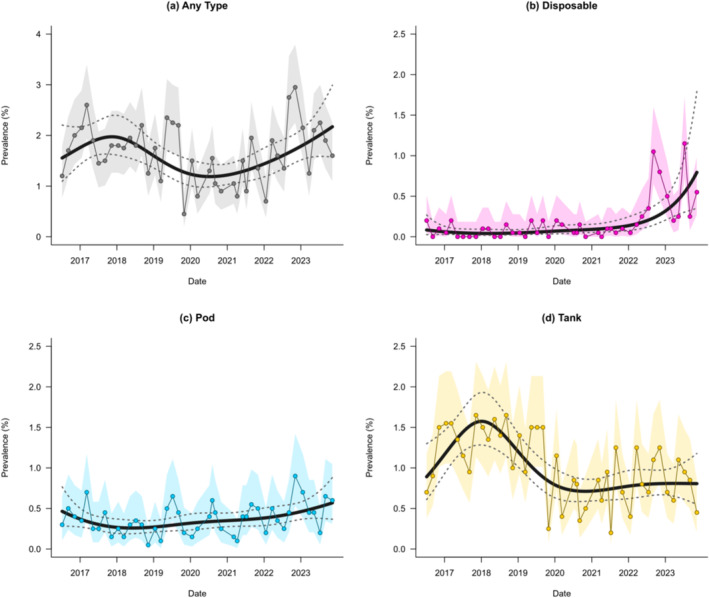
E-cigarette use in the population of Germany has increased from 1.6% (95% confidence interval [CI] = 1.1,2.2) in 2016 to 2.2% (95% CI = 1.6,3.0) at the end of 2023. Disposable e-cigarette use has increased in this period from 0.1% (95% CI = 0.0,0.3) to 0.8% (95% CI = 0.4,1.8). Pod type use exhibited the most stable trend, with a steady rise to 0.6% (95% CI = 0.4,0.9) in 2023. Tank e-cigarette use peaked at 1.6% (95% CI = 1.3,1.9) in November 2017, declined to 0.7% (95% CI = 0.6,0.9) in December 2020, and has since remained constant at 0.8% (95% CI = 0.6,1.0). Disposable e-cigarette users were on average 3.5 and 4.1 years younger than tank and pod users, respectively. They were more likely than tank users to be female, non-daily users, and dual users of tobacco. In the subgroup of dual users, there were no significant differences with regard to urges to smoke, cigarettes smoked per day, motivation to stop, and attempts to stop smoking between users of disposables and other types.
The use of e-cigarettes has increased in Germany from 2016 to 2023, especially that of disposable e-cigarettes, which are now the most commonly used type with a prevalence rate of 0.8%. However, the use of e-cigarettes is still much lower compared with tobacco smoking.
提供2016年至2023年德国(吸烟率约30%的国家)不同类型电子烟(一次性、烟弹式、储油式)的使用情况及趋势数据,并分析这些类型使用者的特征和吸烟行为。
一系列具有全国代表性的横断面面对面家庭调查。
2016 - 2023年德国普通人群。
共92327人(年龄≥14岁),其中1398人报告当前使用电子烟。
通常使用的电子烟类型(单项选择:一次性、烟弹式或储油式)、个人特征以及吸烟/吸电子烟行为。
德国人群中电子烟的使用率从2016年的1.6%(95%置信区间[CI]=1.1,2.2)增至2023年底的2.2%(95%CI = 1.6,3.0)。在此期间,一次性电子烟的使用率从0.1%(95%CI = 0.0,0.3)增至0.8%(95%CI = 0.4,1.8)。烟弹式电子烟的使用呈现最稳定的趋势,稳步上升至2023年的0.6%(95%CI = 0.4,0.9)。储油式电子烟的使用在2017年11月达到峰值1.6%(95%CI = 1.3,1.9),2020年12月降至0.7%(95%CI = 0.6,0.9),此后一直稳定在0.8%(95%CI = 0.6,1.0)。一次性电子烟使用者的平均年龄分别比储油式和烟弹式使用者小3.5岁和4.1岁。与储油式电子烟使用者相比,她们更可能是女性、非每日使用者以及烟草双重使用者。在双重使用者亚组中,一次性电子烟使用者与其他类型使用者在吸烟冲动、每日吸烟量、戒烟动机和戒烟尝试方面无显著差异。
2016年至2023年德国电子烟的使用有所增加,尤其是一次性电子烟,目前是最常用的类型,使用率为0.8%。然而,与吸烟相比,电子烟的使用仍然低得多。