Falarowski Christin, Pieper Elke, Rabenstein Andrea, Mallock-Ohnesorg Nadja, Burgmann Nestor, Franzen Klaas, Gertzen Marcus, Koller Gabriele, Nowak Dennis, Rahofer Anna, Rieder Benedikt, de Oliveira Pinto Kise Gabriel Roselli, Schulz Thomas, Strohmeyer Elena, Laux Peter, Luch Andreas, Rüther Tobias
Department of Psychiatry and Psychotherapy, LMU University Hospital, LMU Munich, Munich, Germany.
Department of Chemical and Product Safety, German Federal Institute for Risk Assessment (BfR), Berlin, Germany.
Sci Rep. 2025 May 9;15(1):16270. doi: 10.1038/s41598-025-97491-5.
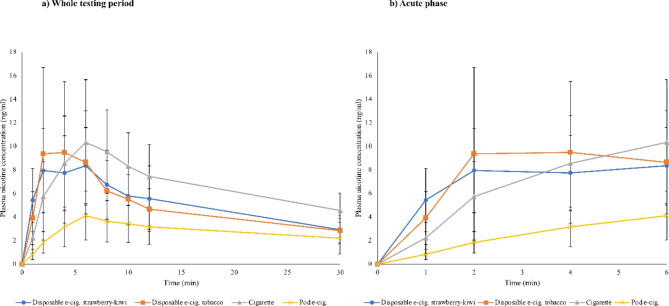
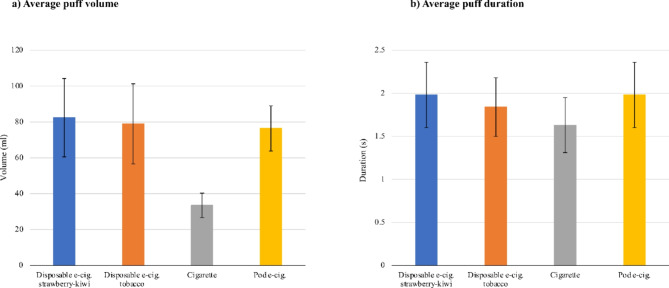
New disposable e-cigarettes are popular, especially among young people. This study aimed to assess their addictive potential by examining puffing behaviors, subjective effects, and conducting laboratory investigations in an experimental setting. Single-center, four-arm, crossover study. Laboratory setting in Munich (LMU-University Hospital), Germany. Eighteen occasionally cigarette-smoking adults aged 19-28. Two disposable e-cigarettes of the same brand (strawberry-kiwi/ tobacco flavored) were tested with a cigarette and a conventional pod e-cigarette as comparators. Usage was ad libitum for 5 min (or the duration of smoking one cigarette) while puffing topography was recorded. Distributed over 30 min blood samples for nicotine plasma concentrations were drawn and hemodynamic parameters and subjective effects assessed. Nicotine delivery of disposable e-cigarettes (C strawberry-kiwi: 7.1 ng/ml, tobacco: 6.9 ng/ml) was similar to the cigarette (8.1 ng/ml) and higher than for the pod e-cigarette (3.1 ng/ml). The nicotine plasma increase in the first minute was the fastest for disposable e-cigarettes. T for the disposable e-cigarettes (strawberry-kiwi: 5 min, tobacco: 6 min) was reached faster than for the cigarette (8 min). Compared to the pod e-cigarette (6 min), t was reached faster with the disposable e-cigarette tobacco. Total nicotine uptake was the lowest for the pod e-cigarette. Puffing behavior differed between e-cigarettes and the cigarette and slightly between both disposable e-cigarettes. Satisfaction and motivation to consume the product again were higher for disposables with a slight preference for strawberry-kiwi flavor. New disposable e-cigarettes hold great addictive potential for young people unestablished in smoking. Besides conducting further research, it is crucial to observe usage trends and strengthen regulations.Trial registration number: DRKS00030978. Date of registration: 21.02.2023.
新型一次性电子烟很受欢迎,尤其是在年轻人当中。本研究旨在通过在实验环境中检查抽吸行为、主观效应并进行实验室调查,来评估其成瘾潜力。单中心、四臂、交叉研究。德国慕尼黑(路德维希 - 马克西米利安大学医院)的实验室环境。18名年龄在19至28岁之间偶尔吸烟的成年人。测试了同一品牌的两种一次性电子烟(草莓奇异果味/烟草味),并与一支香烟和一支传统烟弹式电子烟作为对照。自由使用5分钟(或吸一支烟的时长),同时记录抽吸形态。在30分钟内采集血样以测定血浆尼古丁浓度,并评估血流动力学参数和主观效应。一次性电子烟的尼古丁递送量(草莓奇异果味:7.1纳克/毫升,烟草味:6.9纳克/毫升)与香烟(8.1纳克/毫升)相似,且高于烟弹式电子烟(3.1纳克/毫升)。一次性电子烟在第一分钟内血浆尼古丁的增加速度最快。一次性电子烟(草莓奇异果味:5分钟,烟草味:6分钟)达到峰值的时间比香烟(8分钟)更快。与烟弹式电子烟(6分钟)相比,一次性烟草味电子烟达到峰值的时间更快。烟弹式电子烟的总尼古丁摄入量最低。电子烟和香烟之间的抽吸行为有所不同,两种一次性电子烟之间也略有差异。对于一次性电子烟,再次使用该产品的满意度和意愿更高,对草莓奇异果味略有偏好。新型一次性电子烟对尚未养成吸烟习惯的年轻人具有很大的成瘾潜力。除了开展进一步研究外,观察使用趋势并加强监管至关重要。试验注册号:DRKS00030978。注册日期:2023年2月21日。