Department of Oncology, Jiangsu Cancer Hospital, The Affiliated Cancer Hospital of Nanjing Medical University, Nanjing, Jiangsu, China.
Hum Vaccin Immunother. 2024 Dec 31;20(1):2423479. doi: 10.1080/21645515.2024.2423479. Epub 2024 Nov 4.
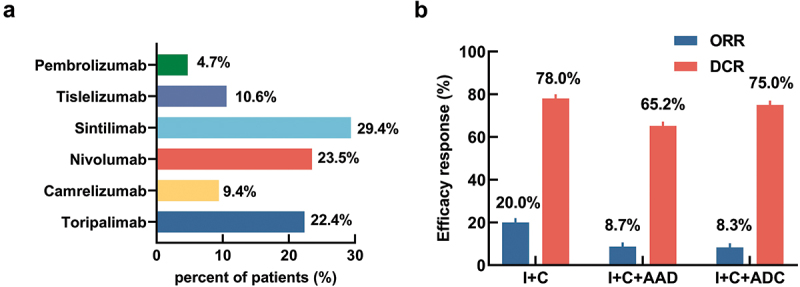
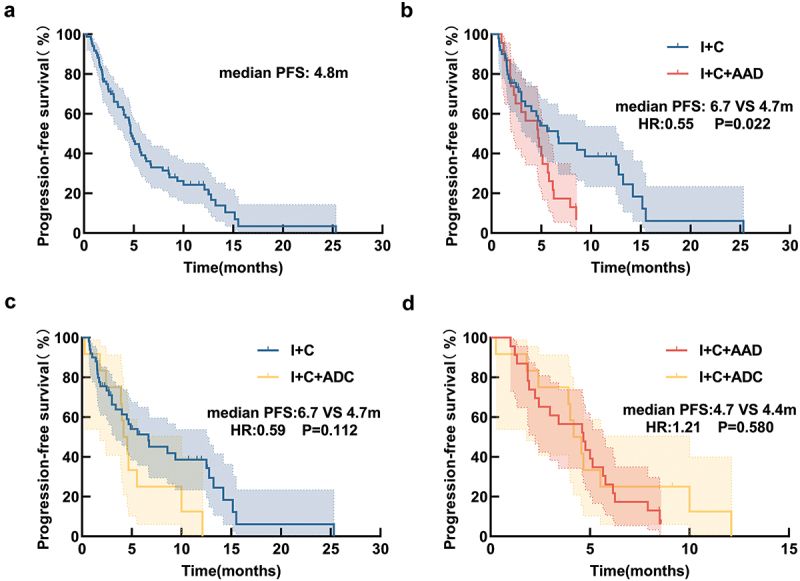
We aimed to explore the efficacy of rechallenge after first-line immunotherapy in advanced gastric cancer (AGC) and to analyze the factors affecting prognosis based on clinical characteristics. Eighty-five AGC patients who underwent rechallenged after the failure of first-line treatment with immune checkpoint inhibitors (ICIs) were retrospectively collected from July 2019 to December 2022 in Jiangsu Cancer Hospital. Potential factors affecting prognosis were analyzed by univariate and multivariate Cox analysis. Survival analysis was performed by Kaplan-Meier method and Log rank test. Stratified factors included human epidermal growth factor receptor 2 (HER-2) and programmed cell death-ligand 1 combined positive score (PD-L1 CPS). The objective response rate (ORR) was 15.3%, and the disease control rate (DCR) was 74.1%. The median progression-free survival (PFS) was 4.8 months. Results showed that patients in the I + C group had the best response. The ORR was 20.0% VS 8.7% in the I + C group and I + C + AAD group. The DCR was 78.0% VS 65.2%, and the median PFS was 6.7 VS 4.7 months [hazard ratio (HR): 0.55, 95% confidence interval (CI): 0.30-1.00, = .022]. The ORR was 20.0% VS 8.3% in the I + C group and I + C + ADC group. The DCR was 78.0% VS 75.0%, and the median PFS was 6.7 VS 4.4 months (HR: 0.59, 95%CI: 0.26-1.30, = .112). The median PFS was 4.7 VS 4.4 months in the I + C + AAD group and I + C + ADC group (HR: 1.21, 95%CI: 0.60-2.47, = .580). Adverse events (AEs) were found in 34 patients, mainly including leukopenia 9 (10.6%), and neutropenia 8 (9.4%). The incidence of grade 3-4 AEs was 8.2%. There were no drug-related deaths and all AEs were manageable. Rechallenge after first-line immunotherapy showed good survival benefit and acceptable safety in the therapy of AGC. Especially for patients with HER-2-positive and PD-L1 CPS ≥ 1%, rechallenge may be an effective treatment modality.
我们旨在探讨晚期胃癌(AGC)一线免疫治疗失败后再次挑战治疗的疗效,并根据临床特征分析影响预后的因素。回顾性收集了 2019 年 7 月至 2022 年 12 月期间,在江苏省肿瘤医院接受免疫检查点抑制剂(ICI)一线治疗失败后接受再次挑战治疗的 85 例 AGC 患者。采用单因素和多因素 Cox 分析对潜在预后因素进行分析。采用 Kaplan-Meier 法和 Log rank 检验进行生存分析。分层因素包括人表皮生长因子受体 2(HER-2)和程序性死亡配体 1 联合阳性评分(PD-L1 CPS)。客观缓解率(ORR)为 15.3%,疾病控制率(DCR)为 74.1%。中位无进展生存期(PFS)为 4.8 个月。结果显示,I+C 组患者的反应最佳。I+C 组的 ORR 为 20.0%,I+C+AAD 组为 8.7%。DCR 分别为 78.0%和 65.2%,中位 PFS 分别为 6.7 个月和 4.7 个月[风险比(HR):0.55,95%置信区间(CI):0.30-1.00, = .022]。I+C 组的 ORR 为 20.0%,I+C+ADC 组为 8.3%。DCR 分别为 78.0%和 75.0%,中位 PFS 分别为 6.7 个月和 4.4 个月(HR:0.59,95%CI:0.26-1.30, = .112)。I+C+AAD 组和 I+C+ADC 组的中位 PFS 分别为 4.7 个月和 4.4 个月(HR:1.21,95%CI:0.60-2.47, = .580)。34 例患者出现不良事件(AE),主要包括白细胞减少 9 例(10.6%)和中性粒细胞减少 8 例(9.4%)。3-4 级 AE 发生率为 8.2%。无药物相关死亡,所有 AE 均可管理。一线免疫治疗后再次挑战治疗在 AGC 的治疗中显示出良好的生存获益和可接受的安全性。特别是对于 HER-2 阳性和 PD-L1 CPS≥1%的患者,再次挑战可能是一种有效的治疗方式。