Research Center for Social Determinants of Health, Research Institute for Endocrine Sciences, Shahid Beheshti University of Medical Sciences, P.O. Box: 19395-4763, Tehran, Iran.
Department of Epidemiology and Biostatistics, Research Institute for Endocrine Sciences, Shahid Beheshti University of Medical Sciences, Tehran, Iran.
Sci Rep. 2024 Nov 4;14(1):26699. doi: 10.1038/s41598-024-77857-x.
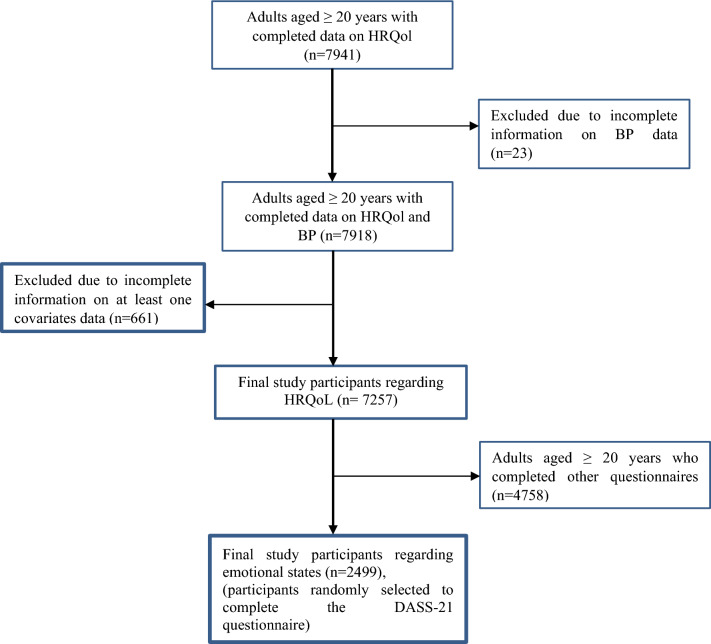
This study aimed to examine the association between blood pressure (BP) with health-related quality of life (HRQoL) and emotional states, considering the disease awareness and commitment to treatment among the Iranian adult population. This cross-sectional study uses the data of 7257 and 2449 individuals aged ≥ 20 who had completed data on HRQoL and emotional states, respectively. Linear and logistic regression were used to evaluate the mentioned association. The results showed that commitment to treatment had an inverse association with physical HRQoL in both sexes, except for bodily pain in men. Concerning mental HRQoL, in women, poor medication adherence was linked to a decline in mental HRQoL and social functioning, while good treatment adherence was associated with a reduction in the mental health domain. However, except for a decrease in vitality of hypertensive males with high treatment adherence, no significant association was found between their mental HRQoL and BP. In women, increased commitment to treatment was associated with anxiety, whereas poor commitment was related to depression and stress. The undiagnosed disease was not associated with any HRQoL and emotional state deficits. This study highlights the significance of psychiatric assessment, counseling, and support services while taking into account gender-specific differences among hypertensive patients. It also emphasizes the necessity for customized interventions for both men and women to improve their mental well-being and adherence to treatment.
本研究旨在探讨伊朗成年人群中,血压(BP)与健康相关生活质量(HRQoL)和情绪状态之间的关系,同时考虑疾病认知和治疗依从性的影响。本横断面研究使用了分别完成 HRQoL 和情绪状态数据的 7257 名和 2449 名年龄≥20 岁的个体的数据。线性和逻辑回归用于评估上述关联。结果表明,治疗依从性与男女两性的生理 HRQoL 呈负相关,除男性的躯体疼痛外。就心理 HRQoL 而言,在女性中,药物治疗依从性差与心理 HRQoL 和社会功能下降有关,而良好的治疗依从性与心理健康领域的下降有关。然而,除了高治疗依从性的高血压男性的活力下降外,他们的心理 HRQoL 与 BP 之间没有发现显著关联。在女性中,治疗依从性的增加与焦虑有关,而治疗依从性差则与抑郁和压力有关。未确诊的疾病与任何 HRQoL 和情绪状态缺陷均无关。本研究强调了在考虑到高血压患者的性别差异的同时,进行精神评估、咨询和支持服务的重要性。它还强调了为男性和女性制定个性化干预措施以改善他们的心理健康和治疗依从性的必要性。