Department of Gastroenterology, Jiangxi Provincial Key Laboratory of Digestive Diseases, Jiangxi Clinical Research Center for Gastroenterology, Digestive Disease Hospital, The First Affiliated Hospital, Jiangxi Medical College, Nanchang University, Nanchang, Jiangxi, China.
Postdoctoral Innovation Practice Base, The First Affiliated Hospital, Jiangxi Medical College, Nanchang University, Nanchang, China.
Sci Rep. 2024 Nov 4;14(1):26605. doi: 10.1038/s41598-024-78135-6.
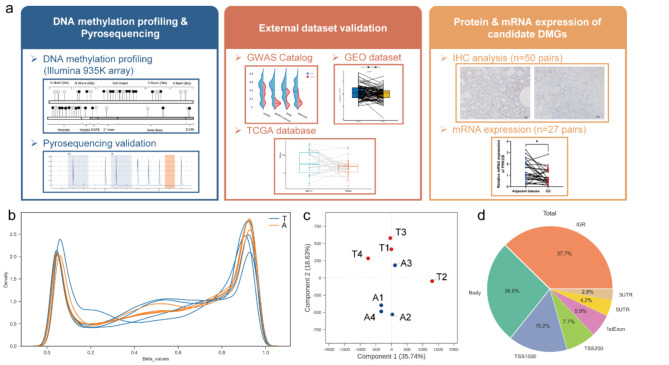
Globally, gastric cancer (GC) ranks among the most prevalent forms of malignancy, posing a significant health burden. Epigenetic modifications, predominantly characterized by alterations in DNA methylation patterns, have been linked to a diverse array of neoplastic processes. Here, we undertake a comprehensive analysis of the DNA methylation signature in GC, with the aim to discover the potential diagnostic epigenetic biomarkers. Utilizing the Illumina 935 K BeadChip, we conducted a genome-wide exploration of DNA methylation patterns in four paired samples of GC tissues and adjacent non-cancerous counterparts. The bisulfite-pyrosequencing (n = 7) was employed to the quantification for methylated gene. The pubic databases including GWAS Catalog, TCGA and GEO were used. The immunohistochemistry and qRT-PCR analysis were performed. In contrast to adjacent tissues, GC tissues manifested pronounced hypermethylation patterns specifically within the promoter cytosine-phosphate-guanine (CpG) islands, indicating localized epigenetic alterations. DNA methylome analysis further revealed 4432 differentially-methylated probes (DMPs), with the gene PRKCB exhibited the most prominent average DNA methylation disparity (mean Δβ = 0.353). Pyrosequencing validation confirmed three DMPs within the PRKCB promoter (cg08406370, cg00735962, and cg18526361). Notably, the mean methylation levels of PRKCB were inversely correlated with mRNA expression levels in the GWAS Catalog. Furthermore, both mRNA and protein expression levels of PRKCB were significantly reduced in GCs when compared to their adjacent non-cancerous counterparts, verified by TCGA and GEO database. Our study reveals significant DNA methylation alterations in GC and emphasizes the pivotal role of PRKCB gene hypermethylation in conferring GC risk, which offers fresh perspectives for advancing diagnostic approaches and therapeutic strategies for GC.
在全球范围内,胃癌(GC)是最常见的恶性肿瘤之一,对健康造成了重大负担。表观遗传修饰主要表现为 DNA 甲基化模式的改变,与多种肿瘤发生过程有关。在这里,我们对 GC 的 DNA 甲基化特征进行了全面分析,旨在发现潜在的诊断性表观遗传生物标志物。我们使用 Illumina 935K BeadChip 对 4 对 GC 组织和相邻非癌组织的 DNA 甲基化模式进行了全基因组探索。我们使用 bisulfite-pyrosequencing(n=7)对甲基化基因进行了定量分析。我们使用了包括 GWAS Catalog、TCGA 和 GEO 在内的公共数据库。我们进行了免疫组织化学和 qRT-PCR 分析。与相邻组织相比,GC 组织表现出明显的高甲基化模式,特别是在启动子胞嘧啶-磷酸-鸟嘌呤(CpG)岛内,表明存在局部的表观遗传改变。DNA 甲基化组分析进一步揭示了 4432 个差异甲基化探针(DMPs),其中 PRKCB 基因表现出最显著的平均 DNA 甲基化差异(平均 Δβ=0.353)。焦磷酸测序验证证实了 PRKCB 启动子内的三个 DMP(cg08406370、cg00735962 和 cg18526361)。值得注意的是,PRKCB 的平均甲基化水平与 GWAS Catalog 中的 mRNA 表达水平呈负相关。此外,与相邻非癌组织相比,PRKCB 的 mRNA 和蛋白表达水平在 TCGA 和 GEO 数据库中均显著降低。我们的研究揭示了 GC 中存在显著的 DNA 甲基化改变,并强调了 PRKCB 基因高甲基化在赋予 GC 风险中的关键作用,为 GC 的诊断方法和治疗策略提供了新的视角。