Liu Zhongjie, Wang Nan, Su Ying, Long Qiming, Peng Yanling, Shangguan Lingfei, Zhang Fan, Cao Shuo, Wang Xu, Ge Mengqing, Xue Hui, Ma Zhiyao, Liu Wenwen, Xu Xiaodong, Li Chaochao, Cao Xuejing, Ahmad Bilal, Su Xiangnian, Liu Yuting, Huang Guizhou, Du Mengrui, Liu Zhenya, Gan Yu, Sun Lei, Fan Xiucai, Zhang Chuan, Zhong Haixia, Leng Xiangpeng, Ren Yanhua, Dong Tianyu, Pei Dan, Wu Xinyu, Jin Zhongxin, Wang Yiwen, Liu Chonghuai, Chen Jinfeng, Gaut Brandon, Huang Sanwen, Fang Jinggui, Xiao Hua, Zhou Yongfeng
National Key Laboratory of Tropical Crop Breeding, Shenzhen Branch, Guangdong Laboratory of Lingnan Modern Agriculture, Key Laboratory of Synthetic Biology, Ministry of Agriculture and Rural Affairs, Agricultural Genomics Institute at Shenzhen, Chinese Academy of Agricultural Sciences, Shenzhen, China.
College of Horticulture, Nanjing Agricultural University, Nanjing, China.
Nat Genet. 2024 Dec;56(12):2804-2814. doi: 10.1038/s41588-024-01967-5. Epub 2024 Nov 4.
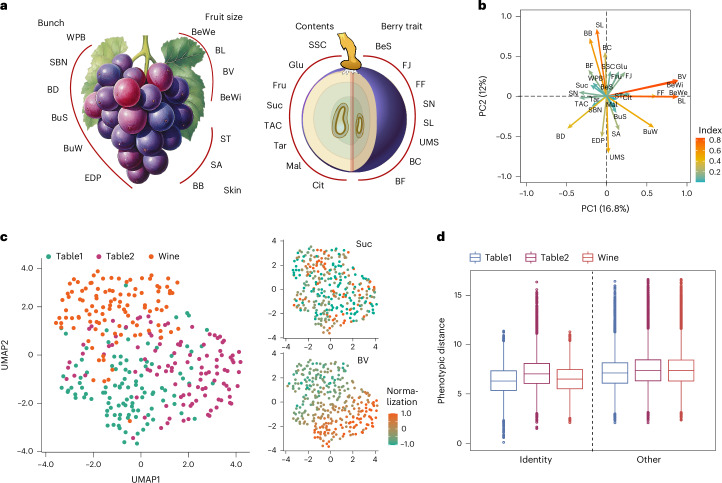
Grapevine breeding is hindered by a limited understanding of the genetic basis of complex agronomic traits. This study constructs a graph-based pangenome reference (Grapepan v.1.0) from 18 newly generated phased telomere-to-telomere assemblies and 11 published assemblies. Using Grapepan v.1.0, we build a variation map with 9,105,787 short variations and 236,449 structural variations (SVs) from the resequencing data of 466 grapevine cultivars. Integrating SVs into a genome-wide association study, we map 148 quantitative trait loci for 29 agronomic traits (50.7% newly identified), with 12 traits significantly contributed by SVs. The estimated heritability improves by 22.78% on average when including SVs. We discovered quantitative trait locus regions under divergent artificial selection in metabolism and berry development between wine and table grapes, respectively. Moreover, significant genetic correlations were detected among the 29 traits. Under a polygenic model, we conducted genomic predictions for each trait. In general, our study facilitates the breeding of superior cultivars via the genomic selection of multiple traits.
对复杂农艺性状遗传基础的有限理解阻碍了葡萄育种。本研究从18个新生成的端粒到端粒的分阶段组装序列和11个已发表的组装序列构建了基于图的泛基因组参考(Grapepan v.1.0)。使用Grapepan v.1.0,我们根据466个葡萄品种的重测序数据构建了一个包含9,105,787个短变异和236,449个结构变异(SVs)的变异图谱。将SVs整合到全基因组关联研究中,我们定位了29个农艺性状的148个数量性状位点(50.7%为新发现),其中12个性状由SVs显著贡献。纳入SVs后,估计遗传力平均提高了22.78%。我们分别在酿酒葡萄和鲜食葡萄的代谢和浆果发育中发现了不同人工选择下的数量性状位点区域。此外,在这29个性状之间检测到显著的遗传相关性。在多基因模型下,我们对每个性状进行了基因组预测。总体而言,我们的研究通过对多个性状的基因组选择促进了优良品种的育种。