
利用葡萄中的克隆多样性:从基因组洞察到现代育种应用。
Harnessing clonal diversity in grapevine: from genomic insights to modern breeding applications.
作者信息
Callipo Paolo, Schmidt Maximilian, Strack Timo, Robinson Hannah, Vasudevan Akshaya, Voss-Fels Kai P
机构信息
Department of Plant Breeding, Hochschule Geisenheim University, Geisenheim, Germany.
出版信息
Theor Appl Genet. 2025 Aug 4;138(8):196. doi: 10.1007/s00122-025-04986-w.
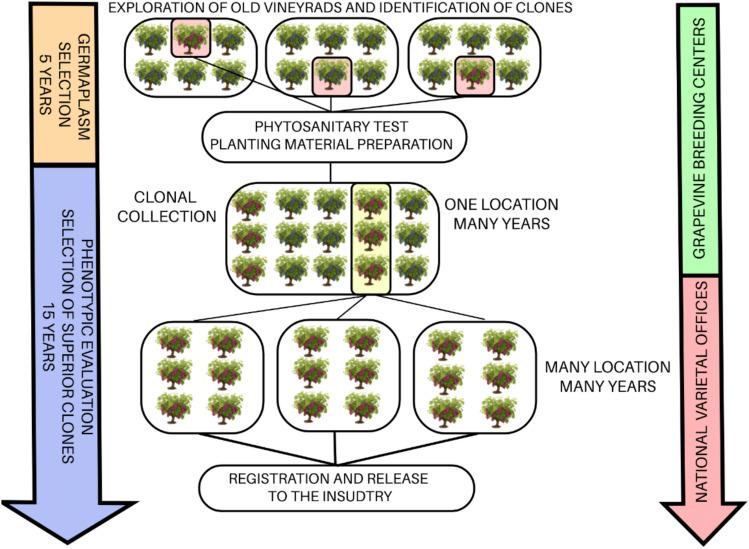
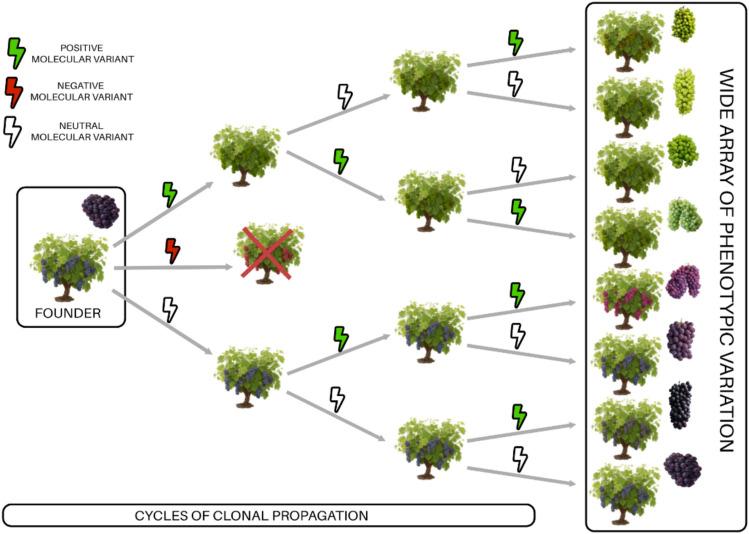
Grapevine has been clonally propagated for thousands of years. Though clonal propagation aims at maintaining varietal identity, somatic mutations and epigenetic modifications accumulated over hundreds to thousands of years lead to intra-varietal diversity. This intra-varietal variation is a very valuable resource in grapevine breeding, as it creates the opportunity to improve important traits related to yield, phenology, stress tolerance, and quality without altering the varietal identity which is extremely important for the industry. Recent advances in genomics, epigenetics, and phenotyping technologies are providing completely new opportunities to gain functional insights into the drivers underlying trait variation and to explore this for accelerated grapevine breeding. This review discusses the interaction between somatic mutations, epigenetic regulation, and emerging breeding technologies. We begin by exploring the phenotypic variation observed within clonal populations across various commercially important varieties, focusing on both agronomic and winemaking-related traits. Next, we examine the extent of genomic and epigenomic variation among clones, highlighting known mutations responsible for somatic variants. We also address how grapevine clonal populations serve as an advantageous model for understanding how genetic and epigenetic variants shape complex trait variation. Given recent advances, we discuss the potential of predictive breeding strategies to accelerate clonal evaluation and how genome editing technologies open new opportunities for targeted genetic improvements without passing through the tedium and unpredictability of clonal selection, driven by natural mutation. Ultimately, these new breeding technologies enable the integration of advanced methods into breeding programmes, optimizing grapevine performance while preserving the unique heritage of historic cultivars.
葡萄的无性繁殖已经持续了数千年。尽管无性繁殖旨在保持品种特性,但数百至数千年来积累的体细胞突变和表观遗传修饰导致了品种内的多样性。这种品种内变异在葡萄育种中是非常宝贵的资源,因为它创造了在不改变对该行业极为重要的品种特性的情况下,改善与产量、物候、胁迫耐受性和品质相关的重要性状的机会。基因组学、表观遗传学和表型分析技术的最新进展为深入了解性状变异的驱动因素并探索其在加速葡萄育种中的应用提供了全新的机会。本文综述了体细胞突变、表观遗传调控和新兴育种技术之间的相互作用。我们首先探讨在各种商业上重要的品种的无性繁殖群体中观察到的表型变异,重点关注农艺性状和与酿酒相关的性状。接下来,我们研究克隆之间基因组和表观基因组变异的程度,突出导致体细胞变异的已知突变。我们还讨论了葡萄无性繁殖群体如何作为理解遗传和表观遗传变异如何塑造复杂性状变异的有利模型。鉴于最近的进展,我们讨论了预测育种策略在加速克隆评估方面的潜力,以及基因组编辑技术如何为有针对性的遗传改良开辟新机会,而无需经历由自然突变驱动的克隆选择的繁琐和不可预测性。最终,这些新的育种技术能够将先进方法整合到育种计划中,在保留历史品种独特传承的同时优化葡萄的性能。
 Zotero 插件