Institute for Regenerative Medicine and Biotherapy, Université de Montpellier, INSERM U1183, Montpellier, 34295, France.
IGF, Université de Montpellier, CNRS, INSERM, Montpellier, France.
Stem Cell Res Ther. 2024 Nov 4;15(1):394. doi: 10.1186/s13287-024-03980-1.
. CD8 Cytotoxic T lymphocytes play a key role in the pathogenesis of autoimmune diseases and clinical conditions such as graft versus host disease and graft rejection. Mesenchymal Stromal Cells (MSCs) are multipotent cells with tissue repair and immunomodulatory capabilities. Since they are able to suppress multiple pathogenic immune responses, MSCs have been proposed as a cellular therapy for the treatment of immune-mediated diseases. However, the mechanisms underlying their immunosuppressive properties are not yet fully understood. MSCs have the remarkable ability to sense tissue injury and inflammation and respond by donating their own mitochondria to neighboring cells. Whether mitochondrial transfer has any role in the repression of CD8 responses is unknown.
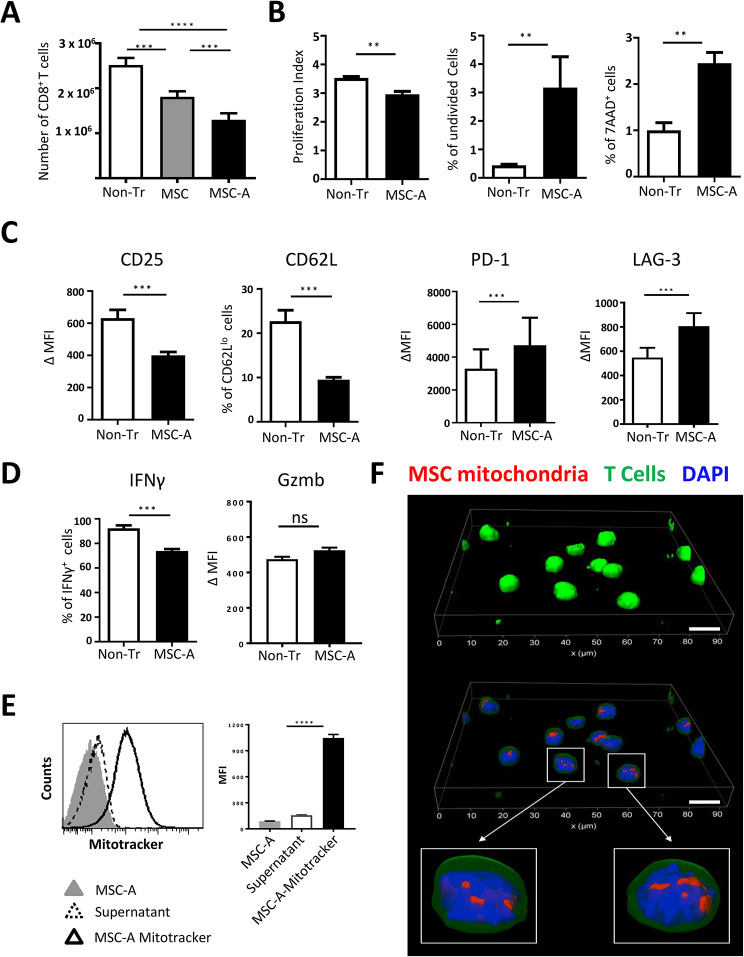
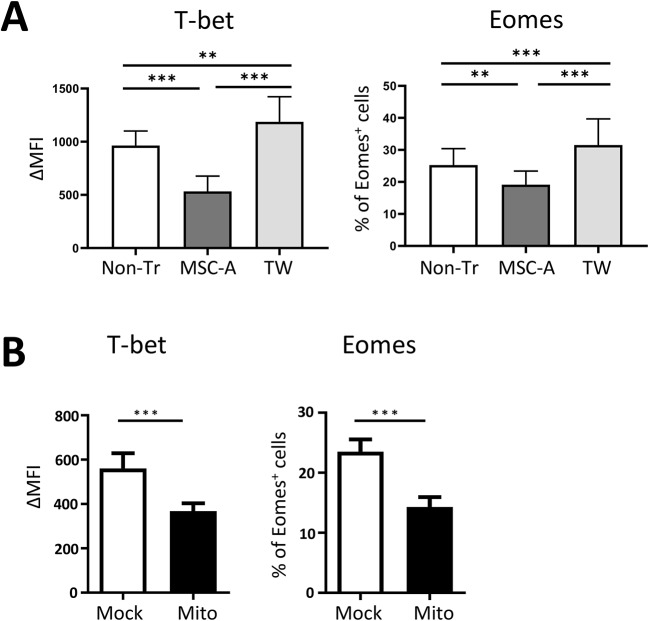
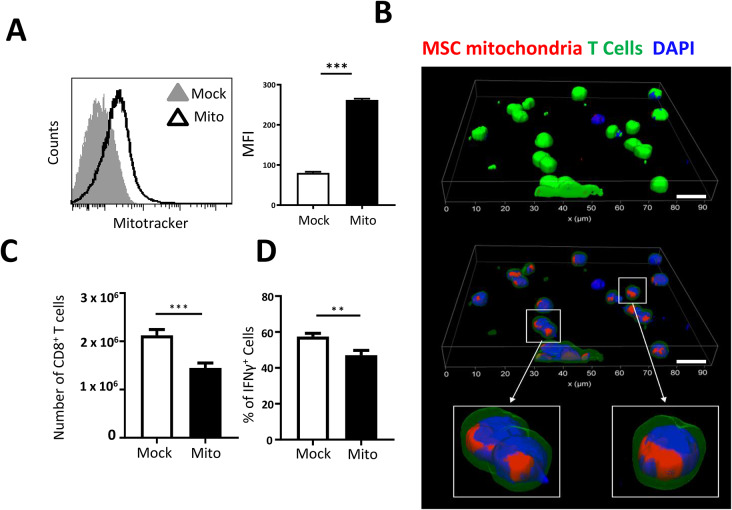
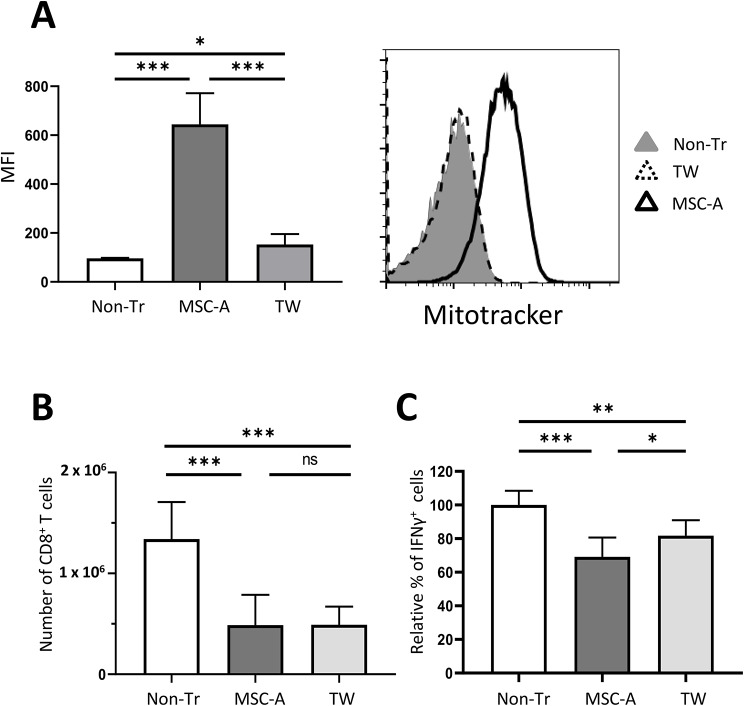
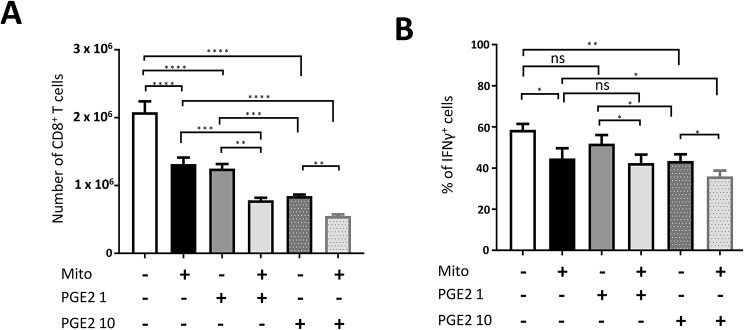
. We have utilized CD8 T cells from Clone 4 TCR transgenic mice that differentiate into effector cells upon activation in vitro and in vivo to address this question. Allogeneic bone marrow derived MSCs, co-cultured with activated Clone 4 CD8 T cells, decreased their expansion, the production of the effector cytokine IFNγ and their diabetogenic potential in vivo. Notably, we found that during this interaction leading to suppression, MSCs transferred mitochondria to CD8 T cells as evidenced by FACS and confocal microscopy. Transfer of MSC mitochondria to Clone 4 CD8 T cells also resulted in decreased expansion and production of IFNγ upon activation. These effects overlapped and were additive with those of prostaglandin E2 secreted by MSCs. Furthermore, preventing mitochondrial transfer in co-cultures diminished the ability of MSCs to inhibit IFNγ production. Finally, we demonstrated that both MSCs and MSC mitochondria downregulated T-bet and Eomes expression, key transcription factors for CTL differentiation, on activated CD8 T cells.
. In this report we showed that MSCs are able to interact with CD8 T cells and transfer them their mitochondria. Mitochondrial transfer contributed to the global suppressive effect of MSCs on CD8 T cell activation by downregulating T-bet and Eomes expression resulting in impaired IFNγ production of activated CD8 T cells.
CD8 细胞毒性 T 淋巴细胞在自身免疫性疾病和移植物抗宿主病、移植物排斥等临床病症的发病机制中发挥关键作用。间充质基质细胞(MSCs)是具有组织修复和免疫调节能力的多能细胞。由于它们能够抑制多种致病免疫反应,因此 MSCs 被提议作为细胞疗法用于治疗免疫介导的疾病。然而,其免疫抑制特性的机制尚未完全阐明。MSCs 具有感知组织损伤和炎症的显著能力,并通过将自身线粒体捐赠给邻近细胞来做出反应。线粒体转移是否在抑制 CD8 反应中发挥作用尚不清楚。
我们利用在体外和体内激活后分化为效应细胞的 Clone 4 TCR 转基因小鼠的 CD8 T 细胞来解决这个问题。与激活的 Clone 4 CD8 T 细胞共培养的异基因骨髓来源的 MSC 减少了它们的扩增、效应细胞因子 IFNγ 的产生和它们在体内的致糖尿病潜力。值得注意的是,我们发现,在导致抑制的这种相互作用过程中,MSC 将线粒体转移到 CD8 T 细胞中,这一点通过 FACS 和共聚焦显微镜得到了证明。MSC 线粒体向 Clone 4 CD8 T 细胞的转移也导致激活后扩增和 IFNγ 的产生减少。这些效应与 MSC 分泌的前列腺素 E2 的效应重叠且具有累加性。此外,在共培养物中阻止线粒体转移会降低 MSC 抑制 IFNγ 产生的能力。最后,我们证明 MSC 和 MSC 线粒体均下调了激活的 CD8 T 细胞上 CTL 分化的关键转录因子 T-bet 和 Eomes 的表达。
在本报告中,我们表明 MSC 能够与 CD8 T 细胞相互作用并将其线粒体转移给它们。线粒体转移通过下调 T-bet 和 Eomes 的表达,导致激活的 CD8 T 细胞 IFNγ 产生受损,从而促进 MSC 对 CD8 T 细胞激活的整体抑制作用。