MacNeil Maggie, Tagami Aya, Sheffield Peter, Ramsden Vivian R, Barker Joan, Boyle Jennifer, Cruickshank Clare, Frymire Eliot, Glazier Richard H, Hill Anita Gombos, Green Michael E, Huang Mary, Jurriaans Marijke, Leid Caron, McCallum Melissa, Precious Sarah, Stans Jo-Ann, Vizza Julie, Walz Murray, Wilkins Sue, Ganann Rebecca
School of Nursing, McMaster University, Hamilton, ON, Canada.
Factor-Inwentash Faculty of Social Work, University of Toronto, Toronto, ON, Canada.
Res Involv Engagem. 2024 Nov 4;10(1):114. doi: 10.1186/s40900-024-00652-5.
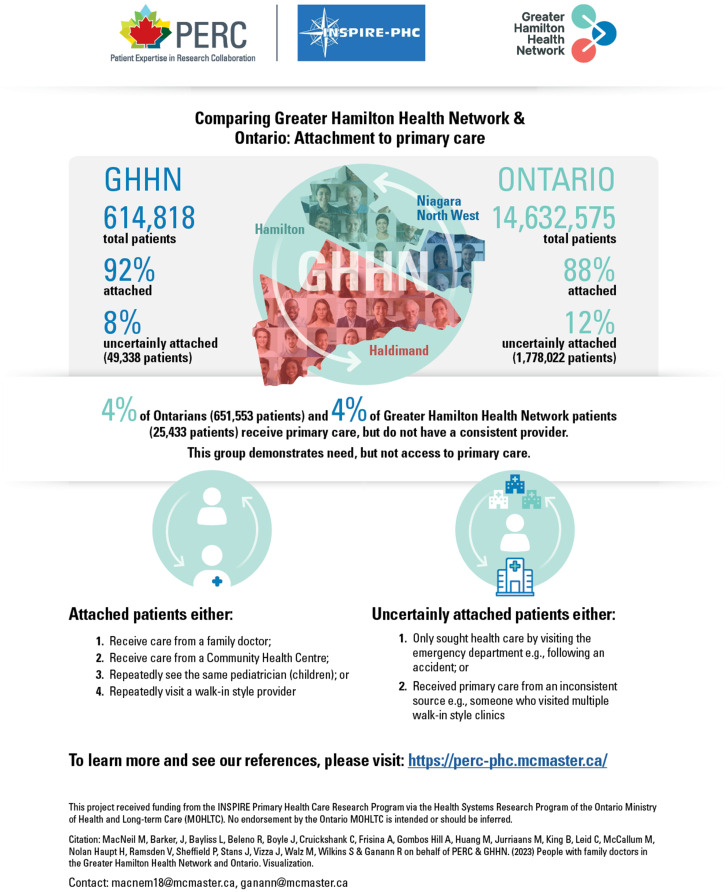
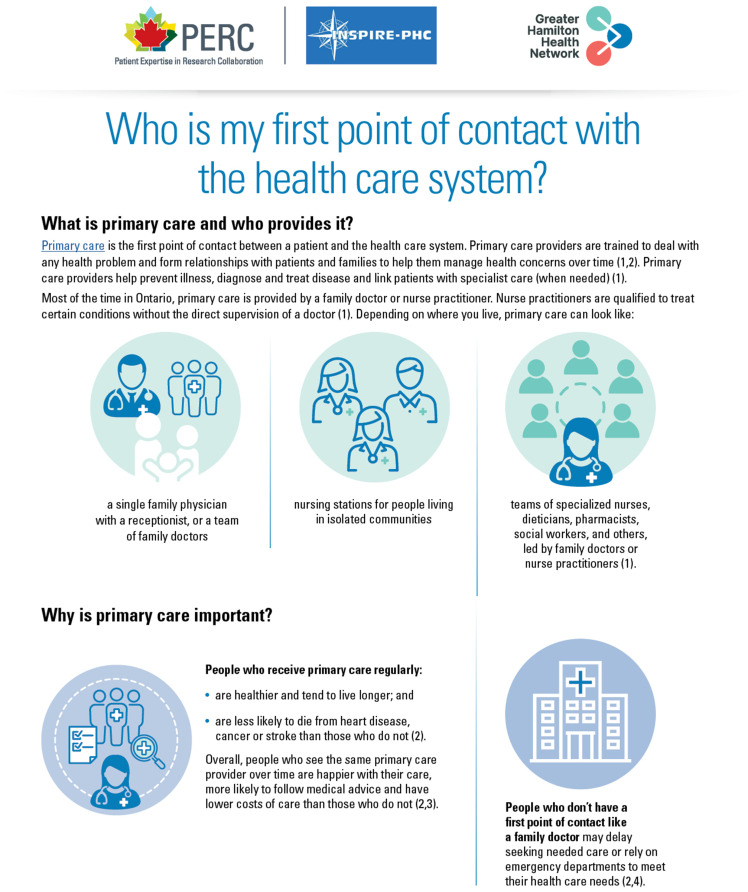
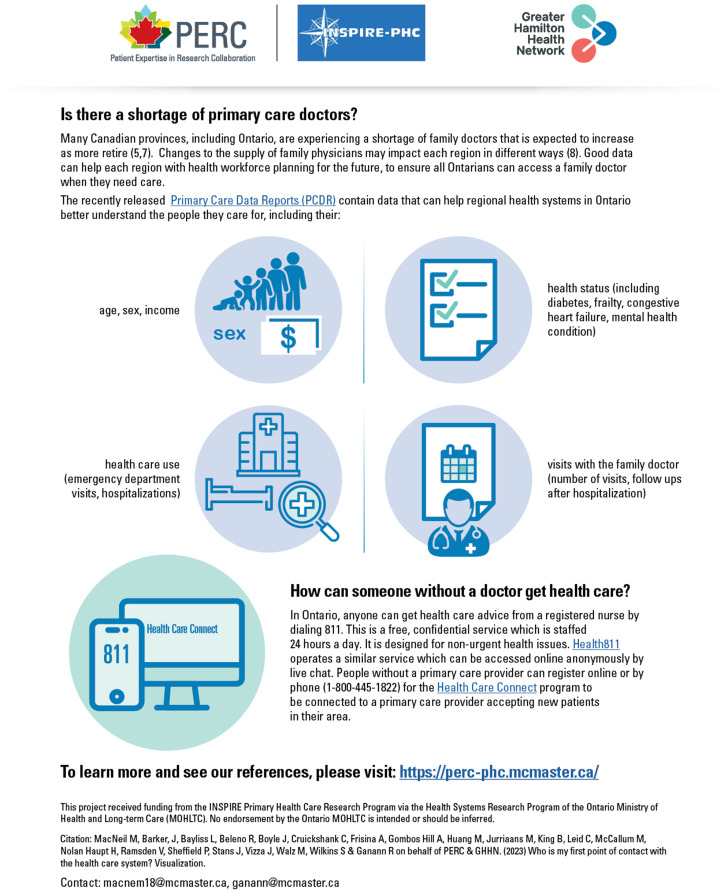
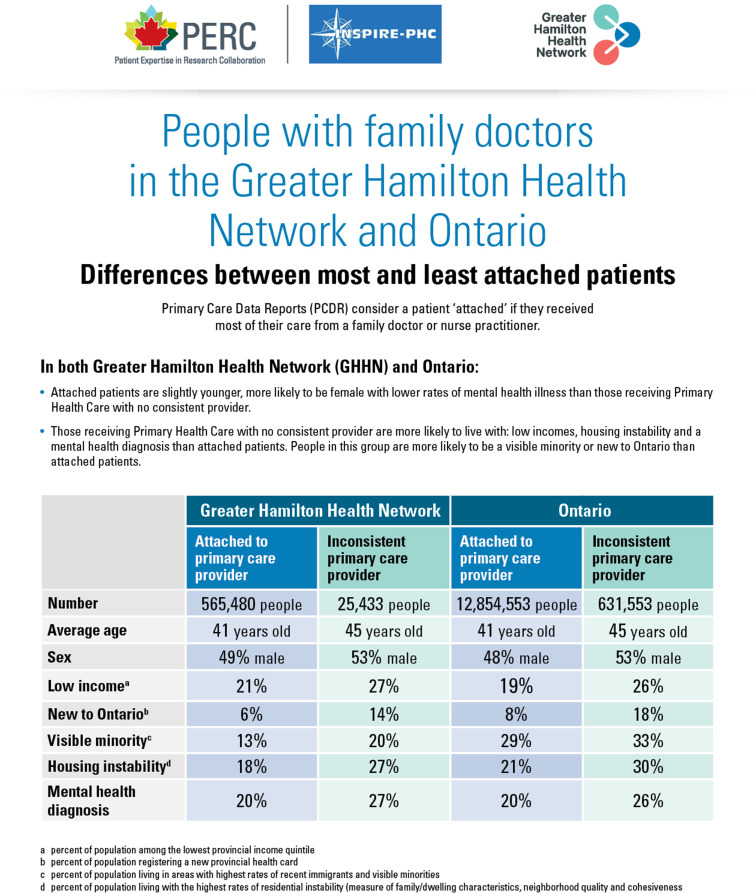
Having a primary care provider is associated with better care experiences and lower care costs. In 2021, INSPIRE-PHC released Primary Care Data Reports - publicly available summaries of administrative billing data about how populations in each of Ontario's 60 health teams use primary care services. Given the characterization of Canadian primary care systems as 'in crisis', publicly available data about primary care at the regional level presented a significant opportunity for knowledge mobilization. An understandable resource could ground the public conversation about primary care access in data. Recognizing the role that lived experience plays in ensuring the public understands research findings, a partnership between patient advisors, Ontario Health Team representatives, researchers, and trainees was established to co-produce public-facing infographics based on primary care data.
Evidence-based guidelines for public health infographic creation and elements of transformative action research guided a six-meeting process to engage up to 14 patient advisors, three Ontario Health Team staff and two primary care trainees. Patient advisors were affiliated with a provincial patient-oriented primary health care research group or a Hamilton-based Ontario Health Team. Ninety-minute meetings were conducted virtually, and notes were shared with attendees to ensure they accurately reflected the conversation. Two consultations with Ontario Health Team-affiliated primary care providers provided direction and ensured project outputs aligned with local priorities.
Project partners shared feedback on draft infographics, audience identification, priority elements from Primary Care Data Reports to include in the infographics, and aesthetic features (e.g., headings, colour scheme, charts). Project partners felt the most important metrics to convey to the public were those that simultaneously reinforced the benefits of primary care on individual health outcomes and health system costs.
Patient engagement in research is becoming widespread, but co-developing knowledge products with patient and health system partners is less common. Our approach to engaging patients prevented both oversimplification and unnecessary complexity in a public-facing visual about attachment to primary care.
拥有一名初级保健提供者与更好的就医体验和更低的医疗成本相关。2021年,初级保健信息与资源促进项目(INSPIRE-PHC)发布了《初级保健数据报告》——这是关于安大略省60个健康团队中每个团队的人群如何使用初级保健服务的行政计费数据的公开摘要。鉴于加拿大初级保健系统被描述为“处于危机之中”,区域层面关于初级保健的公开数据为知识传播提供了重要机会。一份易于理解的资源可以使关于初级保健可及性的公众对话基于数据展开。认识到生活经历在确保公众理解研究结果方面所起的作用,患者顾问、安大略健康团队代表、研究人员和实习生之间建立了合作伙伴关系,以共同制作基于初级保健数据的面向公众的信息图表。
公共卫生信息图表制作的循证指南和变革性行动研究的要素指导了一个为期六次会议的过程,该过程邀请了多达14名患者顾问、三名安大略健康团队工作人员和两名初级保健实习生参与。患者顾问隶属于一个省级以患者为导向的初级卫生保健研究小组或一个位于汉密尔顿的安大略健康团队。90分钟的会议以虚拟方式进行,并与与会者分享会议记录,以确保记录准确反映讨论内容。与隶属于安大略健康团队的初级保健提供者进行的两次磋商提供了指导,并确保项目产出符合当地优先事项。
项目合作伙伴就信息图表草案、受众识别、《初级保健数据报告》中要纳入信息图表的优先要素以及美学特征(如标题、配色方案、图表)分享了反馈意见。项目合作伙伴认为,向公众传达的最重要指标是那些既能强化初级保健对个体健康结果的益处,又能体现对卫生系统成本影响的指标。
患者参与研究正变得越来越普遍,但与患者和卫生系统合作伙伴共同开发知识产品的情况则较少见。我们让患者参与的方法避免了在面向公众的关于与初级保健联系的视觉展示中出现过度简化和不必要的复杂情况。