Shen Xiao-Lei, Jiang Yu-Han, Li Shen-Jie, Xie Xin-Yi, Cheng Yu, Wu Li, Shen Jun, Chen Wei, Liu Jian-Ren
Department of Neurology, Shanghai Ninth People's Hospital, Shanghai Jiao Tong University School of Medicine, Shanghai, 200011, China.
Brain Behav Immun Health. 2024 Oct 18;42:100889. doi: 10.1016/j.bbih.2024.100889. eCollection 2024 Dec.
Patients with coronavirus disease 2019(COVID-2019) infections may still experience long-term effects, with fatigue being one of the most frequent ones. Clinical research on the long COVID in the Chinese population after infection is comparatively lacking.
To collect and analyze the long-term effects of non-severe COVID-19 infection patients and to develop a model for the prediction of fatigue symptoms.
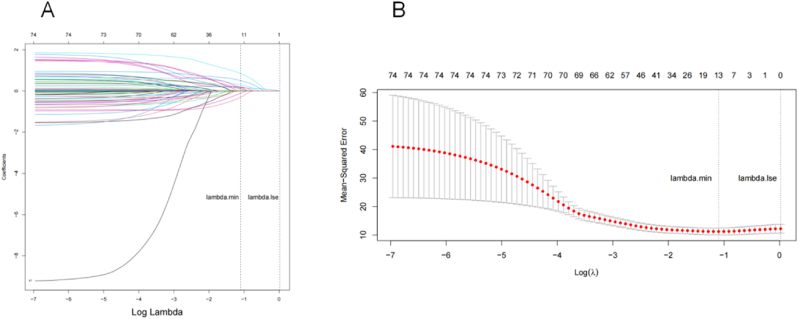
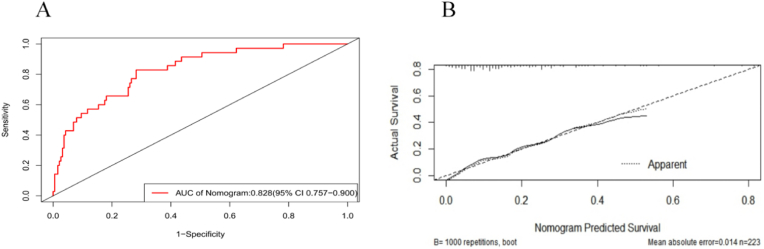
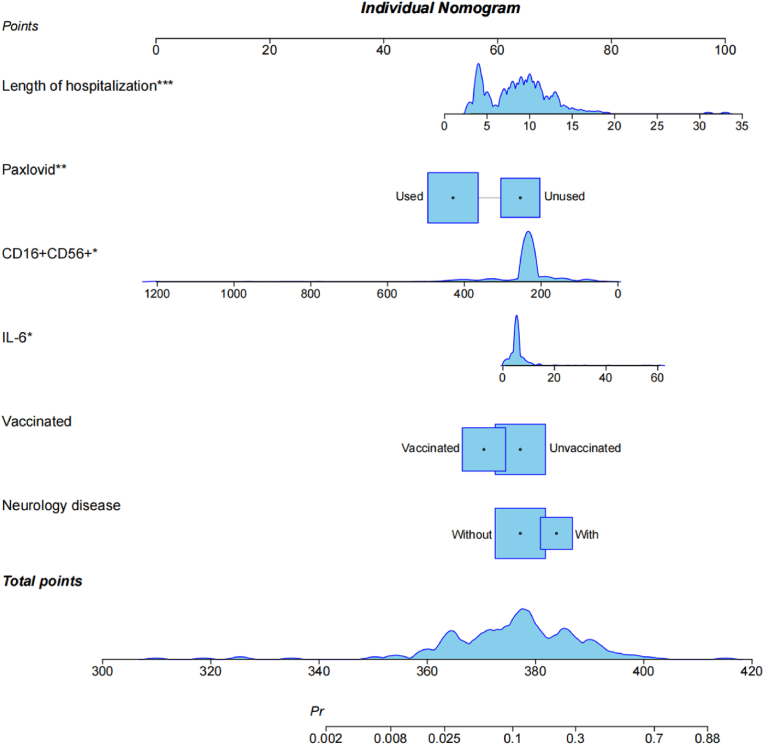
223 non-severe COVID-19 patients admitted to one designated hospital were enrolled after finish all the self-designed clinical information registration form and nine-month follow-up. We explored the frequency and symptom types of long COVID. Correlation analysis was done on the neuropsychological scale results. After cluster analysis, lasoo regression and logistic regressions, a nomogram prediction model was produced as a result of investigating the risk factors for fatigue.
A total of 108 (48.4%) of the 223 non-severe COVID-19 patients reported sequelae for more than 4 weeks, and of these, 35 (15.7%) had fatigue sequelae that were scale-confirmed. Other sequelae of more than 10% were brain fog ( = 37,16.6%), cough ( = 26,11.7%) and insomnia (n = 23,10.3%). A correlation between depression and fatigue was discovered following the completion of neuropsychological scale. The duration of hospitalization, the non-use of antiviral medications in treatment, IL-6 and CD16+CD56 cell levels in blood are the main independent risk factors and predictors of fatigue sequelae in long COVID. Additionally, the neurology diseases and vaccination status may also influence the fatigue sequelae.
Nearly half of the patients infected with COVID-19 Omicron variant complained of sequelae, and fatigue was the most common symptom, which was correlated with depression. Significant predictors of fatigue sequelae included length of hospitalization, non-use of antiviral drug, and immune-related serum markers of IL-6 and CD16+CD56 NK cell levels. The presence of neurology diseases and a lack of vaccination could also predict the occurrence of fatigue sequelae.
2019冠状病毒病(COVID-19)感染患者可能仍会经历长期影响,疲劳是最常见的影响之一。在中国人群中,感染后新冠长期症状的临床研究相对较少。
收集并分析非重症COVID-19感染患者的长期影响,并建立疲劳症状预测模型。
223例入住某指定医院的非重症COVID-19患者在完成所有自行设计的临床信息登记表并进行9个月随访后入组。我们探究了新冠长期症状的发生频率和症状类型。对神经心理量表结果进行相关性分析。经过聚类分析、lasso回归和逻辑回归后,通过研究疲劳的危险因素得出了列线图预测模型。
223例非重症COVID-19患者中,共有108例(48.4%)报告后遗症持续超过4周,其中35例(15.7%)有经量表确认的疲劳后遗症。超过10%的其他后遗症为脑雾(n = 37,16.6%)、咳嗽(n = 26,11.7%)和失眠(n = 23,10.3%)。完成神经心理量表后发现抑郁与疲劳之间存在相关性。住院时间、治疗中未使用抗病毒药物、血液中IL-6和CD16+CD56细胞水平是新冠长期症状中疲劳后遗症的主要独立危险因素和预测因素。此外,神经疾病和疫苗接种状况也可能影响疲劳后遗症。
近一半感染新冠奥密克戎变异株的患者抱怨有后遗症,疲劳是最常见的症状,且与抑郁相关。疲劳后遗症的重要预测因素包括住院时间、未使用抗病毒药物以及IL-6和CD16+CD56自然杀伤细胞水平等免疫相关血清标志物。神经疾病的存在和未接种疫苗也可预测疲劳后遗症的发生。