Gardner Sarah M, Vogt Austin, Penning Trevor M, Marmorstein Ronen
Graduate Group in Biochemistry and Molecular Biophysics, Perelman School of Medicine University of Pennsylvania, Philadelphia, Pennsylvania, USA; Abramson Family Cancer Research Institute, University of Pennsylvania, Philadelphia Pennsylvania, USA.
Abramson Family Cancer Research Institute, University of Pennsylvania, Philadelphia Pennsylvania, USA; Department of Biochemistry and Biophysics, University of Pennsylvania, Philadelphia, Pennsylvania, USA.
J Biol Chem. 2024 Dec;300(12):107945. doi: 10.1016/j.jbc.2024.107945. Epub 2024 Nov 4.
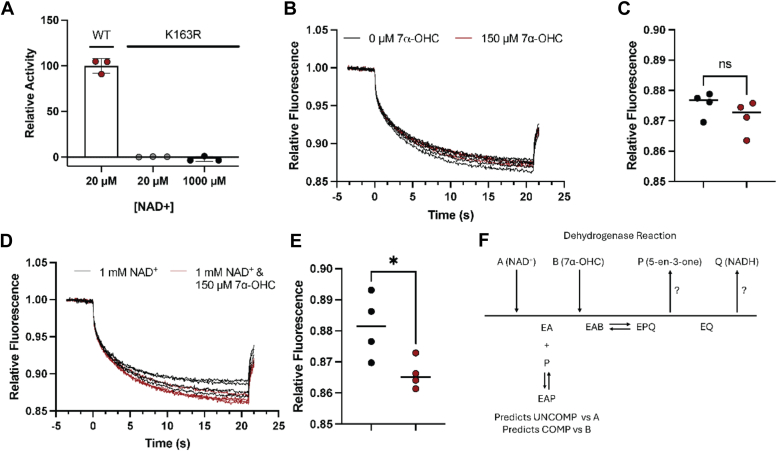
Cholesterol is a key sterol whose homeostasis is primarily maintained through bile acid metabolism. Proper bile acid formation is vital for nutrient and fat-soluble vitamin absorption and emulsification of lipids. Synthesis of bile acids occurs through two main pathways, both of which rely on 3β-hydroxy-Δ-C-steroid oxidoreductase (HSD3B7) to begin epimerization of the 3β hydroxyl of cholesterol into its active 3α conformation. In this sequence, HSD3B7 catalyzes the dehydrogenation of the 3β-hydroxy group followed by isomerization of the Δ-cholestene-3-one. These reactions are some of the many steps that transform cholesterol for either storage or secretion. HSD3B7 has distinct activity from other 3β-HSD family members leaving significant gaps in our understanding of its mode of catalysis and substrate specificity. In addition, the role of HSD3B7 in health and disease positions it as a metabolic vulnerability that could be harnessed as a therapeutic target. To this end, we evaluated the mechanism of HSD3B7 catalysis and reveal that HSD3B7 displays activity toward diverse 7α-hydroxylated oxysterols. HSD3B7 retains its catalytic efficiency toward these substrates, suggesting that its substrate binding pocket can withstand changes in polarity upon alterations to this hydrocarbon tail. Experiments aimed at determining substrate order are consistent with HSD3B7 catalyzing a sequential ordered bi-bi reaction mechanism with the binding of NAD followed by 7α-hydroxycholesterol to form a central complex. HSD3B7 bifunctional activity is dependent on membrane localization through a putative membrane-associated helix giving insight into potential regulation of enzyme activity. We found strong binding of the NADH product thought to activate the isomerization reaction. Homology models of HSD3B7 reveal a potential substrate pocket that allows for oxysterol binding, and mutagenesis was utilized to support this model. Together, these studies offer an understanding of substrate specificity and kinetic mechanism of HSD3B7, which can be exploited for future drug development.
胆固醇是一种关键的甾醇,其体内平衡主要通过胆汁酸代谢来维持。适当的胆汁酸形成对于营养物质和脂溶性维生素的吸收以及脂质的乳化至关重要。胆汁酸的合成通过两条主要途径进行,这两条途径都依赖于3β-羟基-Δ-C-甾醇氧化还原酶(HSD3B7)来启动胆固醇3β羟基向其活性3α构象的差向异构化。在这个过程中,HSD3B7催化3β-羟基的脱氢反应,随后是Δ-胆甾烯-3-酮的异构化反应。这些反应是将胆固醇转化用于储存或分泌的众多步骤中的一部分。HSD3B7具有与其他3β-HSD家族成员不同的活性,这使得我们对其催化模式和底物特异性的理解存在重大差距。此外,HSD3B7在健康和疾病中的作用使其成为一种代谢脆弱点,可被用作治疗靶点。为此,我们评估了HSD3B7的催化机制,并发现HSD3B7对多种7α-羟基化氧甾醇具有活性。HSD3B7对这些底物保持其催化效率,这表明其底物结合口袋能够承受该烃链改变时极性的变化。旨在确定底物顺序的实验与HSD3B7催化顺序有序的双底物双产物反应机制一致,即先结合NAD,然后结合7α-羟基胆固醇形成中心复合物。HSD3B7的双功能活性依赖于通过一个假定的膜相关螺旋进行膜定位,这为酶活性的潜在调节提供了线索。我们发现NADH产物有很强的结合作用,认为它能激活异构化反应。HSD3B7的同源模型揭示了一个允许氧甾醇结合的潜在底物口袋,并利用诱变来支持该模型。总之,这些研究提供了对HSD3B7底物特异性和动力学机制的理解,可用于未来的药物开发。