Department of Earth and Space Sciences, Southern University of Science and Technology, Shenzhen, China.
Guangdong Provincial Key Laboratory of Geophysical High-resolution Imaging Technology, Southern University of Science and Technology, Shenzhen, China.
Nature. 2024 Nov;635(8037):114-120. doi: 10.1038/s41586-024-08069-6. Epub 2024 Nov 6.
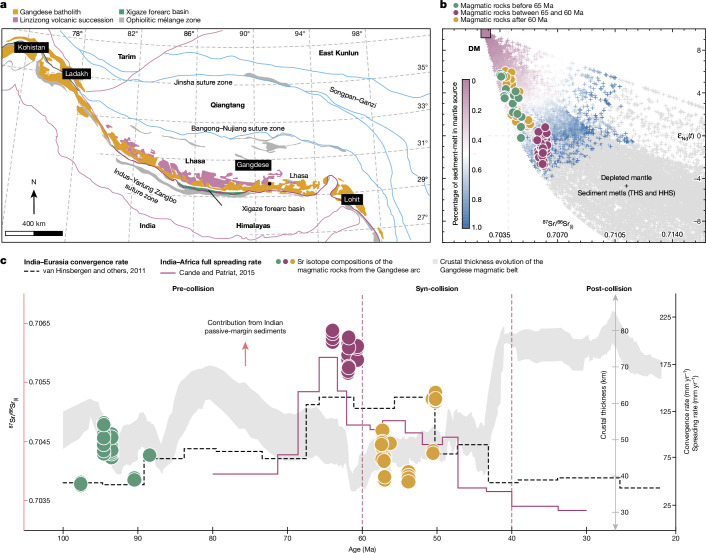
The fast increase of convergence rate between India and Eurasia around 65 million years ago (Ma)-from approximately 8 cm yr to a peak rate of approximately 18 cm yr-remains a complex geological event to explain, given the inherent uncertainty surrounding the tectonic history and the intricate interplay of forces influencing plate speed. Here we use a combination of geochemical analysis and geodynamic modelling to propose that this rapid convergence can be explained by sediment subduction derived from the northern Indian passive margin. Through isotope and trace element analysis, we find an enhanced contribution of terrigenous sediment melt to the mantle source of the Gangdese magmatic rocks around 65 Ma, concurrent with the acceleration of India-Eurasia convergence. Numerical experiments suggest that subduction of sediments more than 1 km thick covering an approximately 1,000-km-wide ocean basin abutting the northern Indian passive margin starting from 65 Ma could have spurred the increased convergence rate and further led to significant crustal extension, consistent with empirical observations. Our study implies that the acceleration of India-Eurasia convergence marks the arrival of passive-margin-derived sediments, constraining the initial India-Eurasia collision to be around 60 Ma. It further suggests that temporary accelerations in subduction rates might be a common feature at the final stage of continental assembly.
印度和欧亚大陆之间的收敛速度在大约 6500 万年前(Ma)快速增加——从大约 8cm/yr 增加到峰值的大约 18cm/yr——鉴于围绕构造历史的固有不确定性以及影响板块速度的复杂力量相互作用,这仍然是一个复杂的地质事件。在这里,我们使用地球化学分析和地球动力学建模的组合来提出,这种快速收敛可以通过来自印度北部被动大陆边缘的沉积物俯冲来解释。通过同位素和微量元素分析,我们发现冈底斯岩浆岩的地幔源中,陆源沉积物熔体的贡献增强,大约在 6500 万年前,与印度-欧亚大陆收敛速度的加速同时发生。数值实验表明,从 6500 万年前开始,俯冲厚度超过 1 公里、覆盖约 1000 公里宽的海洋盆地的沉积物,可以刺激收敛速度的增加,并进一步导致显著的地壳伸展,与经验观察一致。我们的研究表明,印度-欧亚大陆收敛速度的加快标志着被动大陆边缘衍生沉积物的到来,限制了印度-欧亚大陆碰撞的初始时间在 6000 万年前左右。它进一步表明,俯冲速率的暂时加速可能是大陆聚合最后阶段的一个共同特征。