Yuan Jie, Yang Zhenyu, Deng Chenglong, Krijgsman Wout, Hu Xiumian, Li Shihu, Shen Zhongshan, Qin Huafeng, An Wei, He Huaiyu, Ding Lin, Guo Zhengtang, Zhu Rixiang
State Key Laboratory of Lithospheric Evolution, Institute of Geology and Geophysics, Chinese Academy of Sciences, Beijing 100029, China.
College of Resources, Environment and Tourism, Capital Normal University, Beijing 100048, China.
Natl Sci Rev. 2020 Jul 27;8(7):nwaa173. doi: 10.1093/nsr/nwaa173. eCollection 2021 Jul.
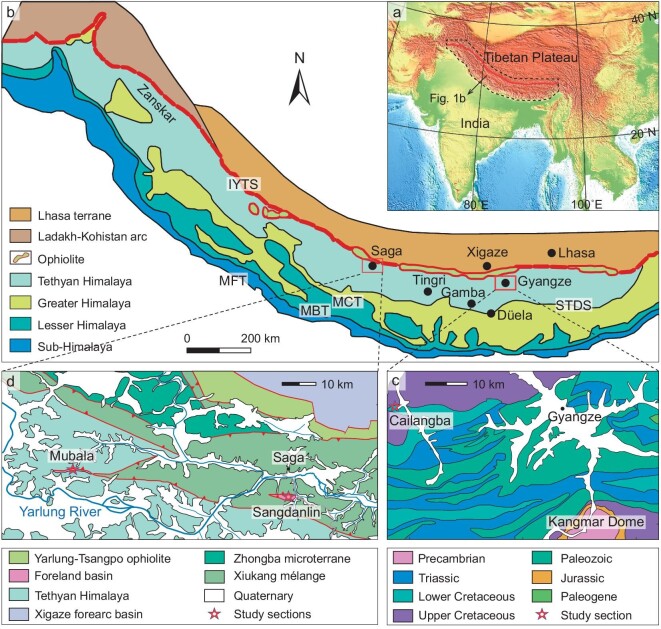
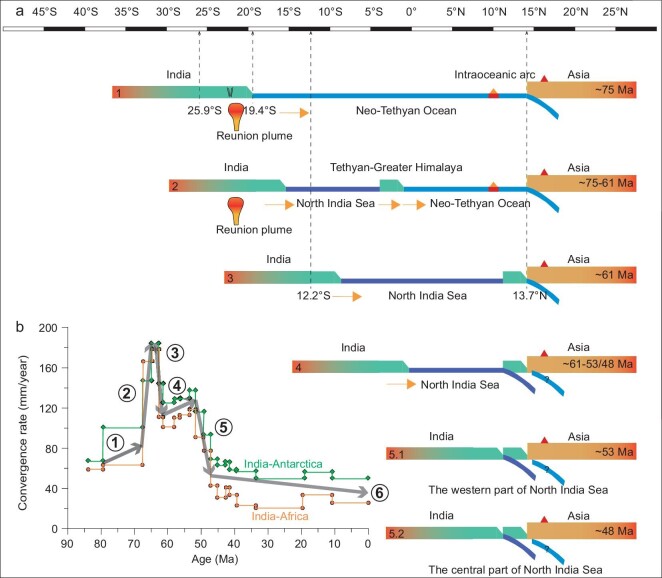
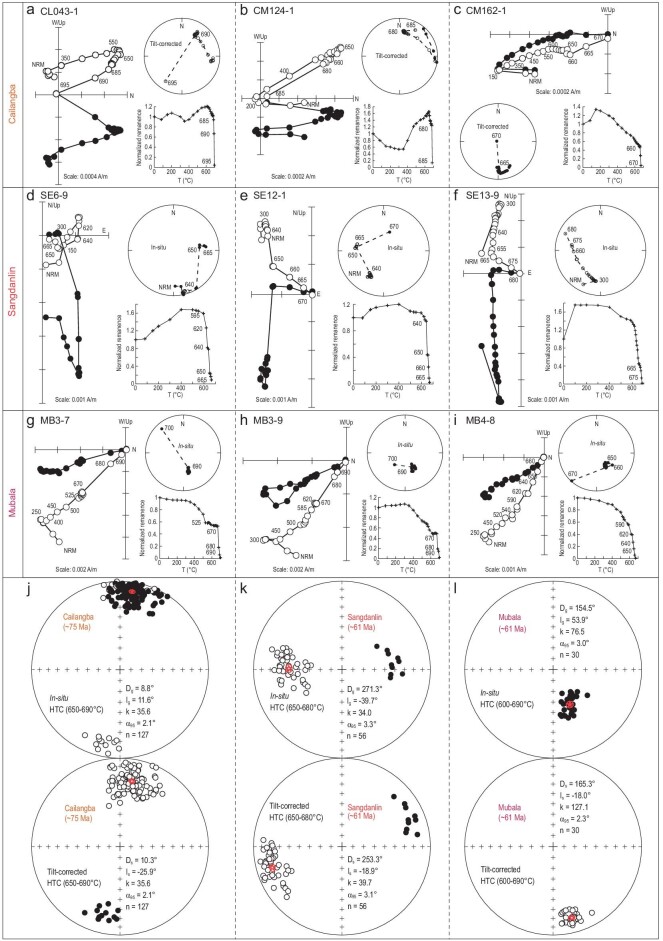
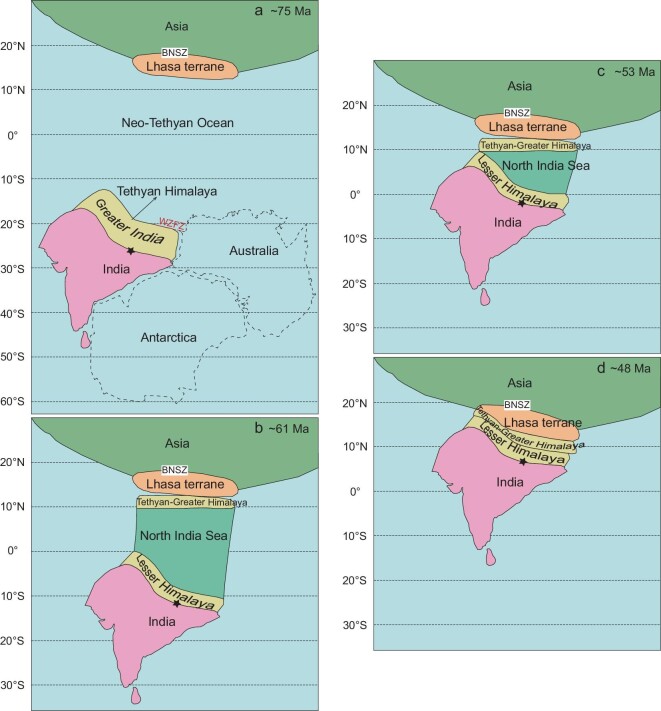
The India-Asia collision is an outstanding smoking gun in the study of continental collision dynamics. How and when the continental collision occurred remains a long-standing controversy. Here we present two new paleomagnetic data sets from rocks deposited on the distal part of the Indian passive margin, which indicate that the Tethyan Himalaya terrane was situated at a paleolatitude of ∼19.4°S at ∼75 Ma and moved rapidly northward to reach a paleolatitude of ∼13.7°N at ∼61 Ma. This implies that the Tethyan Himalaya terrane rifted from India after ∼75 Ma, generating the North India Sea. We document a new two-stage continental collision, first at ∼61 Ma between the Lhasa and Tethyan Himalaya terranes, and subsequently at ∼53-48 Ma between the Tethyan Himalaya terrane and India, diachronously closing the North India Sea from west to east. Our scenario matches the history of India-Asia convergence rates and reconciles multiple lines of geologic evidence for the collision.
印度-亚洲碰撞是大陆碰撞动力学研究中一个突出的确凿证据。大陆碰撞是如何发生以及何时发生的,仍然是一个长期存在的争议问题。在此,我们展示了来自印度被动大陆边缘远端沉积岩石的两个新的古地磁数据集,这些数据集表明,特提斯喜马拉雅地块在约75 Ma时位于约19.4°S的古纬度,并迅速向北移动,在约61 Ma时到达约13.7°N的古纬度。这意味着特提斯喜马拉雅地块在约75 Ma之后从印度裂开,形成了北印度洋。我们记录了一个新的两阶段大陆碰撞过程,首先是在约61 Ma时拉萨地块与特提斯喜马拉雅地块之间发生碰撞,随后在约53 - 48 Ma时特提斯喜马拉雅地块与印度之间发生碰撞,自西向东依次封闭了北印度洋。我们的设想与印度-亚洲汇聚速率的历史相匹配,并协调了碰撞过程的多条地质证据。