Nuffield Department of Public Health, NIHR Policy Research Unit in Maternal and Neonatal Health and Care, National Perinatal Epidemiology Unit, University of Oxford, Old Road Campus, Headington, Oxford, OX3 7LF, UK.
Imperial College Healthcare NHS Trust, London, UK.
BMC Pregnancy Childbirth. 2024 Nov 6;24(1):725. doi: 10.1186/s12884-024-06910-4.
It is challenging for mothers who give birth very preterm to produce sufficient breast milk by expressing for weeks before their baby is able to feed from the breast, and then to transition from tube feeding to breastfeeding. Lactation is most successful when stimulated shortly after birth, established within 72 h, and maintained by expressing 6-8 times a day. This study explored mothers' experiences of how breast milk feeding and breastfeeding for very preterm babies can be supported by staff and the facilities of a neonatal unit.
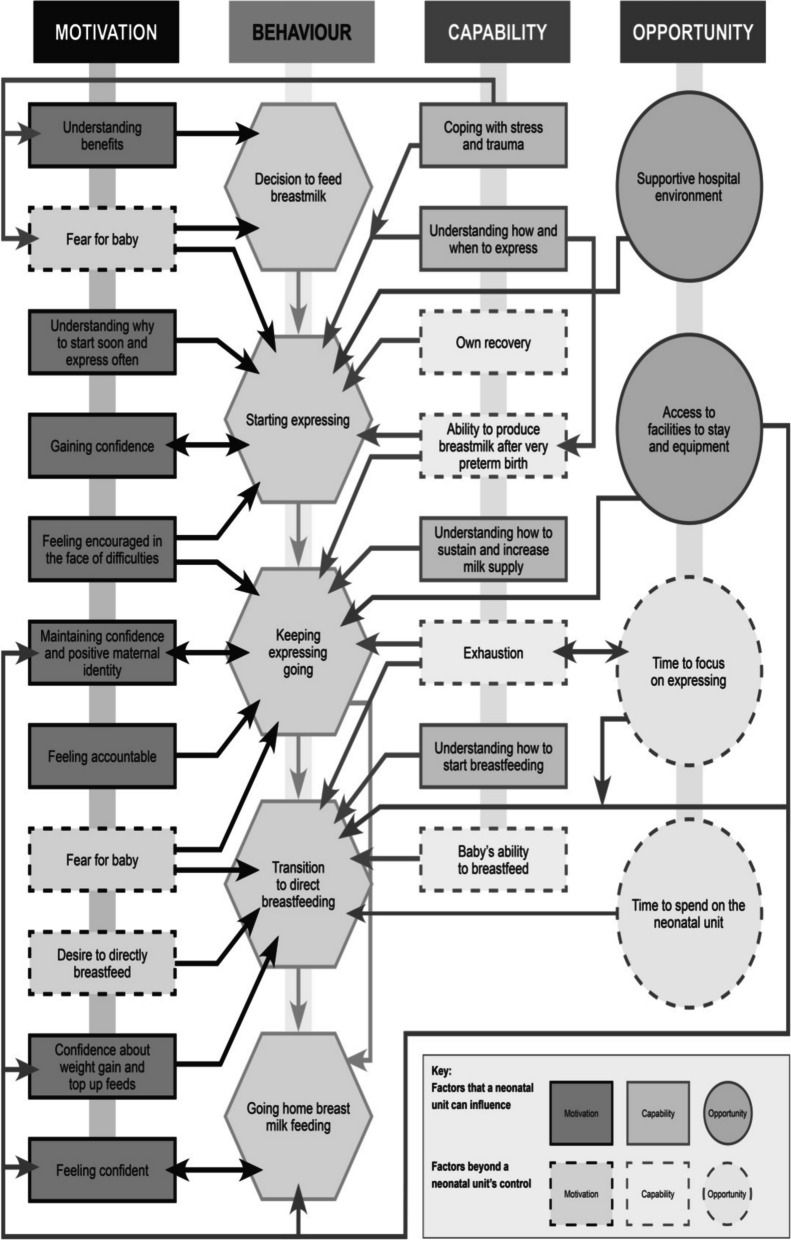
Twenty-three mothers of very preterm babies were interviewed, from four neonatal units in England with high or low rates of breast milk feeding at discharge. Interviews were analysed using the COM-B framework to consider how mothers' behaviour (breast milk feeding and breastfeeding) is affected by capability, opportunity and motivation.
Mothers' motivation in the traumatic situation of very preterm birth was strongly affected by information from staff about the benefits of breast milk for their baby, the importance of early and frequent expressing, and how to assess the effectiveness of direct breastfeeding. It was maintained through positive feedback about their efforts which built their confidence, and reassurance about what is 'normal' growth when a baby begins direct breastfeeding. Motivation needed to be supported by opportunity, including access to equipment for expressing and facilities to stay near the neonatal unit, and also by capability, which required proactive and skilled information and support from staff. Specialist support and facilities varied between units, and some mothers were not given necessary information or had their motivation undermined by staff comments.
Interventions to increase breast milk feeding and breastfeeding for very preterm babies should address mothers' motivation, capability and opportunity, aiming for systematic elimination of obstacles. Mothers value personalised and skilled specialist support, but also need other staff to be able to give consistent information and affirmation focused on their efforts rather than their success, with a trauma-informed approach. Investing in rooming-in facilities that minimise the separation of mothers and babies is likely to overcome a key obstacle.
对于早产儿的母亲来说,通过在婴儿能够从乳房中进食前的数周进行挤奶,并从管饲喂养过渡到母乳喂养,来产生足够的母乳是具有挑战性的。在出生后不久进行刺激、在 72 小时内建立、并通过每天挤奶 6-8 次来维持母乳喂养,是最成功的。本研究探讨了工作人员和新生儿病房的设施如何支持早产儿母亲进行母乳喂养和奶瓶喂养。
对英格兰四家新生儿病房的 23 名早产儿母亲进行了访谈,这四家新生儿病房的母乳喂养率在出院时高低不一。使用 COM-B 框架对访谈进行了分析,以考虑母亲的行为(母乳喂养和奶瓶喂养)如何受到能力、机会和动机的影响。
在早产儿出生的创伤环境中,母亲的动机受到工作人员关于母乳对婴儿益处、早期频繁挤奶的重要性以及如何评估直接母乳喂养效果的信息的强烈影响。工作人员对母亲努力的积极反馈增强了母亲的信心,同时也让母亲对婴儿开始直接母乳喂养时的“正常”生长感到放心,从而维持了母亲的动机。动机需要机会的支持,包括获得挤奶设备和靠近新生儿病房的设施的机会,也需要能力的支持,这需要工作人员提供积极主动和熟练的信息和支持。专科支持和设施在各病房之间存在差异,一些母亲没有得到必要的信息,或者工作人员的评论削弱了她们的动机。
为增加早产儿的母乳喂养和奶瓶喂养,干预措施应针对母亲的动机、能力和机会,旨在系统消除障碍。母亲重视个性化和熟练的专科支持,但也需要其他工作人员能够提供一致的信息和肯定,关注母亲的努力而不是她们的成功,并采用创伤知情的方法。投资于最小化母婴分离的母婴同室设施可能会克服一个关键障碍。