Hirsch Erin A, Fathi Joelle, Ciupek Andrew, Carter-Bawa Lisa
Center for Discovery & Innovation at Hackensack Meridian Health, Cancer Prevention Precision Control Institute, 111 Ideation Way, Nutley, NJ, 07110, USA.
GO2 for Lung Cancer, Washington, DC, USA.
Implement Sci Commun. 2024 Nov 6;5(1):126. doi: 10.1186/s43058-024-00658-w.
The efficacy of lung cancer screening (LCS) to reduce lung cancer specific mortality is heavily dependent on adherence to recommended screening guidelines, with real-world adherence rates reported to be drastically lower than rates described in clinical trials. There is a dearth in the literature on reminder processes and clinical workflows used to address adherence and robust data is needed to fully understand which clinical set-ups, processes, and context enhance and increase continued LCS participation. This paper describes a protocol for an environmental scan of adherence and reminder processes that are currently used in LCS programs across the United States.
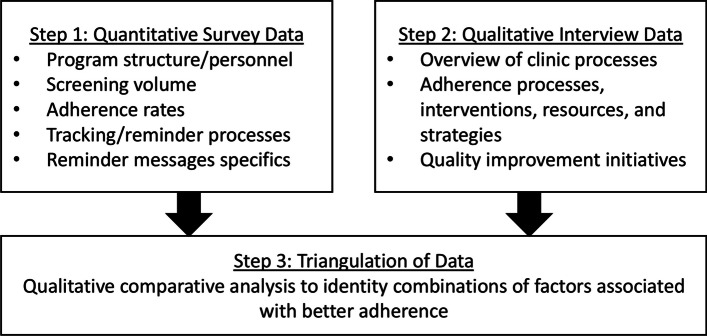
This study will triangulate data using a 3-step explanatory sequential mixed methods design to describe mechanisms of current adherence and reminder systems within academic and community LCS programs to pinpoint clinic or system barrier and facilitator combinations that contribute to increased adherence. In step 1, surveys from a nationally representative sample of LCS programs will yield quantitative data about program structure, volume, and tracking/reminder processes and messages. After completion of the survey, interested LCS program personnel will be invited to participate in an in-depth interview (step 2) to explore current processes and interventions used for adherence at the participant and program level. Finally, in step 3, triangulation of quantitative and qualitative data will be completed through qualitative comparative analysis to identify combinations of components that affect higher or lower adherence.
This research advances the state of the science by filling a gap in knowledge about LCS program characteristics and processes associated with better adherence which can inform the development and implementation of interventions that are scalable and sustainable across a wide variety of clinical practice settings.
肺癌筛查(LCS)降低肺癌特异性死亡率的疗效在很大程度上取决于对推荐筛查指南的遵守情况,据报道,实际世界中的遵守率远低于临床试验中描述的比率。关于用于解决遵守问题的提醒流程和临床工作流程的文献匮乏,需要强有力的数据来全面了解哪些临床设置、流程和背景能增强并提高持续参与肺癌筛查的比例。本文描述了一项对美国各地肺癌筛查项目中目前使用的遵守和提醒流程进行环境扫描的方案。
本研究将采用三步解释性序列混合方法设计对数据进行三角测量,以描述学术和社区肺癌筛查项目中当前遵守和提醒系统的机制,从而确定有助于提高遵守率的诊所或系统障碍及促进因素组合。在第一步中,来自具有全国代表性的肺癌筛查项目样本的调查将产生关于项目结构、数量以及跟踪/提醒流程和信息的定量数据。在调查完成后,感兴趣的肺癌筛查项目人员将被邀请参与深入访谈(第二步),以探索在参与者和项目层面用于提高遵守率的当前流程和干预措施。最后,在第三步中,将通过定性比较分析完成定量和定性数据的三角测量,以确定影响遵守率高低的各组成部分的组合。
本研究通过填补关于肺癌筛查项目特征以及与更好遵守相关的流程方面的知识空白,推动了科学发展,这可为在各种临床实践环境中可扩展且可持续的干预措施的开发和实施提供参考。