Department of Social Work, Education, and Community Wellbeing, Northumbria University, Newcastle Upon Tyne, UK.
Department of Nursing, Midwifery and Health, Northumbria University, Newcastle upon Tyne, UK.
Health Expect. 2023 Oct;26(5):1997-2012. doi: 10.1111/hex.13808. Epub 2023 Jul 4.
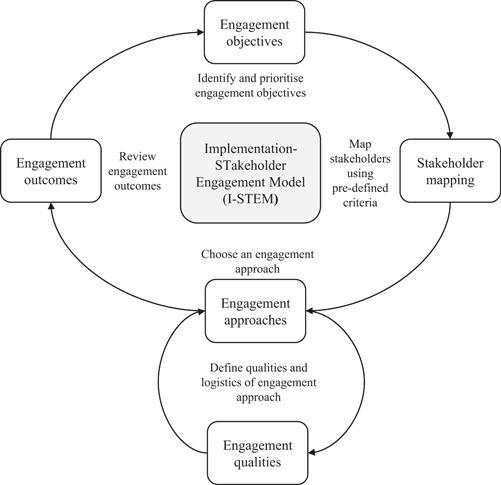
The implementation science literature acknowledges a need for engagement of key stakeholders when designing, delivering and evaluating implementation work. To date, the literature reports minimal or focused stakeholder engagement, where stakeholders are engaged in either barrier identification and/or barrier prioritisation. This paper begins to answer calls from the literature for the development of tools and guidance to support comprehensive stakeholder engagement in implementation research and practice. The paper describes the systematic development of the Implementation-STakeholder Engagement Model (I-STEM) in the context of an international, large-scale empirical implementation study (ImpleMentAll) aimed at evaluating the effectiveness of a tailored implementation toolkit. The I-STEM is a sensitising tool that defines key considerations and activities for undertaking stakeholder engagement activities across an implementation process.
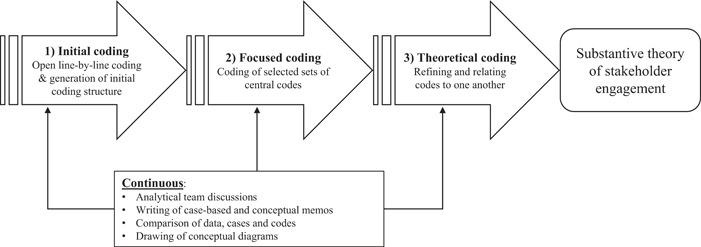
In-depth, semistructured interviews and observations were conducted with implementers who were tailoring implementation strategies to integrate and embed internet-based cognitive behavioural therapy (iCBT) services in 12 routine mental health care organisations in nine countries in Europe and Australia. The analytical process was informed by principles of first- and third-generation Grounded Theory, including constant comparative method.
We conducted 55 interviews and observed 19 implementation-related activities (e.g., team meetings and technical support calls). The final outcome of our analysis is expressed in an initial version of the I-STEM, consisting of five interrelated concepts: engagement objectives, stakeholder mapping, engagement approaches, engagement qualities and engagement outcomes. Engagement objectives are goals that implementers plan to achieve by working with stakeholders in the implementation process. Stakeholder mapping involves identifying a range of organisations, groups or people who may be instrumental in achieving the engagement objectives. Engagement approaches define the type of work that is undertaken with stakeholders to achieve the engagement objectives. Engagement qualities define the logistics of the engagement approach. Lastly, every engagement activity may result in a range of engagement outcomes.
The I-STEM represents potential avenues for substantial stakeholder engagement activity across key phases of an implementation process. It provides a conceptual model for the planning, delivery, evaluation and reporting of stakeholder engagement activities. The I-STEM is nonprescriptive and highlights the importance of a flexible, iterative approach to stakeholder engagement. It is developmental and will require application and validation across a range of implementation activities.
Patient contribution to ImpleMentAll trial was facilitated by GAMIAN-Europe at all stages-from grant development to dissemination. GAMIAN-Europe brings together a wide variety of patient representation organisations (local, regional and national) from almost all European countries. GAMIAN-Europe was involved in pilot testing the ItFits-toolkit and provided their views on the various aspects, including stakeholder engagement. Patients were also represented in the external advisory board providing support and advice on the design, conduct and interpretation of the wider project, including the development of the ItFits-toolkit.
ClinicalTrials.gov NCT03652883. Retrospectively registered on 29 August 2018.
实施科学文献承认,在设计、提供和评估实施工作时需要让主要利益相关者参与进来。迄今为止,文献报告了很少或重点利益相关者的参与,其中利益相关者要么参与了障碍识别,要么参与了障碍优先级排序。本文开始回应文献中的呼吁,即开发工具和指南,以支持在实施研究和实践中全面参与利益相关者。本文描述了在一个国际大型实证实施研究(ImpleMentAll)背景下,系统开发实施-利益相关者参与模型(I-STEM)的情况,该研究旨在评估定制实施工具包的有效性。I-STEM 是一种敏感工具,它定义了在整个实施过程中开展利益相关者参与活动的关键考虑因素和活动。
对实施者进行了深入的半结构化访谈和观察,这些实施者正在调整实施策略,以便将基于互联网的认知行为疗法(iCBT)服务整合和嵌入欧洲和澳大利亚的 12 个常规心理健康护理机构中。分析过程受到第一代和第三代扎根理论原则的指导,包括恒定性比较方法。
我们进行了 55 次访谈并观察了 19 次与实施相关的活动(例如,团队会议和技术支持电话)。我们分析的最终结果以 I-STEM 的初始版本表示,该版本由五个相互关联的概念组成:参与目标、利益相关者映射、参与方法、参与质量和参与结果。参与目标是实施者计划通过与实施过程中的利益相关者合作来实现的目标。利益相关者映射涉及确定一系列可能对实现参与目标有帮助的组织、团体或人员。参与方法定义了与利益相关者一起完成以实现参与目标的工作类型。参与质量定义了参与方法的后勤工作。最后,每一次参与活动都可能产生一系列参与结果。
I-STEM 代表了在实施过程的关键阶段进行实质性利益相关者参与活动的潜在途径。它为利益相关者参与活动的规划、交付、评估和报告提供了一个概念模型。I-STEM 不具有规定性,强调了对利益相关者参与采取灵活、迭代方法的重要性。它是发展性的,需要在各种实施活动中应用和验证。
在 ImpleMentAll 试验的所有阶段,从资助开发到传播,GAMIAN-Europe 都促进了患者的参与。GAMIAN-Europe 将来自欧洲几乎所有国家的各种患者代表组织(地方、地区和国家)聚集在一起。GAMIAN-Europe 参与了 ItFits 工具包的试点测试,并就各个方面提供了他们的意见,包括利益相关者参与。患者还代表了外部顾问委员会,为设计、进行和解释更广泛的项目提供支持和建议,包括 ItFits 工具包的开发。
ClinicalTrials.gov NCT03652883。于 2018 年 8 月 29 日回顾性注册。