Sirotiak Zoe, Lee Duck-Chul, Brellenthin Angelique G
Department of Kinesiology, Iowa State University, Ames, IA, United States.
Department of Health and Human Development, University of Pittsburgh, Pittsburgh, PA, United States.
Front Psychol. 2024 Oct 23;15:1498900. doi: 10.3389/fpsyg.2024.1498900. eCollection 2024.
Physical activity (PA) is associated with better perceived health among individuals with chronic conditions. However, PA's relationship with perceived health in people with long COVID is unclear and may be modified by long COVID symptom burden.
Participants with self-reported long COVID ( = 379) responded to an online survey cross-sectionally assessing PA levels, perceived physical and mental health, and intensity of CDC-defined long COVID symptoms on a 0-100 scale. Linear regression analyses assessed the associations between PA and perceived physical and mental health, after accounting for sociodemographic, health behavior, and long COVID intensity variables, with analyses comparing health across PA levels.
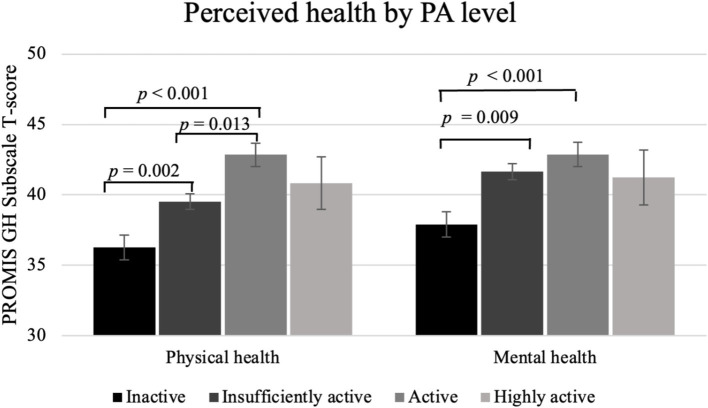
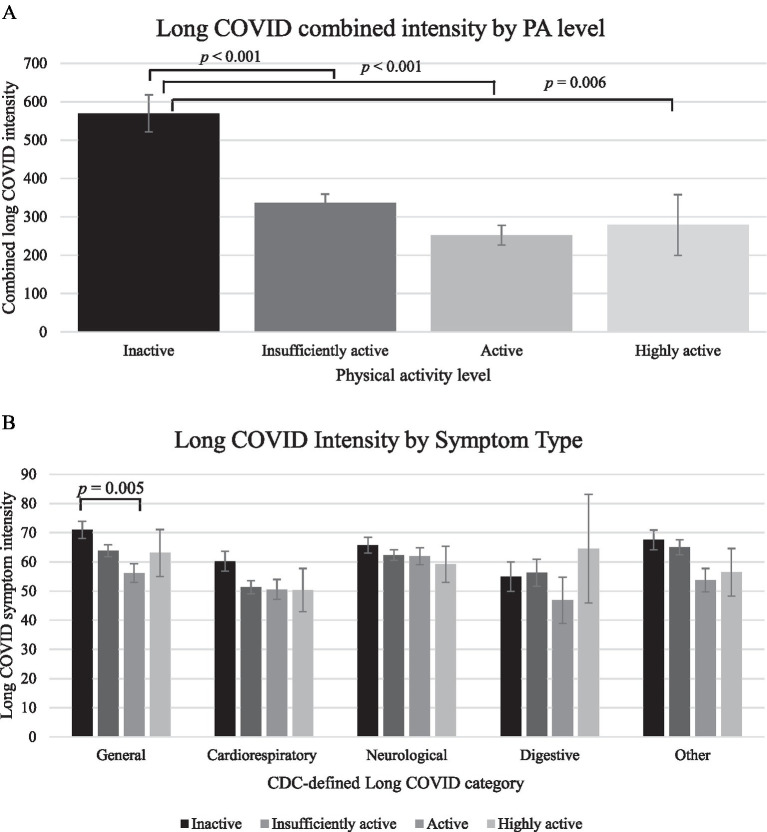
Increasing levels of PA were associated with increases in perceived physical health ( = 0.27, < 0.001) and mental health ( = 0.19, < 0.001) after accounting for sociodemographic and health behavior variables. PA remained significantly associated with perceived physical health ( = 0.15, < 0.001) but not perceived mental health ( = 0.09, = 0.067) after the adding long COVID intensity to the model. Insufficiently active and active groups reported significant better physical and mental health than the inactive group (s < 0.05), while the highly active group did not significantly differ from any other group on perceived physical or mental health (s > 0.05). Inactive individuals reported significantly greater long COVID symptom burden compared to each other PA level (s < 0.05).
Higher levels of PA may be associated with better physical health among individuals with long COVID, even after accounting for symptom intensity. However, long COVID symptom intensity may confound the relationship between PA and mental health among individuals with long COVID.
体育活动(PA)与慢性病患者更好的健康感知相关。然而,PA与长期新冠患者健康感知之间的关系尚不清楚,并且可能会受到长期新冠症状负担的影响。
自我报告患有长期新冠的参与者(n = 379)对一项在线调查进行了横断面回复,该调查评估了PA水平、身心健康感知以及按0-100量表衡量的美国疾病控制与预防中心定义的长期新冠症状强度。线性回归分析在考虑了社会人口统计学、健康行为和长期新冠强度变量后,评估了PA与身心健康感知之间的关联,并进行了跨PA水平比较健康状况的分析。
在考虑了社会人口统计学和健康行为变量后,PA水平的提高与身体健康感知的增加(β = 0.27,p < 0.001)和心理健康感知的增加(β = 0.19,p < 0.001)相关。在模型中加入长期新冠强度后,PA与身体健康感知仍显著相关(β = 0.15,p < 0.001),但与心理健康感知不再显著相关(β = 0.09,p = 0.067)。活动不足和活动组报告的身心健康状况明显优于不活动组(p < 0.05),而高活动组在身体或心理健康感知方面与其他任何组均无显著差异(p > 0.05)。与其他PA水平相比,不活动个体报告的长期新冠症状负担明显更大(p < 0.05)。
即使在考虑症状强度后,较高水平的PA可能与长期新冠患者更好的身体健康相关。然而,长期新冠症状强度可能会混淆长期新冠患者中PA与心理健康之间的关系。