Institut Pasteur d'Alger, Eco-Epidémiologie Parasitaire et Génétique des Populations, Alger, Algeria.
Institut Pasteur, Université Paris Cité, Arboviruses and InsectVectors, Paris, France.
PLoS Negl Trop Dis. 2024 Nov 7;18(11):e0012651. doi: 10.1371/journal.pntd.0012651. eCollection 2024 Nov.
Algeria like other North African countries is experiencing recurrent episodes of West Nile Virus (WNV) emergences and new health threats associated with the introduction of Aedes albopictus in 2010 are to be feared. To improve the surveillance of mosquito-borne pathogens, we performed a study using innovative tools based on multiplex molecular methods.
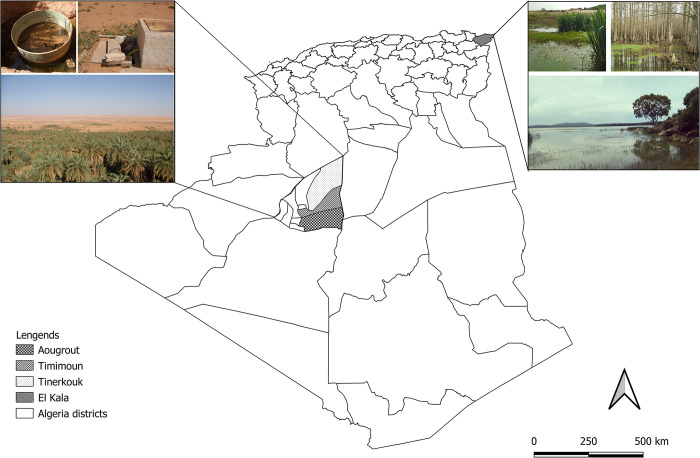
We combined two approaches: a high-throughput chip based on the BioMark Dynamic array system to detect arboviruses in mosquitoes, and a set of immunologic methods (ELISA, microsphere immunoassays (MIA) and virus microneutralization tests (MNT)) for serological surveys in animal hosts. We investigated two distinct regions: a first zone located in the coastal humid region and a second one in the Saharan desert region.
We collected a total of 1,658 mosquitoes belonging to nine different species and found predominantly Culex pipienss. l. (56.5%) and Cx. perexiguus (27.5%). From 180 pools of 10 mosquitoes, we detected four arboviruses: Banna virus (BAV), chikungunya virus (CHIKV), Sindbis virus (SINV), and Usutu virus (USUV). Moreover, we examined 389 blood samples from equids and poultry and found that 52.4% were positive for flavivirus antibodies in ELISA, while 30.8% were positive for WNV and two chickens and two equids were positive for USUV by MNT and MIA respectively.
To our knowledge, this is the first report of five arboviruses circulating in Algeria, with three reported for the first time (CHIKV, BAV, and USUV). Our study brings evidence that reinforcing surveillance using more discriminant tools may help in anticipating future emergences and propose adapted control measures.
阿尔及利亚与其他北非国家一样,经常出现西尼罗河病毒(WNV)的爆发,并且由于 2010 年引入白纹伊蚊,可能会出现新的健康威胁。为了加强对蚊媒病原体的监测,我们使用基于多重分子方法的创新工具进行了一项研究。
我们结合了两种方法:一种是基于 BioMark 动态阵列系统的高通量芯片,用于检测蚊子中的虫媒病毒,另一种是一组免疫方法(ELISA、微球免疫分析(MIA)和病毒微量中和试验(MNT)),用于动物宿主的血清学调查。我们调查了两个不同的区域:一个位于沿海湿润地区,另一个位于撒哈拉沙漠地区。
我们共收集了 1658 只属于九个不同物种的蚊子,主要是库蚊属的淡色库蚊(Culex pipienss. l.)(56.5%)和埃及伊蚊(Cx. perexiguus)(27.5%)。从 180 个 10 只蚊子的混合池中,我们检测到了四种虫媒病毒:巴尼亚病毒(BAV)、基孔肯雅病毒(CHIKV)、辛德毕斯病毒(SINV)和乌舒图病毒(USUV)。此外,我们检查了来自马和家禽的 389 份血液样本,发现 52.4%的样本在 ELISA 中对黄病毒抗体呈阳性,而 30.8%的样本对 WNV 呈阳性,两只鸡和两只马通过 MNT 和 MIA 分别对 USUV 呈阳性。
据我们所知,这是首次在阿尔及利亚报告五种虫媒病毒的循环,其中三种是首次报告(CHIKV、BAV 和 USUV)。我们的研究表明,使用更具鉴别力的工具加强监测,可能有助于预测未来的爆发,并提出相应的控制措施。