Blazek Audrey M, Meade Gabriela, Jackson Lauren M, Gavrilova Ralitza, Stierwalt Julie, Martinez-Thompson Jennifer M, Duffy Joseph R, Clark Heather, Machulda Mary M, Whitwell Jennifer L, Josephs Keith A, Utianski Rene L, Botha Hugo
From the Neurology (A.M.B., L.M.J., R.G., J.M.M.-T., K.A.J., H.B.); Speech Pathology (G.M., J.S., J.R.D., H.C., R.L.U.); Psychology (M.M.M.); and Radiology (J.L.W.), Mayo Clinic, Rochester, MN.
Neurol Genet. 2024 Nov 1;10(6):e200202. doi: 10.1212/NXG.0000000000200202. eCollection 2024 Dec.
To describe a case of spinocerebellar ataxia presenting with progressive apraxia of speech (AOS).
A 54-year-old man with progressive speech changes was seen clinically and referred to our observational research program on degenerative speech and language disorders. He underwent detailed speech-language and neurologic assessments and multimodal neuroimaging studies. Three board-certified speech-language pathologists, blinded to other study data, reached a consensus speech diagnosis.
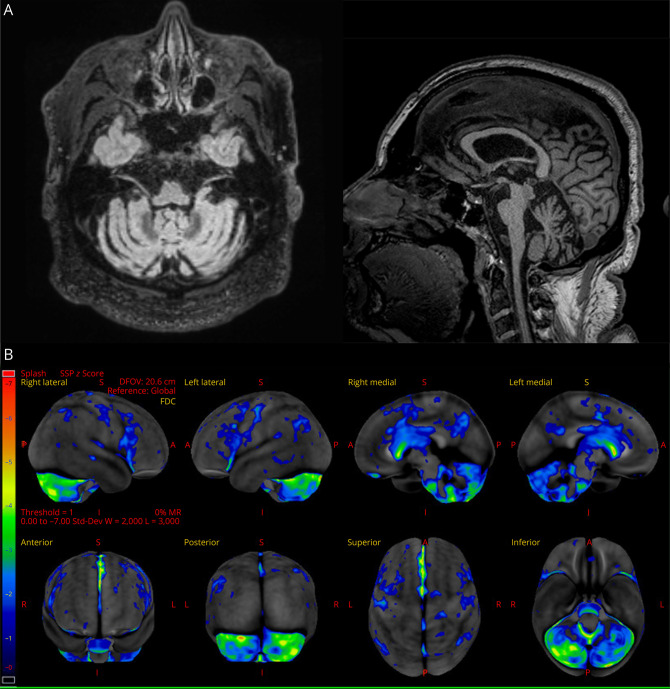
The patient reported 2 years of progressive speech changes against a background of mild imbalance. Speech alternating and sequential motion rates were regular but moderately slow. He segmented syllables, most prominently during repetition of multisyllabic words, and had decreased prosodic variation in connected speech. He was diagnosed with prosodic-predominant primary progressive AOS. He had mild extremity ataxia and difficulty with tandem gait on neurologic examination. MRI showed marked pontine-cerebellar atrophy. FDG-PET showed premotor area and posterior fossa hypometabolism. Genetic testing revealed cytosine-adenine-guanine repeat expansion in the gene, consistent with spinocerebellar ataxia type 2 (SCA2).
SCA2 is an autosomal dominant, degenerative disease characterized by cerebellar ataxia, including ataxic dysarthria. Our case demonstrates that SCA2 can manifest with progressive AOS. Neuroimaging supported involvement of areas classically associated with AOS.
描述一例以进行性言语失用(AOS)为表现的脊髓小脑共济失调病例。
一名有进行性言语变化的54岁男性接受了临床检查,并被转诊至我们关于退行性言语和语言障碍的观察性研究项目。他接受了详细的言语语言和神经学评估以及多模态神经影像学研究。三名获得委员会认证的言语语言病理学家在对其他研究数据不知情的情况下达成了共识性的言语诊断。
患者报告在轻度平衡障碍的背景下有2年的进行性言语变化。言语交替和连续运动速率正常但中度缓慢。他在音节划分方面存在问题,在重复多音节词时最为明显,并且在连贯言语中韵律变化减少。他被诊断为以韵律为主的原发性进行性AOS。神经系统检查发现他有轻度肢体共济失调和串联步态困难。MRI显示明显的脑桥小脑萎缩。FDG-PET显示运动前区和后颅窝代谢减低。基因检测显示该基因存在胞嘧啶-腺嘌呤-鸟嘌呤重复扩增,与2型脊髓小脑共济失调(SCA2)一致。
SCA2是一种常染色体显性退行性疾病,其特征为小脑共济失调,包括共济失调性构音障碍。我们的病例表明SCA2可表现为进行性AOS。神经影像学支持经典上与AOS相关区域的受累。