
肾盂成形术和输尿管重建手术趋势:2006年至2022年德国全人群分析
Pyeloplasty and Ureteral Reconstruction Surgery Trends: A Total Population Analysis in Germany from 2006 to 2022.
作者信息
Flegar Luka, Kipfer Felix, Durmus Tufan, Eisenmenger Nicole, Karschuck Philipp, Aksoy Cem, Reimold Philipp, Martin Thomas, Haak Lennard, Koch Rainer, Moritz Rudolf, Huber Johannes, Groeben Christer
机构信息
Department of Urology, Philipps-University Marburg, Marburg, Germany.
Department of Urology, Royal Melbourne Hospital, Melbourne, VIC, Australia.
出版信息
Eur Urol Open Sci. 2024 Oct 24;70:116-123. doi: 10.1016/j.euros.2024.10.011. eCollection 2024 Dec.
BACKGROUND AND OBJECTIVE
With advancement in technology, it has been possible to use minimally invasive surgical approaches for performing pyeloplasty for the treatment of ureteral strictures. This study aims to investigate the current trends of pyeloplasty and reconstructive ureteral procedures.
METHODS
We analyzed the nationwide German hospital billing database (Destatis) from 2006 to 2022. Linear regression models were utilized for the identification of trends over time.
KEY FINDINGS AND LIMITATIONS
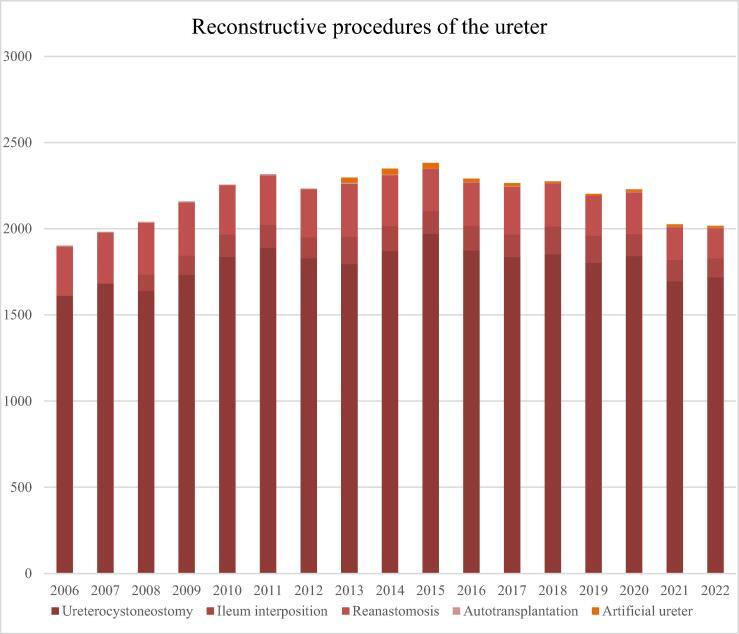
A total of 34 975 pyeloplasties and 37 470 cases with ureteral reconstruction procedures were analyzed. The total number of pyeloplasties increased from 1990 procedures in 2006 to 2251 in 2019, before declining again down to 1916 procedures in 2022 ( = 0.783). Open pyeloplasty cases decreased from 79.5% in 2006 to 17.6% in 2022, while those using the robotic approach increased from 0.3% in 2006 to 35.9% in 2022 ( < 0.001). The median length of stay (LOS) for open pyeloplasty decreased from 13 d in 2006 to 8 d in 2022 ( < 0.001). The median LOS for robotic pyeloplasty decreased from 8 d in 2008 to 5 d in 2022 ( < 0.001). In-hospital mortality was 0.15% after open pyeloplasty versus 0.07% for robotic-assisted pyeloplasty versus 0.03 for laparoscopic pyeloplasty ( = 0.009 for comparison of open vs robotic). Reconstructive ureteral surgical cases per year appeared relatively stable, with 1929 cases in 2006 and 2014 cases in 2022 ( = 0.713). A surgical robot was used in 4.5% of all cases with a ureter reconstruction, with inclining shares per year from 0.2% in 2009 and 18.3% in 2022 ( < 0.001).
CONCLUSIONS AND CLINICAL IMPLICATIONS
This study showed an increasing trend toward minimally invasive pyeloplasty in recent years. For reconstructive procedures, the share of robotics was less pronounced. LOS decreased for all procedures and was shortest for the robotic approach.
PATIENT SUMMARY
In this study, current trends of pyeloplasty and reconstructive ureteral procedures in Germany between 2006 and 2022 were investigated. In recent years, minimally invasive pyeloplasty is increasingly being used and length of hospital stay has also decreased.
背景与目的
随着技术的进步,采用微创外科手术方法进行肾盂成形术治疗输尿管狭窄已成为可能。本研究旨在调查肾盂成形术和输尿管重建手术的当前趋势。
方法
我们分析了2006年至2022年德国全国医院收费数据库(德国联邦统计局)。利用线性回归模型确定随时间的趋势。
主要发现与局限性
共分析了34975例肾盂成形术和37470例输尿管重建手术病例。肾盂成形术的总数从2006年的1990例增加到2019年的2251例,随后再次下降至2022年的1916例(P = 0.783)。开放性肾盂成形术病例从2006年的79.5%降至2022年的17.6%,而机器人手术方法的病例从2006年的0.3%增加到2022年的35.9%(P < 0.001)。开放性肾盂成形术的中位住院时间从2006年的13天降至2022年的8天(P < 0.001)。机器人肾盂成形术的中位住院时间从2008年的8天降至2022年的5天(P < 0.001)。开放性肾盂成形术后的院内死亡率为0.15%,机器人辅助肾盂成形术为0.07%,腹腔镜肾盂成形术为0.03%(开放性与机器人手术比较,P = 0.009)。每年输尿管重建手术病例相对稳定,2006年为1929例,2022年为2014例(P = 0.713)。在所有输尿管重建病例中,4.5%使用了手术机器人,每年的占比从2009年的0.2%上升至2022年的18.3%(P < 0.001)。
结论与临床意义
本研究显示近年来微创肾盂成形术呈上升趋势。对于重建手术,机器人手术的占比不太明显。所有手术的住院时间均有所缩短,机器人手术方法的住院时间最短。
患者总结
本研究调查了2006年至2022年德国肾盂成形术和输尿管重建手术的当前趋势。近年来,微创肾盂成形术的使用越来越多,住院时间也有所缩短。


 Zotero 插件