Li Xun, Chu Van Trung, Kocks Christine, Rajewsky Klaus
Immune Regulation and Cancer, Max-Delbrück-Center for Molecular Medicine in the Helmholtz Association (MDC), Berlin, Germany.
Genome Engineering and Disease Models, Max-Delbrück-Center for Molecular Medicine in the Helmholtz Association (MDC), Berlin, Germany.
Bio Protoc. 2024 Oct 20;14(20):e5085. doi: 10.21769/BioProtoc.5085.
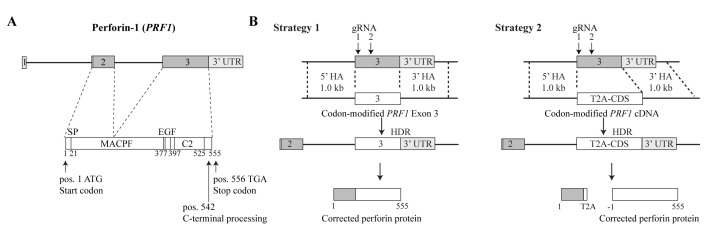
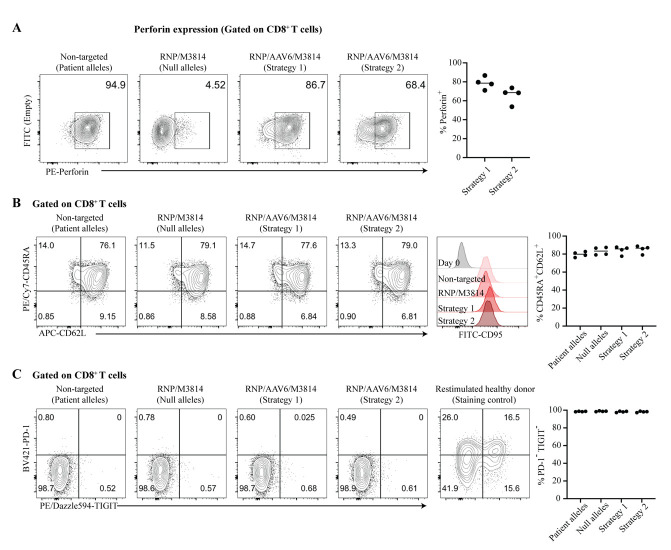
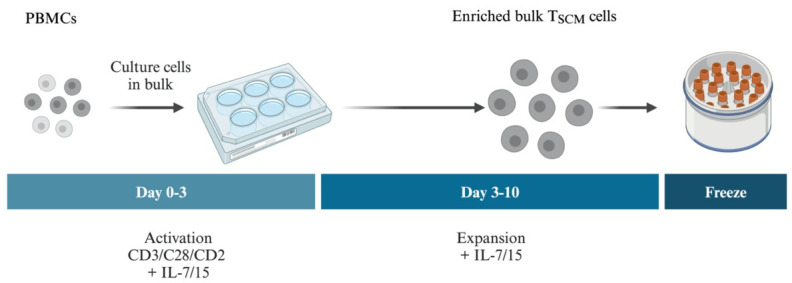
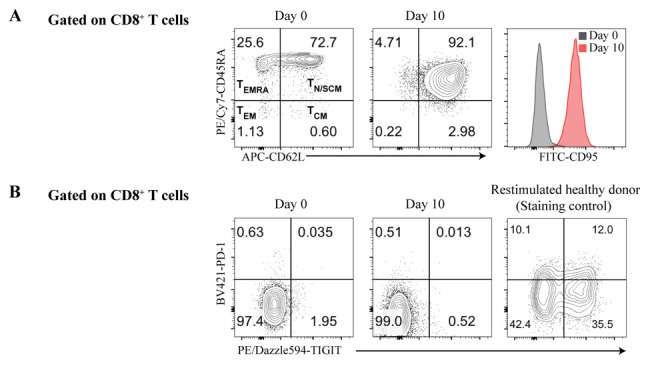
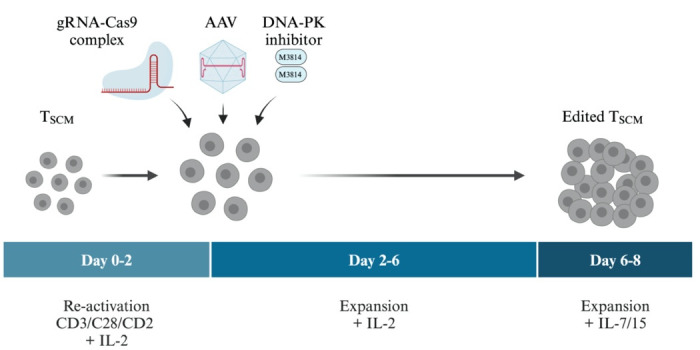
The adoptive transfer of autologous, long-lived, gene-repaired T cells is a promising way to treat inherited T-cell immunodeficiencies. However, adoptive T-cell therapies require a large number of T cells to be manipulated and infused back into the patient. This poses a challenge in primary immunodeficiencies that manifest early in childhood and where only small volumes of blood samples may be available. Our protocol describes the ex vivo expansion of potentially long-lived human T memory stem cells (T), starting from a limited number of peripheral blood mononuclear cells (PBMCs). Using the perforin gene as an example, we provide detailed instructions for precise gene repair of human T cells and the expansion of T. The efficiency of precise gene repair can be increased by suppressing unintended non-homologous end-joining (NHEJ) events. Our protocol yields edited T-cell populations that are ready for phenotyping, genome-wide off-target analysis, and functional characterization. Key features • Expansion and enrichment of T from PBMCs using IL-7 and IL-15. • Phenotyping of T. • Design of "off-the-shelf" gene-repair strategies based on knock-in of a single exon or complete cDNA and design of effective guide RNAs and DNA donor templates. • High-efficiency gene targeting using CRISPR-Cas9, recombinant adeno-associated virus serotype 6 (rAAV6), and a selective small molecule inhibitor of DNA-dependent protein kinase (DNA-PK).
自体、长寿、基因修复的T细胞过继性转移是治疗遗传性T细胞免疫缺陷的一种有前景的方法。然而,过继性T细胞疗法需要大量T细胞进行操作并回输到患者体内。这对于在儿童早期就表现出来且可能仅能获得少量血样的原发性免疫缺陷病来说是一项挑战。我们的方案描述了从有限数量的外周血单个核细胞(PBMC)开始,体外扩增潜在长寿的人类T记忆干细胞(T)。以穿孔素基因为例,我们提供了人类T细胞精确基因修复及T细胞扩增的详细操作指南。通过抑制意外的非同源末端连接(NHEJ)事件,可以提高精确基因修复的效率。我们的方案产生的编辑后T细胞群体可用于表型分析、全基因组脱靶分析和功能表征。关键特性 • 使用IL-7和IL-15从PBMC中扩增和富集T细胞。 • T细胞的表型分析。 • 基于单个外显子敲入或完整cDNA的“现成”基因修复策略设计以及有效引导RNA和DNA供体模板的设计。 • 使用CRISPR-Cas9、重组腺相关病毒6型(rAAV6)和DNA依赖性蛋白激酶(DNA-PK)的选择性小分子抑制剂进行高效基因靶向。