
评估无影像、计算机辅助导航系统中直接前侧全髋关节置换术的替代注册平面。
Evaluating Alternative Registration Planes in Imageless, Computer-Assisted Navigation Systems for Direct Anterior Total Hip Arthroplasty.
机构信息
Sydney Musculoskeletal Health, Kolling Institute, Northern Clinical School, Faculty of Medicine and Health, University of Sydney, Camperdown, NSW 2064, Australia.
Institute of Future Health, South China University of Technology, Guangzhou 511442, China.
出版信息
Sensors (Basel). 2024 Nov 4;24(21):7092. doi: 10.3390/s24217092.
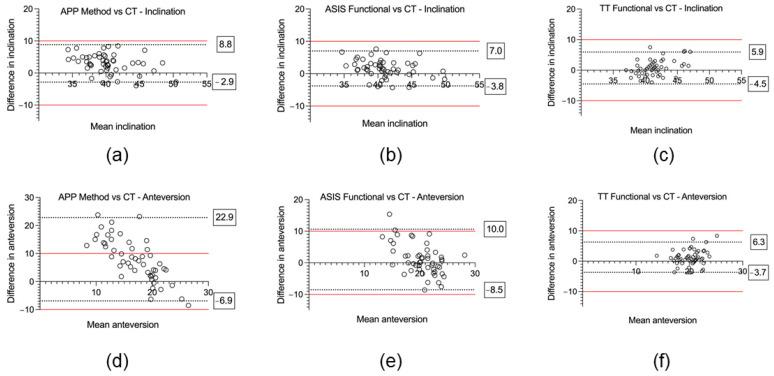
(1) Background: Imageless computer navigation systems have the potential to improve the accuracy of acetabular cup position in total hip arthroplasty (THA). Popular imageless navigation methods include locating the patient in a three-dimensional space (registration method) while using a baseline to angle the acetabular cup (reference plane). This study aims to compare the accuracy of different methods for determining postoperative acetabular cup positioning in THA via the direct anterior approach. (2) Methods: Fifty-one participants were recruited. Optical and inertial sensor imageless navigation systems were used simultaneously with three combinations of registration methods and reference planes: the anterior pelvic plane (APP), the anterior superior iliac spine (ASIS) and the table tilt (TT) method. Postoperative acetabular cup position, inclination, and anteversion were assessed using CT scans. (3) Results: For inclination, the mean absolute error (MAE) was lower using the TT method (2.4° ± 1.7°) compared to the ASIS (2.8° ± 1.7°, = 0.17) and APP method (3.7° ± 2.1°, < 0.001). For anteversion, the MAE was significantly lower for the TT method (2.4° ± 1.8°) in contrast to the ASIS (3.9° ± 3.2°, = 0.005) and APP method (9.1° ± 6.2°, < 0.001). (4) Conclusion: A functional reference plane is superior to an anatomic reference plane to accurately measure intraoperative acetabular cup inclination and anteversion in THA using inertial imageless navigation systems.
(1)背景:无影像计算机导航系统有可能提高全髋关节置换术(THA)中髋臼杯位置的准确性。流行的无影像导航方法包括在三维空间中定位患者(注册方法),同时使用基线来确定髋臼杯的角度(参考平面)。本研究旨在比较直接前入路 THA 中不同方法确定术后髋臼杯位置的准确性。
(2)方法:招募了 51 名参与者。同时使用光学和惯性传感器无影像导航系统,采用三种注册方法和参考平面的组合:骨盆前平面(APP)、髂前上棘(ASIS)和桌子倾斜(TT)方法。使用 CT 扫描评估术后髋臼杯位置、倾斜度和前倾角。
(3)结果:对于倾斜度,TT 方法的平均绝对误差(MAE)较低(2.4°±1.7°),低于 ASIS 方法(2.8°±1.7°,=0.17)和 APP 方法(3.7°±2.1°,<0.001)。对于前倾角,TT 方法的 MAE 明显较低(2.4°±1.8°),低于 ASIS 方法(3.9°±3.2°,=0.005)和 APP 方法(9.1°±6.2°,<0.001)。
(4)结论:在使用惯性无影像导航系统的 THA 中,功能参考平面优于解剖参考平面,可更准确地测量术中髋臼杯倾斜度和前倾角。




 Zotero 插件