Department of Radiology, Sun Yat-Sen Memorial Hospital, Sun Yat-Sen University, Guangzhou, China.
Guangdong Provincial Key Laboratory of Advanced Biomaterials, Department of Biomedical Engineering, Southern University of Science and Technology, Shenzhen, China.
Nat Commun. 2024 Nov 9;15(1):9723. doi: 10.1038/s41467-024-54081-9.
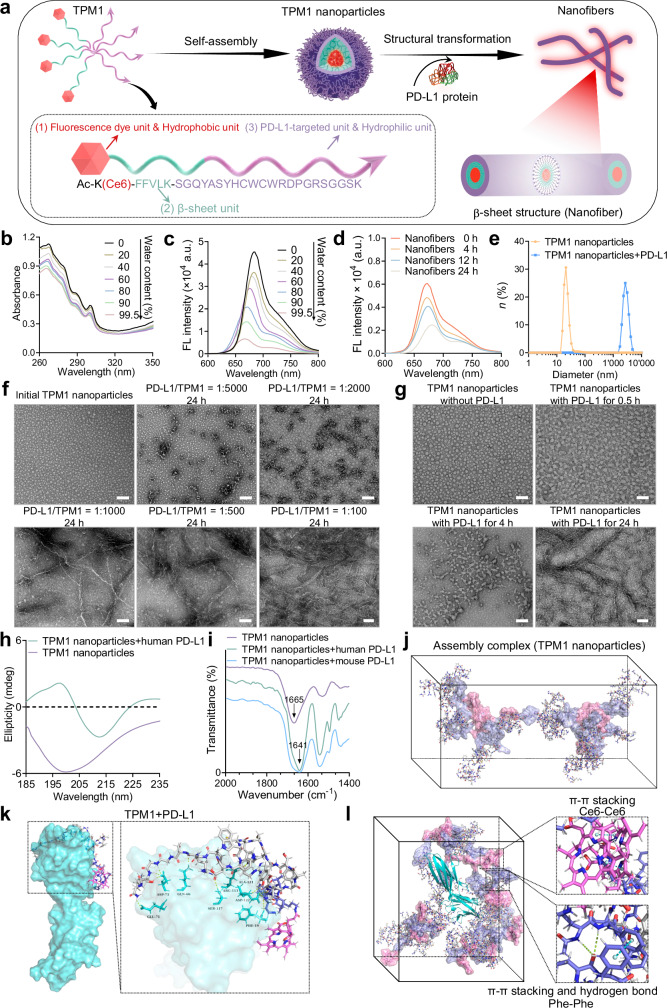
Immune checkpoint blockade (ICB) therapy has emerged as a new therapeutic paradigm for a variety of advanced cancers, but wide clinical application is hindered by low response rate. Here we use a peptide-based, biomimetic, self-assembly strategy to generate a nanoparticle, TPM1, for binding PD-L1 on tumour cell surface. Upon binding with PD-L1, TPM1 transforms into fibrillar networks in situ to facilitate the aggregation of both bound and unbound PD-L1, thereby resulting in the blockade of the PD-1/PD-L1 pathway. Characterizations of TPM1 manifest a prolonged retention in tumour ( > 7 days) and anti-cancer effects associated with reinvigorating CD8 T cells in multiple mice tumour models. Our results thus hint TPM1 as a potential strategy for enhancing the ICB efficacy.
免疫检查点阻断 (ICB) 疗法已经成为多种晚期癌症的一种新的治疗范例,但由于响应率低,其广泛的临床应用受到阻碍。在这里,我们使用基于肽的仿生自组装策略来生成一种纳米颗粒 TPM1,用于结合肿瘤细胞表面的 PD-L1。与 PD-L1 结合后,TPM1 在原位转化为纤维状网络,以促进结合和未结合的 PD-L1 的聚集,从而阻断 PD-1/PD-L1 通路。TPM1 的特性表明其在肿瘤中的滞留时间延长( > 7 天),并与在多种小鼠肿瘤模型中重新激活 CD8 T 细胞相关的抗癌作用。因此,我们的结果提示 TPM1 是一种增强 ICB 疗效的潜在策略。