Institute for Health Economics and Clinical Epidemiology (IGKE), School of Medicine, University of Cologne, Cologne, Germany.
Institute for Research in Operative Medicine (IFOM), Faculty of Health, School of Medicine, Witten/Herdecke University, Ostmerheimer Str. 200, 51109, Cologne, Germany.
BMC Med Res Methodol. 2024 Nov 9;24(1):271. doi: 10.1186/s12874-024-02384-2.
Systematic reviews (SRs) are used to inform clinical practice guidelines and healthcare decision making by synthesising the results of primary studies. Efficiently retrieving as many relevant SRs as possible is challenging with a minimum number of databases, as there is currently no guidance on how to do this optimally. In a previous study, we determined which individual databases contain the most SRs, and which combination of databases retrieved the most SRs. In this study, we aimed to validate those previous results by using a different, larger, and more recent set of SRs.
We obtained a set of 100 Overviews of Reviews that included a total of 2276 SRs. SR inclusion was assessed in MEDLINE, Embase, and Epistemonikos. The mean inclusion rates (% of included SRs) and corresponding 95% confidence intervals were calculated for each database individually, as well as for combinations of MEDLINE with each other database and reference checking. Features of SRs not identified by the best database combination were reviewed qualitatively.
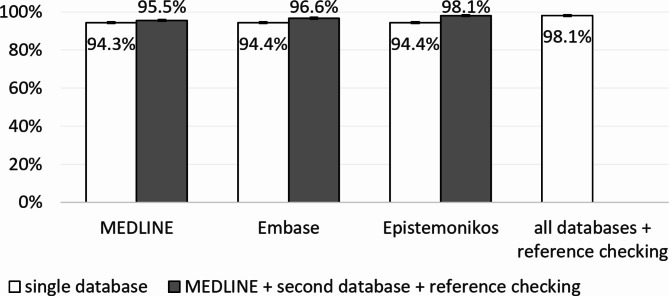
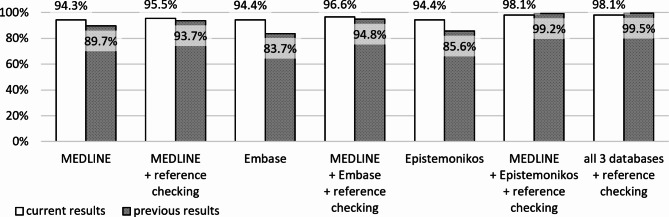
Inclusion rates of SRs were similar in all three databases (mean inclusion rates in % with 95% confidence intervals: 94.3 [93.9-94.8] for MEDLINE, 94.4 [94.0-94.9] for Embase, and 94.4 [93.9-94.9] for Epistemonikos). Adding reference checking to MEDLINE increased the inclusion rate to 95.5 [95.1-96.0]. The best combination of two databases plus reference checking consisted of MEDLINE and Epistemonikos (98.1 [97.7-98.5]). Among the 44/2276 SRs not identified by this combination, 34 were published in journals from China, four were other journal publications, three were health agency reports, two were dissertations, and one was a preprint. When discounting the journal publications from China, the SR inclusion rate in the recommended combination (MEDLINE, Epistemonikos and reference checking) was even higher than in the previous study (99.6 vs. 99.2%).
A combination of databases and reference checking was the best approach to searching for biomedical SRs. MEDLINE and Epistemonikos, complemented by checking the references of the included studies, was the most efficient and produced the highest recall. However, our results point to the presence of geographical bias, because some publications in journals from China were not identified.
https://doi.org/10.17605/OSF.IO/R5EAS (Open Science Framework).
系统评价(SRs)通过综合主要研究的结果,为临床实践指南和医疗保健决策提供信息。使用尽可能少的数据库高效地检索尽可能多的相关 SRs 具有挑战性,因为目前还没有关于如何最佳地做到这一点的指导。在之前的一项研究中,我们确定了哪些单独的数据库包含最多的 SRs,以及哪些数据库组合检索到最多的 SRs。在本研究中,我们旨在使用一组不同的、更大的和更新的 SRs 来验证之前的结果。
我们获得了一组包含 2276 个 SRs 的 100 个综述。在 MEDLINE、Embase 和 Epistemonikos 中评估了 SR 的纳入情况。为每个数据库分别计算了包含的 SR 比例(包含的 SR 比例的平均值和 95%置信区间),以及 MEDLINE 与其他数据库的组合以及参考检查的组合。定性审查了最佳数据库组合未识别的 SRs 的特征。
所有三个数据库中的 SRs 纳入率相似(95%置信区间的平均纳入率为%:MEDLINE 为 94.3[93.9-94.8],Embase 为 94.4[94.0-94.9],Epistemonikos 为 94.4[93.9-94.9])。将参考检查添加到 MEDLINE 将纳入率提高到 95.5[95.1-96.0]。由 MEDLINE 和 Epistemonikos 组成的两个数据库加参考检查的最佳组合为 98.1[97.7-98.5]。在未被该组合识别的 2276 个 SR 中的 44 个中,34 个发表在中国的期刊上,4 个是其他期刊出版物,3 个是卫生机构报告,2 个是学位论文,1 个是预印本。在扣除来自中国的期刊出版物后,在推荐组合(MEDLINE、Epistemonikos 和参考检查)中的 SR 纳入率甚至高于之前的研究(99.6%比 99.2%)。
数据库和参考检查的组合是搜索生物医学 SRs 的最佳方法。由 MEDLINE 和 Epistemonikos 组成,辅以检查纳入研究的参考文献,是最有效的方法,召回率最高。然而,我们的结果表明存在地理偏差,因为来自中国期刊的一些出版物未被识别。