Cherkasova Viktoriia, Kovalchuk Olga, Kovalchuk Igor
Department of Biological Sciences, University of Lethbridge, Lethbridge, Alberta T1K 3M4, Canada.
Oncoscience. 2024 Nov 12;11:99-105. doi: 10.18632/oncoscience.611. eCollection 2024.
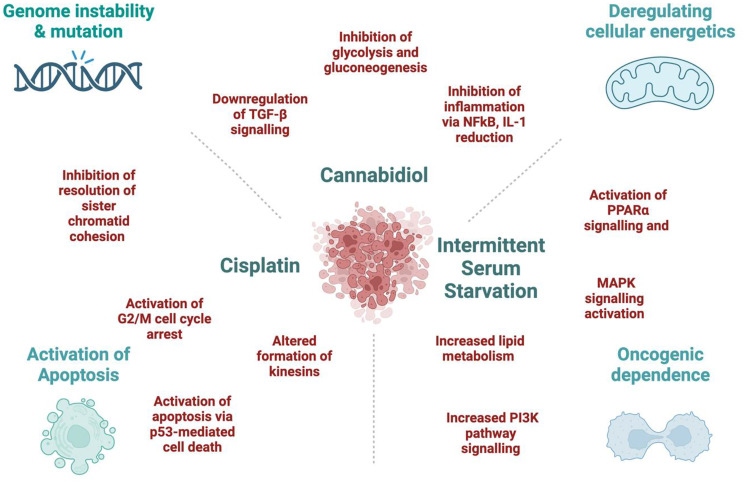
Chemotherapy is a therapy of choice for many cancers. However, it is often inefficient for long-term patient survival and is usually accompanied by multiple adverse effects. The adverse effects are mainly associated with toxicity to normal cells, frequently resulting in immune system depression, nausea, loss of appetite and metabolic changes. In this respect, the combination of chemotherapy with cannabinoids, especially non-psychoactive, such as cannabidiol, cannabinol and other minor cannabinoids, as well as terpenes, may become very useful. This is especially pertinent because the mechanisms of anticancer effects of cannabinoids on cancer cells are often different from conventional chemotherapeutics. In addition, cannabinoids help alleviate chemotherapy-induced adverse effects, regulate sleep and appetite, and are shown to have analgesic properties. Another component for achieving potential anti-cancer synergism is regulating nutrient availability and metabolism by calorie restriction and intermittent fasting in cancer cells. As tumours require a lot of energy to grow and because glucose is constantly available, malignant cells often opt to use glucose as a primary source of ATP production through substrate-level phosphorylation (fermentation) rather than through oxidative phosphorylation. Thus, periodic depletion of cancer cells of primary fuel, glucose, could result in a strong synergy in killing cancer cells by chemo- and possibly radiotherapy when combined with cannabinoids. This commentary will discuss what is known about such combinatorial treatments, including potential mechanisms and future protocols.
化疗是许多癌症的首选治疗方法。然而,它对患者的长期生存往往效果不佳,并且通常伴随着多种不良反应。这些不良反应主要与对正常细胞的毒性有关,常常导致免疫系统抑制、恶心、食欲不振和代谢变化。在这方面,化疗与大麻素(尤其是无精神活性的大麻素,如大麻二酚、大麻酚和其他微量大麻素)以及萜类化合物联合使用可能会非常有用。这一点尤为重要,因为大麻素对癌细胞的抗癌作用机制往往与传统化疗药物不同。此外,大麻素有助于减轻化疗引起的不良反应,调节睡眠和食欲,并且已显示出具有镇痛特性。实现潜在抗癌协同作用的另一个要素是通过对癌细胞进行热量限制和间歇性禁食来调节营养物质的可利用性和代谢。由于肿瘤生长需要大量能量,且葡萄糖持续可得,恶性细胞通常选择通过底物水平磷酸化(发酵)而非氧化磷酸化将葡萄糖作为产生三磷酸腺苷(ATP)的主要来源。因此,定期耗尽癌细胞的主要燃料——葡萄糖,在与大麻素联合使用时,可能会在化疗以及可能的放疗中产生强大的协同作用来杀死癌细胞。本评论将讨论关于此类联合治疗的已知情况,包括潜在机制和未来方案。