Infection Biology Unit, German Primate Center-Leibniz Institute for Primate Research, Göttingen, Germany.
Faculty of Biology and Psychology, Georg-August-University Göttingen, Göttingen, Germany.
PLoS Pathog. 2024 Nov 13;20(11):e1012653. doi: 10.1371/journal.ppat.1012653. eCollection 2024 Nov.
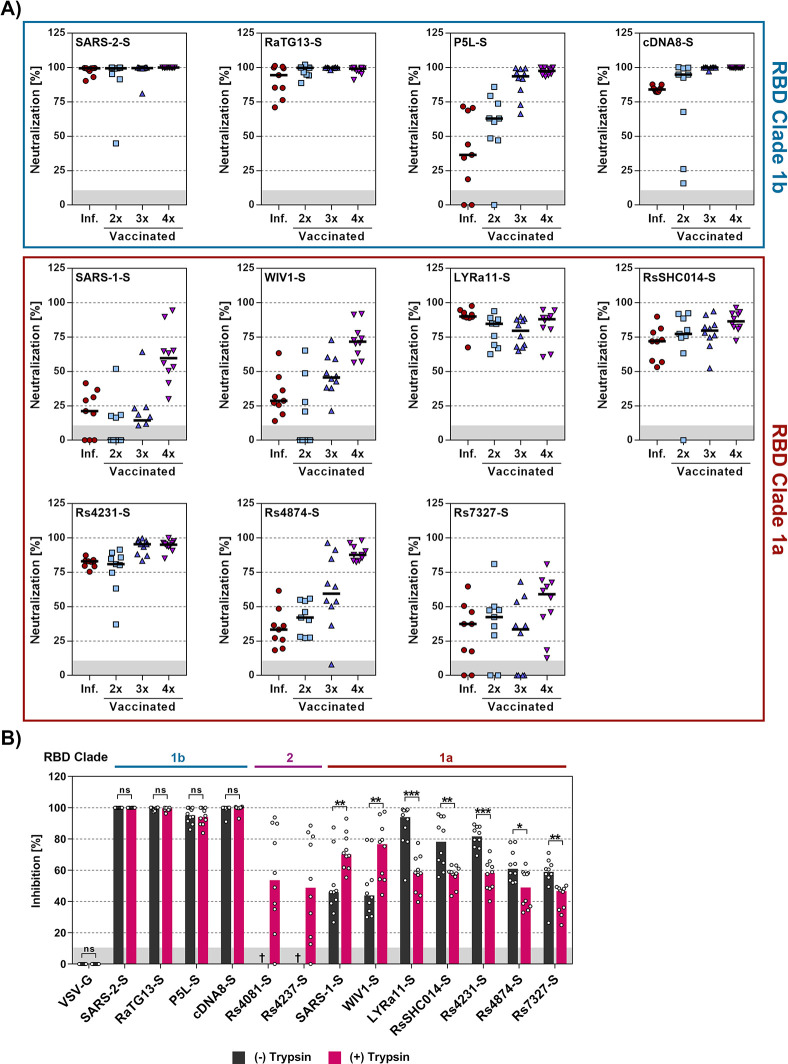
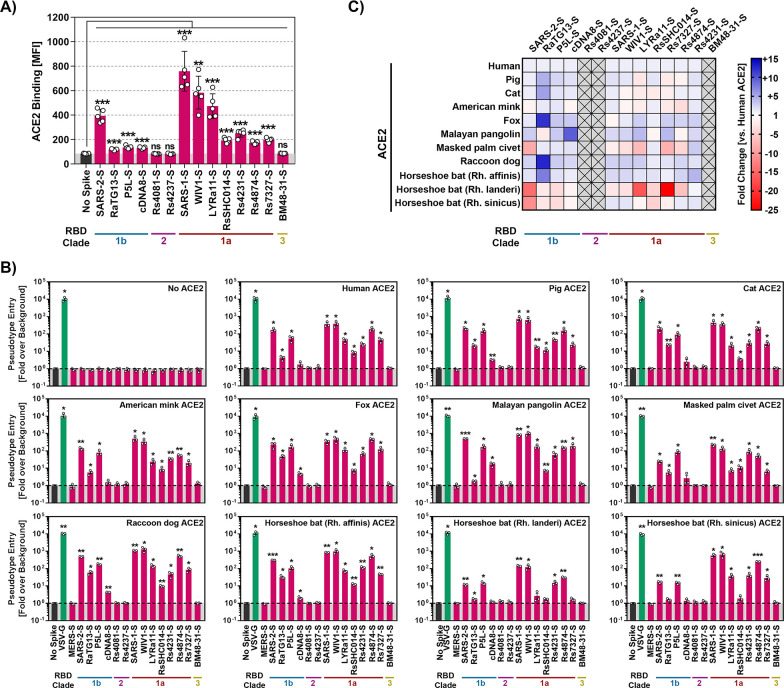
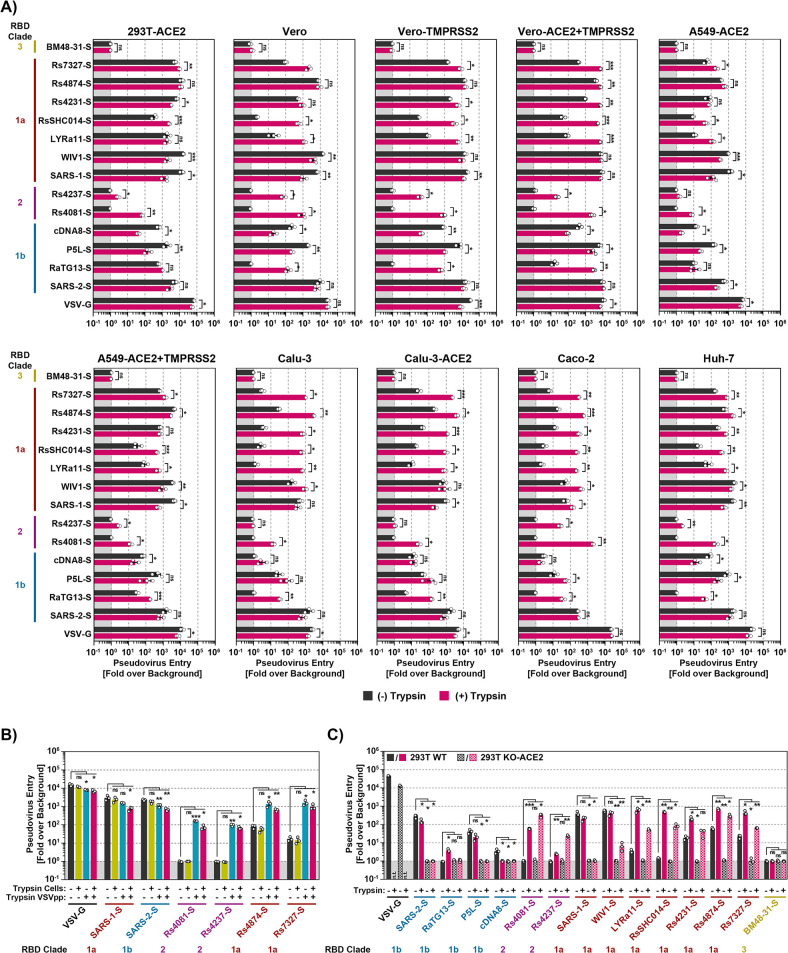
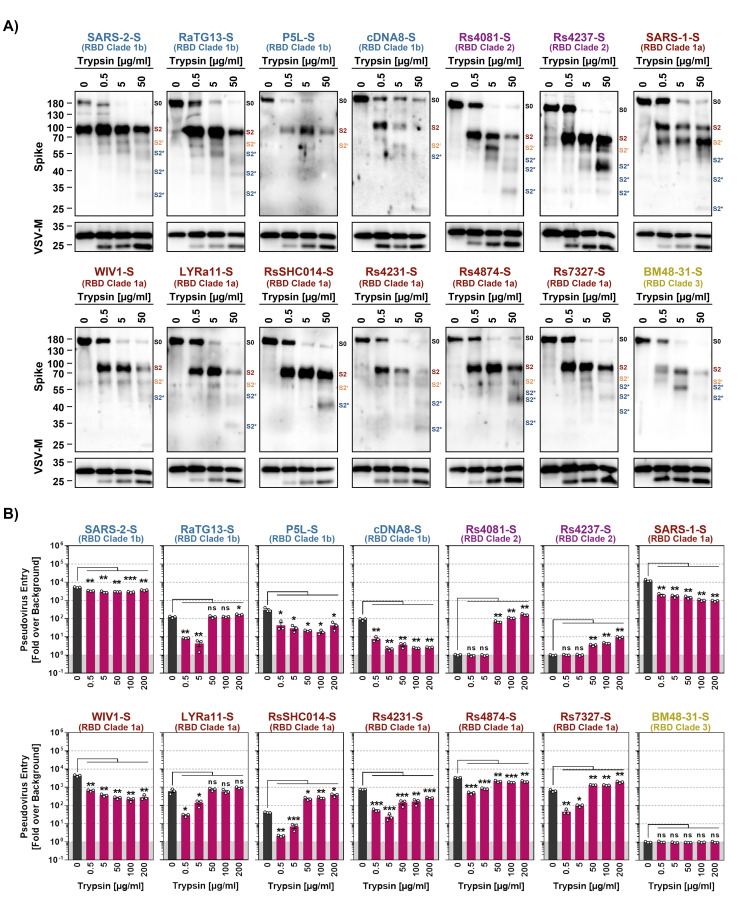
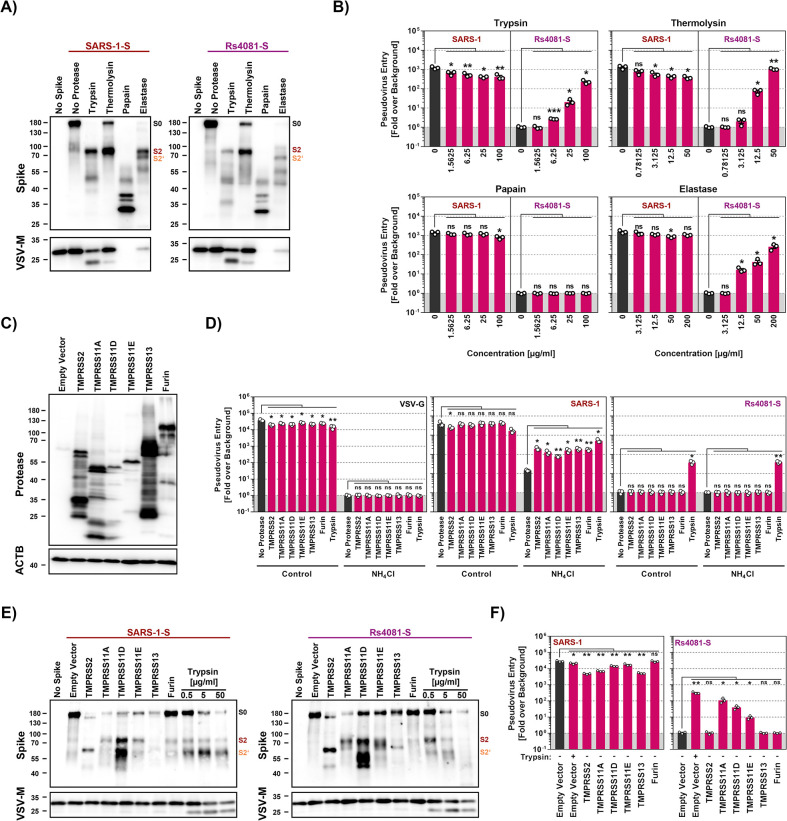
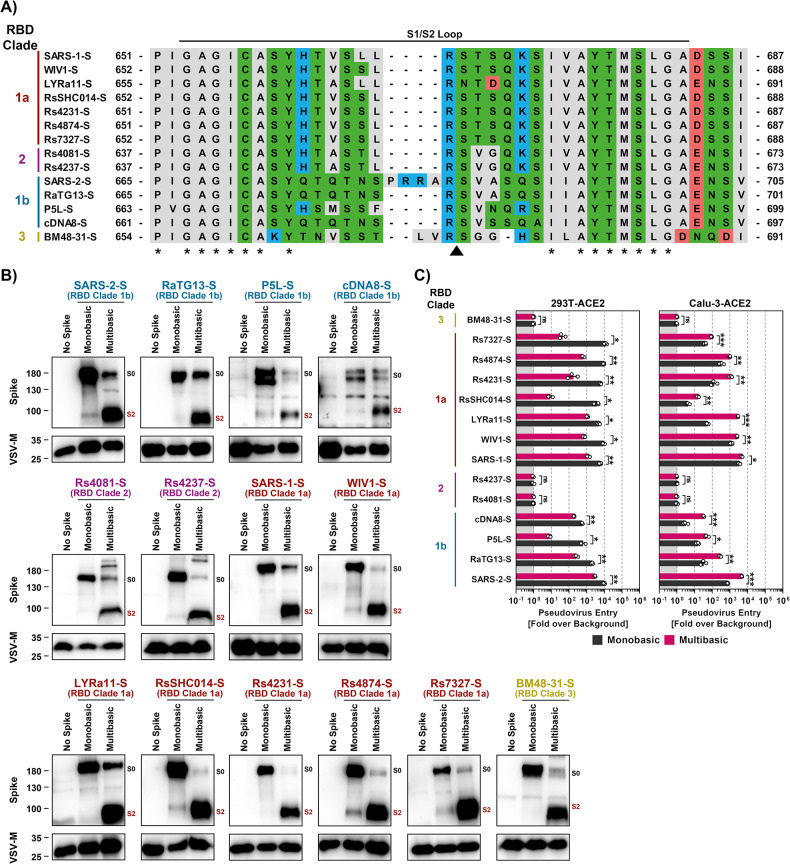
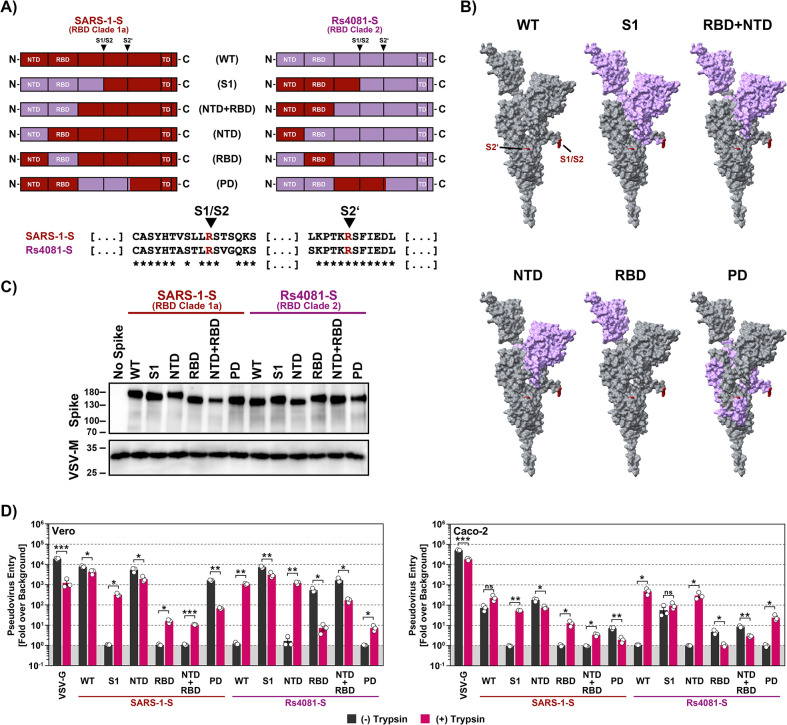
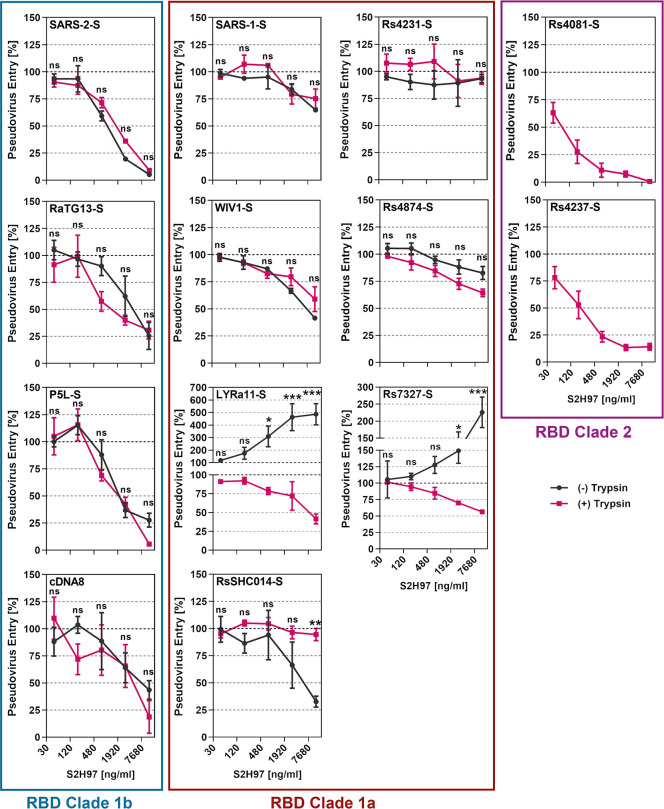
The COVID-19 pandemic, caused by SARS-CoV-2, demonstrated that zoonotic transmission of animal sarbecoviruses threatens human health but the determinants of transmission are incompletely understood. Here, we show that most spike (S) proteins of horseshoe bat and Malayan pangolin sarbecoviruses employ ACE2 for entry, with human and raccoon dog ACE2 exhibiting broad receptor activity. The insertion of a multibasic cleavage site into the S proteins increased entry into human lung cells driven by most S proteins tested, suggesting that acquisition of a multibasic cleavage site might increase infectivity of diverse animal sarbecoviruses for the human respiratory tract. In contrast, two bat sarbecovirus S proteins drove cell entry in an ACE2-independent, trypsin-dependent fashion and several ACE2-dependent S proteins could switch to the ACE2-independent entry pathway when exposed to trypsin. Several TMPRSS2-related cellular proteases but not the insertion of a multibasic cleavage site into the S protein allowed for ACE2-independent entry in the absence of trypsin and may support viral spread in the respiratory tract. Finally, the pan-sarbecovirus antibody S2H97 enhanced cell entry driven by two S proteins and this effect was reversed by trypsin while trypsin protected entry driven by a third S protein from neutralization by S2H97. Similarly, plasma from quadruple vaccinated individuals neutralized entry driven by all S proteins studied, and availability of the ACE2-independent, trypsin-dependent pathway reduced neutralization sensitivity. In sum, our study reports a pathway for entry into human cells that is ACE2-independent, can be supported by TMPRSS2-related proteases and may be associated with antibody evasion.
由 SARS-CoV-2 引起的 COVID-19 大流行表明,动物沙贝科病毒的人畜共患病传播威胁着人类健康,但传播的决定因素尚不完全清楚。在这里,我们表明,大多数马蹄蝠和马来穿山甲沙贝科病毒的刺突(S)蛋白都使用 ACE2 进行进入,而人类和浣熊狗 ACE2 则表现出广泛的受体活性。在 S 蛋白中插入一个多碱性裂解位点会增加大多数测试的 S 蛋白驱动的人肺细胞进入,这表明获得多碱性裂解位点可能会增加不同动物沙贝科病毒对人类呼吸道的感染性。相比之下,两种蝙蝠沙贝科病毒 S 蛋白以 ACE2 非依赖、胰蛋白酶依赖的方式驱动细胞进入,当暴露于胰蛋白酶时,几种 ACE2 依赖的 S 蛋白可以切换到 ACE2 非依赖的进入途径。几种 TMPRSS2 相关的细胞蛋白酶,但不是在 S 蛋白中插入多碱性裂解位点,允许在没有胰蛋白酶的情况下进行 ACE2 非依赖性进入,并且可能支持病毒在呼吸道中的传播。最后,泛沙贝科病毒抗体 S2H97 增强了两种 S 蛋白驱动的细胞进入,而这种效应被胰蛋白酶逆转,而胰蛋白酶保护了第三种 S 蛋白驱动的进入免受 S2H97 的中和。同样,四重接种个体的血浆中和了所有研究的 S 蛋白驱动的进入,而 ACE2 非依赖、胰蛋白酶依赖途径的可用性降低了中和敏感性。总之,我们的研究报告了一种进入人细胞的途径,该途径 ACE2 非依赖,可以由 TMPRSS2 相关蛋白酶支持,并且可能与抗体逃逸有关。