School of Kinesiology and Health Studies, Queen's University, Kingston, ON, Canada.
School of Education, Faculty of the Arts, Social Sciences & Humanities, University of Wollongong, Early Start, Wollongong, Australia.
BMC Pediatr. 2024 Nov 14;24(1):735. doi: 10.1186/s12887-024-05186-z.
Sleep, sedentary behaviour, physical activity, and the composition of these movement behaviours across the 24-h day are associated with cognitive function in early years children. This study used a Goldilocks day compositional data analysis approach to identify the optimal duration of sleep, sedentary behaviour, light physical activity, and moderate-to-vigorous physical activity associated with desired cognitive function outcomes in early years children.
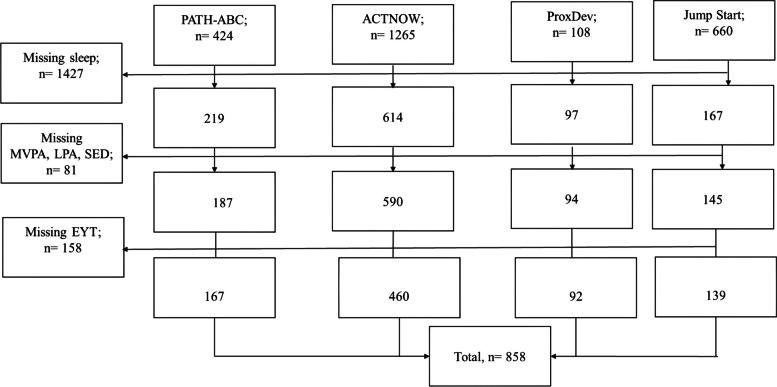
This cross-sectional study included 858 children aged 2.8-5.5 years from the Sleep and Activity Database for the Early Years. 24-h movement behaviours (sleep, sedentary behaviour, light physical activity, moderate-to-vigorous physical activity) were measured using ActiGraph accelerometers. Cognitive function was measured using three tasks from the Early Years Toolbox: visual-spatial working memory, response inhibition, and expressive vocabulary. A Goldilocks day compositional data analysis approach was used in R software to identify the optimal time-use compositions associated with the best 10% of the cognitive function scores.
The movement behaviour composition and the relative time spent in sleep and sedentary behaviour but not different intensities of physical activity were significantly associated with working memory (P ≤ 0.01). The movement behaviour composition and relative time spent in sleep, sedentary behaviour, and different intensities of physical activity were not significantly associated with response inhibition or expressive vocabulary (P > 0.2). Therefore, optimal time use was only determined for working memory. Optimal daily durations for working memory were observed with 11:00 (hr:min) of sleep, 5:42 of sedentary behaviour, 5:06 of light physical activity, and 2:12 of moderate-to-vigorous physical activity.
Working memory was the only cognitive function outcome related to the 24-h movement behaviour composition. Optimal sleep for working memory was consistent with current recommended durations, while optimal moderate-to-vigorous physical activity greatly exceeded minimal recommended levels. Optimal sedentary behaviour was longer and light physical activity was shorter than the sample average.
睡眠、久坐行为、体力活动以及 24 小时内这些运动行为的组成与儿童早期的认知功能有关。本研究使用 Goldilocks 天组成数据分析方法来确定与儿童早期理想认知功能结果相关的最佳睡眠、久坐行为、低强度体力活动和中高强度体力活动时长。
本横断面研究纳入了来自睡眠和早期数据库的 858 名 2.8-5.5 岁儿童。使用 ActiGraph 加速度计测量 24 小时运动行为(睡眠、久坐行为、低强度体力活动、中高强度体力活动)。使用早期工具箱中的三个任务测量认知功能:视觉空间工作记忆、反应抑制和表达词汇。在 R 软件中使用 Goldilocks 天组成数据分析方法确定与认知功能得分最佳的 10%相关的最佳时间利用组成。
运动行为组成和睡眠时间以及久坐行为时间相对比例与工作记忆显著相关(P≤0.01),但不同强度的体力活动无显著相关(P>0.2)。因此,仅确定了工作记忆的最佳时间利用。观察到最佳的每日工作记忆持续时间分别为 11:00(小时:分钟)的睡眠时间、5:42 的久坐行为时间、5:06 的低强度体力活动时间和 2:12 的中高强度体力活动时间。
工作记忆是唯一与 24 小时运动行为组成相关的认知功能结果。最佳的睡眠时长有利于工作记忆,与当前推荐的时长一致,而最佳的中高强度体力活动时间大大超过了最低推荐水平。最佳的久坐行为时间长,低强度体力活动时间短于样本平均值。