Department of Respiratory Medicine, Nanjing Drum Tower Hospital, Affiliated Hospital of Medical School, Nanjing University, Nanjing, China.
Department of Thoracic Surgery, Jinling Hospital, Affiliated Hospital of Medical School, Nanjing University, Nanjing, China.
J Exp Clin Cancer Res. 2024 Nov 15;43(1):302. doi: 10.1186/s13046-024-03220-7.
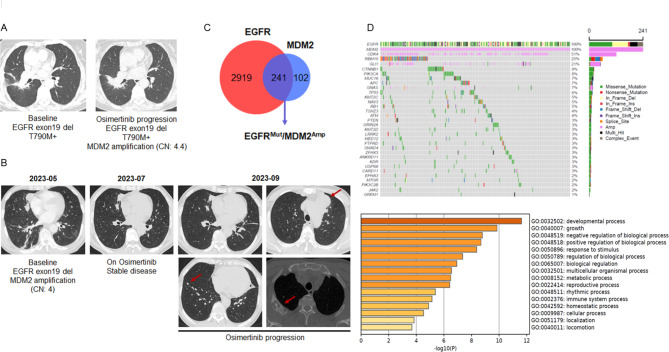
Overcoming resistance to Osimertinib in epidermal growth factor receptor (EGFR) mutant non-small cell lung cancer (NSCLC) is clinically challenging because the underlying mechanisms are not fully understood. The murine double minute 2 (MDM2) has been extensively described as a tumor promotor in various malignancies, mainly through a negative regulatory machinery on the p53 tumor suppressor. However, the significance of MDM2 on the sensitivity to Osimertinib has not been described.
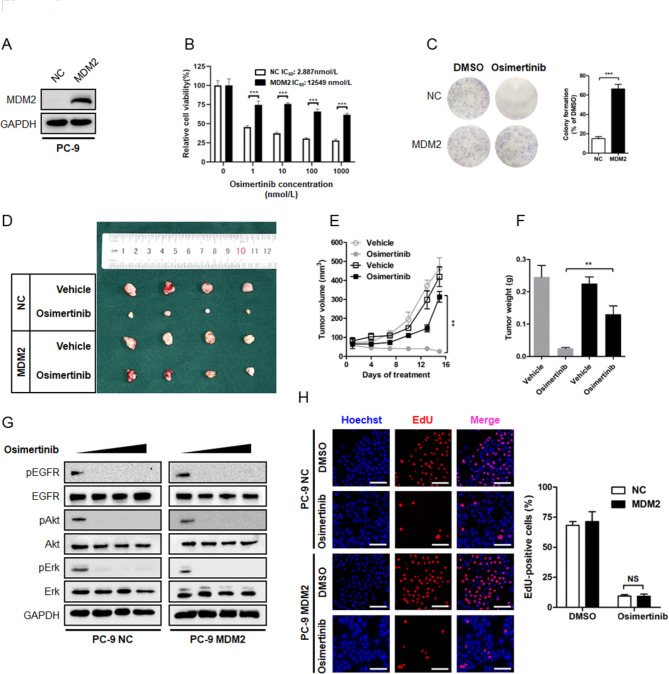
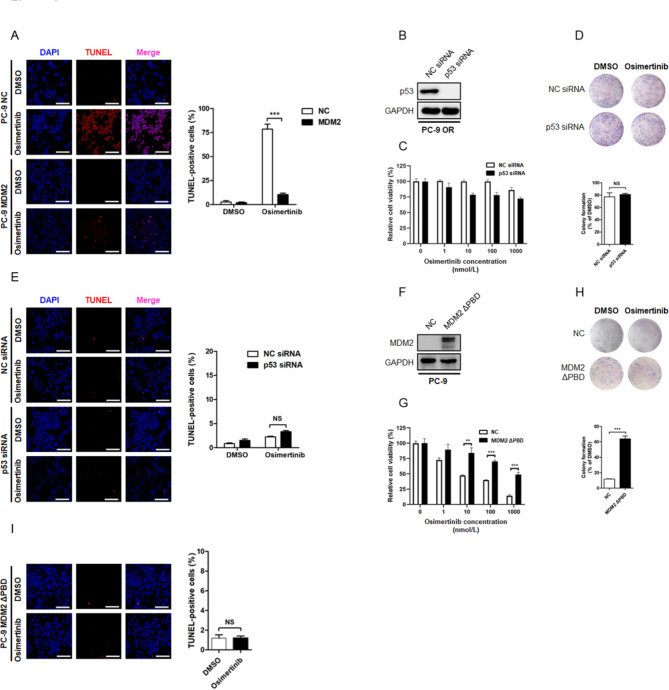
Osimertinib resistant cells were generated by standard dose escalation strategy and individual resistant clones were isolated for MDM2 testing. The MDM2 and its mutant constructs (ΔPBD, ΔRING, C464A) were introduced into PC-9, HCC827 and H1975 cells and evaluated for the sensitivity to Osimertinib by MTT assay, colony formation, EdU assay and TUNEL assay. MDM2 expression in resistant cells was manipulated by pharmacological and molecular approaches, respectively. Proteins that were implicated in PI3K/Akt, MAPK/Erk and apoptosis signaling were measured by Western blot analysis. Candidate proteins that interacted with MDM2 were captured by immunoprecipitation and probed with indicated antibodies.
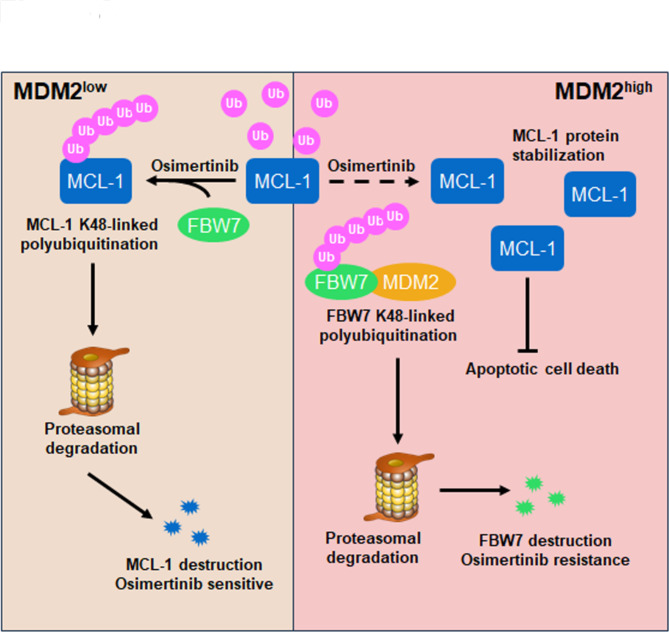
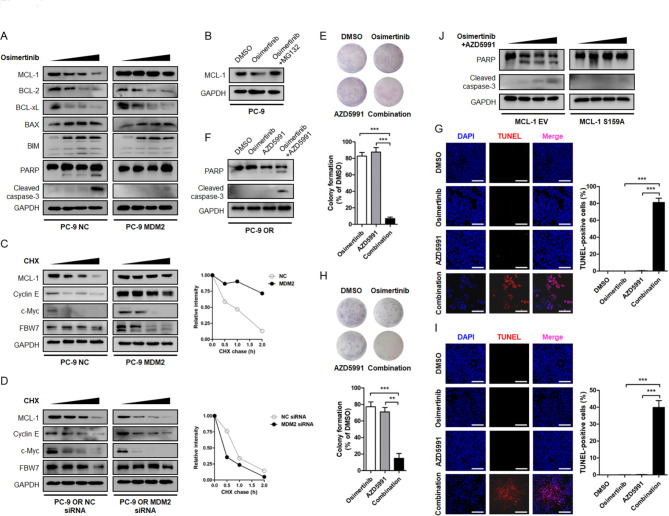
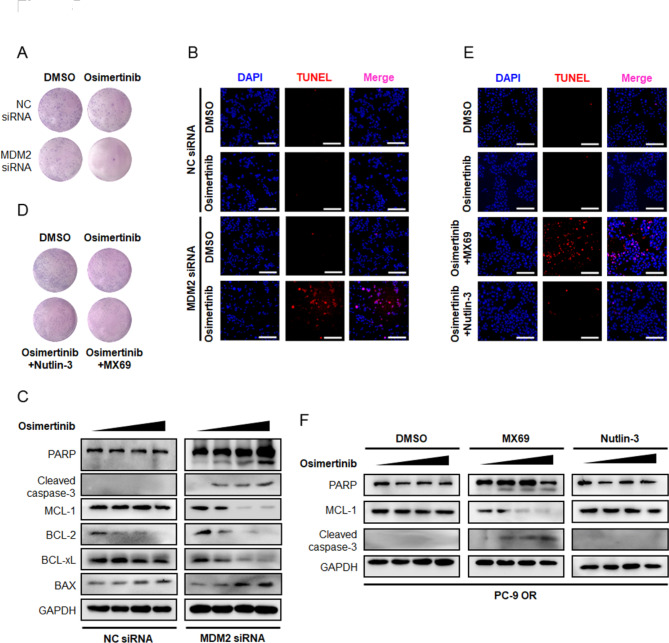
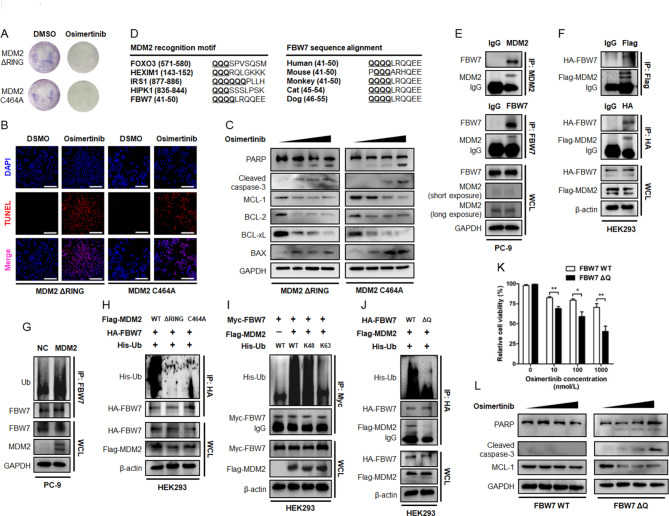
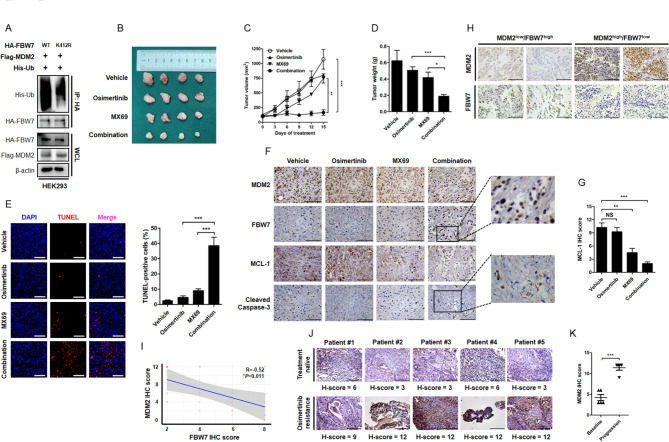
In comparison with parental PC-9 cells, the PC-9 OR resistant cells expressed high level of MDM2. Ectopic expression of MDM2 in PC-9, HCC827 and H1975 sensitive cells generated an Osimertinib resistant phenotype, regardless of p53 status. MDM2 promoted resistance to Osimertinib through a PI3K/Akt and MAPK/Erk-independent machinery, in contrast, MDM2 selectively stabilized MCL-1 protein to arrest Osimertinib-induced cancer cell apoptosis. Mechanistically, MDM2 acted as a E3 ligase to ubiquitinate FBW7, a well-established E3 ligase for MCL-1, at Lys412 residue, which resulted in FBW7 destruction and MCL-1 stabilization. Targeting MDM2 to augment MCL-1 protein breakdown overcame resistance to Osimertinib in vitro and in vivo. Finally, the clinical relevance of MDM2-FBW7-MCL-1 regulatory axis was validated in mouse xenograft tumor model and in NSCLC specimen.
Overexpression of MDM2 is a novel resistant mechanism to Osimertinib in EGFR mutant NSCLC. MDM2 utilizes its E3 ligase activity to provoke FBW7 destruction and sequentially leads to MCL-1 stabilization. Cancer cells with aberrant MDM2 state are refractory to apoptosis induction and elicit a resistant phenotype to Osimertinib. Therefore, targeting MDM2 would be a feasible approach to overcome resistance to Osimertinib in EGFR mutant NSCLC.
克服表皮生长因子受体(EGFR)突变非小细胞肺癌(NSCLC)对奥希替尼的耐药性在临床上具有挑战性,因为其潜在机制尚未完全阐明。鼠双微体 2(MDM2)已在各种恶性肿瘤中被广泛描述为肿瘤促进剂,主要通过对 p53 肿瘤抑制因子的负调控机制。然而,MDM2 对奥希替尼敏感性的意义尚未描述。
通过标准剂量递增策略生成奥希替尼耐药细胞,并分离单个耐药克隆进行 MDM2 检测。将 MDM2 及其突变构建体(ΔPBD、ΔRING、C464A)导入 PC-9、HCC827 和 H1975 细胞,并通过 MTT 测定、集落形成、EdU 测定和 TUNEL 测定评估奥希替尼的敏感性。分别通过药理学和分子方法操纵耐药细胞中的 MDM2 表达。通过 Western blot 分析测量参与 PI3K/Akt、MAPK/Erk 和细胞凋亡信号的蛋白质。通过免疫沉淀捕获与 MDM2 相互作用的候选蛋白,并使用指示抗体进行探测。
与亲本 PC-9 细胞相比,PC-9 OR 耐药细胞表达高水平的 MDM2。在 PC-9、HCC827 和 H1975 敏感细胞中外源表达 MDM2 产生了奥希替尼耐药表型,而与 p53 状态无关。MDM2 通过一种 PI3K/Akt 和 MAPK/Erk 非依赖性机制促进对奥希替尼的耐药性,相反,MDM2 选择性稳定 MCL-1 蛋白以阻止奥希替尼诱导的癌细胞凋亡。在机制上,MDM2 作为 E3 连接酶,在赖氨酸 412 残基上将 FBW7(MCL-1 的一种公认的 E3 连接酶)泛素化,导致 FBW7 破坏和 MCL-1 稳定。靶向 MDM2 以增加 MCL-1 蛋白降解克服了奥希替尼在体外和体内的耐药性。最后,在小鼠异种移植肿瘤模型和 NSCLC 标本中验证了 MDM2-FBW7-MCL-1 调节轴的临床相关性。
在 EGFR 突变 NSCLC 中,MDM2 的过表达是对奥希替尼耐药的一种新机制。MDM2 利用其 E3 连接酶活性引发 FBW7 破坏,并随后导致 MCL-1 稳定。具有异常 MDM2 状态的癌细胞对凋亡诱导无反应,并产生对奥希替尼的耐药表型。因此,靶向 MDM2 可能是克服 EGFR 突变 NSCLC 对奥希替尼耐药性的一种可行方法。