St Pierre Skyler R, Darwin Ethan C, Adil Divya, Aviles Magaly C, Date Archer, Dunne Reese A, Lall Yanav, Parra Vallecillo María, Perez Medina Valerie A, Linka Kevin, Levenston Marc E, Kuhl Ellen
Department of Mechanical Engineering, Stanford University, Stanford, CA, USA.
Institute of Applied Mechanics, RWTH Aachen, Aachen, Germany.
NPJ Sci Food. 2024 Nov 15;8(1):94. doi: 10.1038/s41538-024-00330-6.
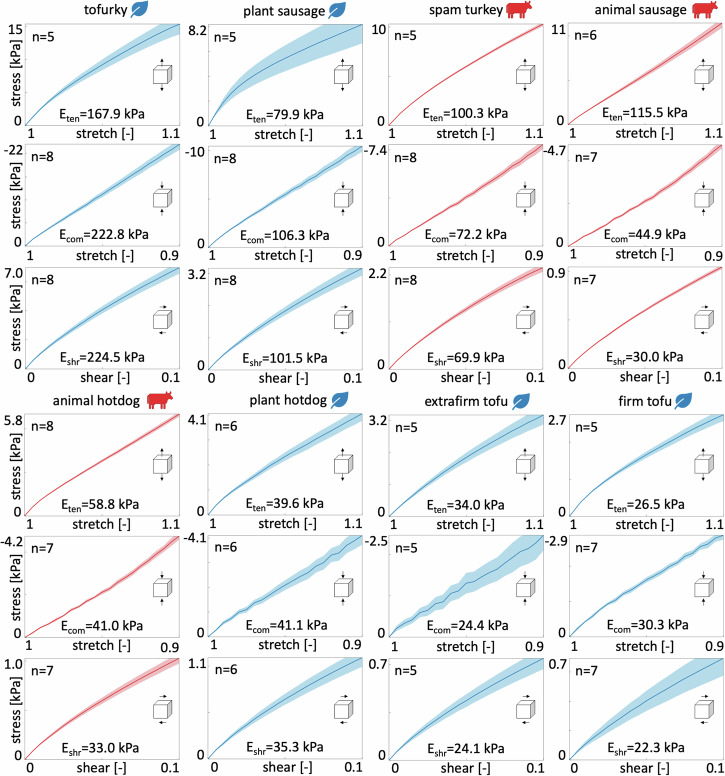
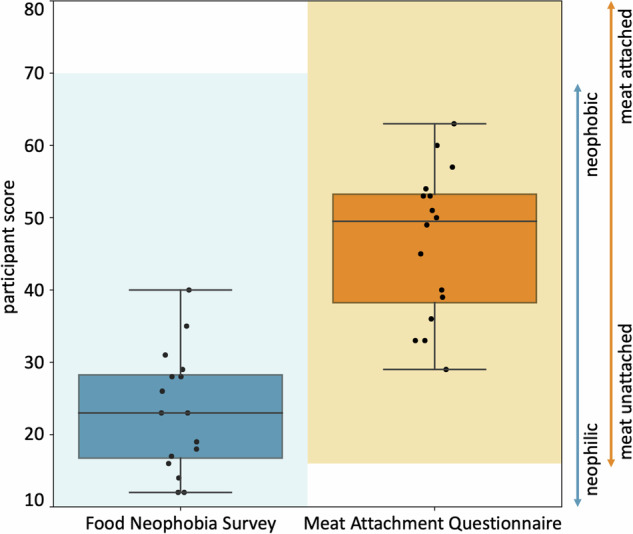
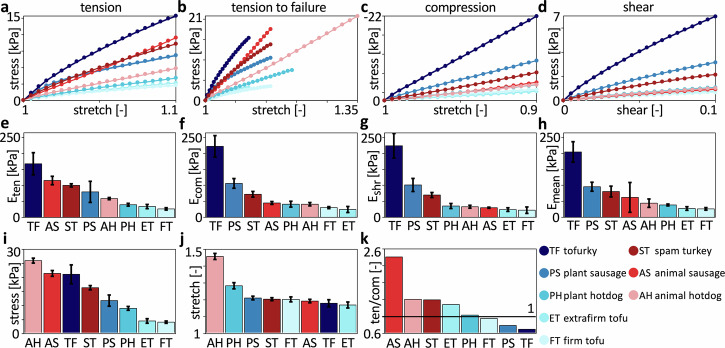
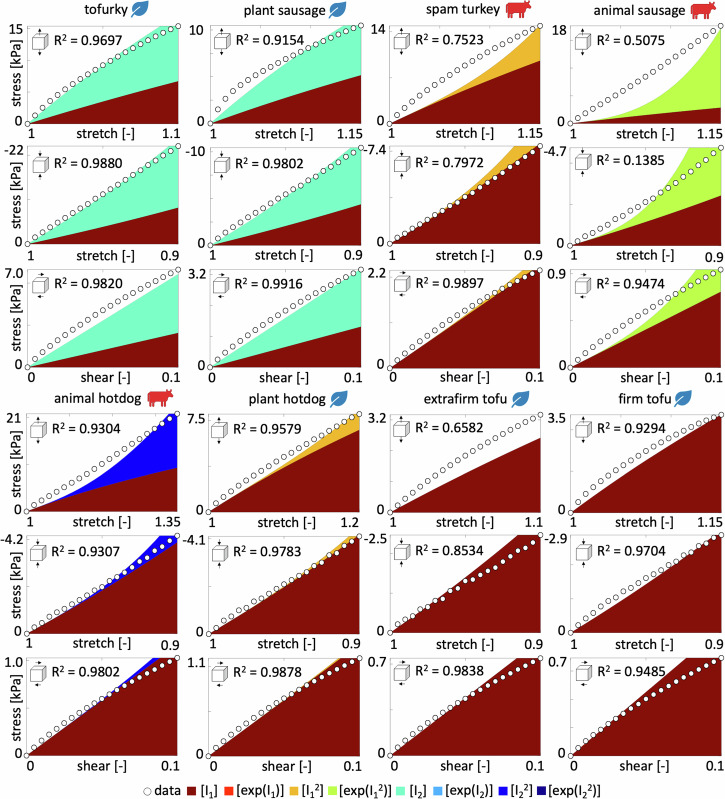
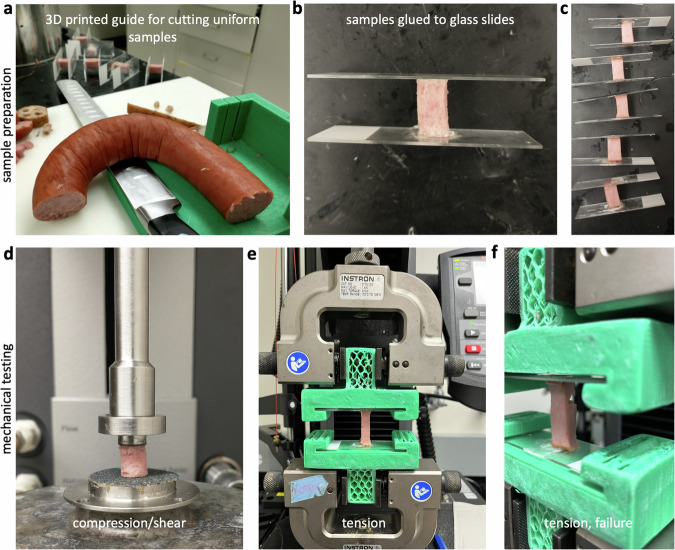
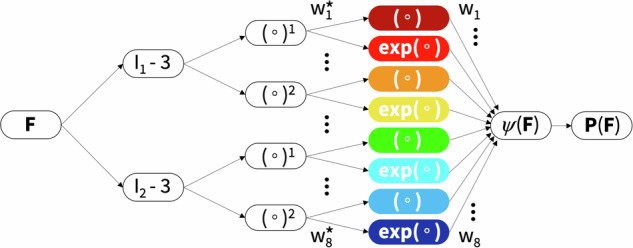
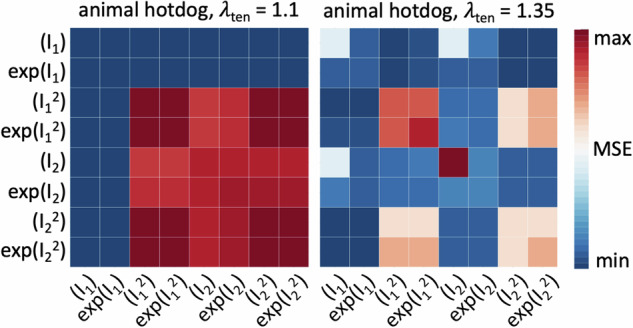
Eating less meat is associated with a healthier body and planet. Yet, we remain reluctant to switch to a plant-based diet, largely due to the sensory experience of plant-based meat. Food scientists characterize meat using a double compression test, which only probes one-dimensional behavior. Here we use tension, compression, and shear tests-combined with constitutive neural networks-to automatically discover the behavior of eight plant-based and animal meats across the entire three-dimensional spectrum. We find that plant-based sausage and hotdog, with stiffnesses of 95.9 ± 14.1 kPa and 38.7 ± 3.0 kPa, successfully mimic their animal counterparts, with 63.5 ± 45.7 kPa and 44.3 ± 13.2 kPa, while tofurky is twice as stiff, and tofu is twice as soft. Strikingly, a complementary food tasting survey produces in nearly identical stiffness rankings for all eight products (ρ = 0.833, p = 0.015). Probing the fully three-dimensional signature of meats is critical to understand subtle differences in texture that may result in a different perception of taste. Our data and code are freely available at https://github.com/LivingMatterLab/CANN.
少吃肉有益于身体健康,也有利于地球环境。然而,我们仍然不愿意转向以植物为基础的饮食,这在很大程度上是由于植物肉的感官体验。食品科学家使用双压缩试验来表征肉类,该试验仅探究一维行为。在这里,我们使用拉伸、压缩和剪切试验,并结合本构神经网络,自动发现八种植物肉和动物肉在整个三维范围内的行为。我们发现,植物基香肠和热狗的硬度分别为95.9±14.1kPa和38.7±3.0kPa,成功地模仿了动物同类产品,其硬度分别为63.5±45.7kPa和44.3±13.2kPa,而火鸡素肉的硬度是动物肉的两倍,豆腐则是动物肉的一半。令人惊讶的是,一项补充性的食品品尝调查对所有八种产品给出了几乎相同的硬度排名(ρ = 0.833,p = 0.015)。探究肉类的全三维特征对于理解质地的细微差异至关重要,这些差异可能会导致不同的味觉感受。我们的数据和代码可在https://github.com/LivingMatterLab/CANN上免费获取。